
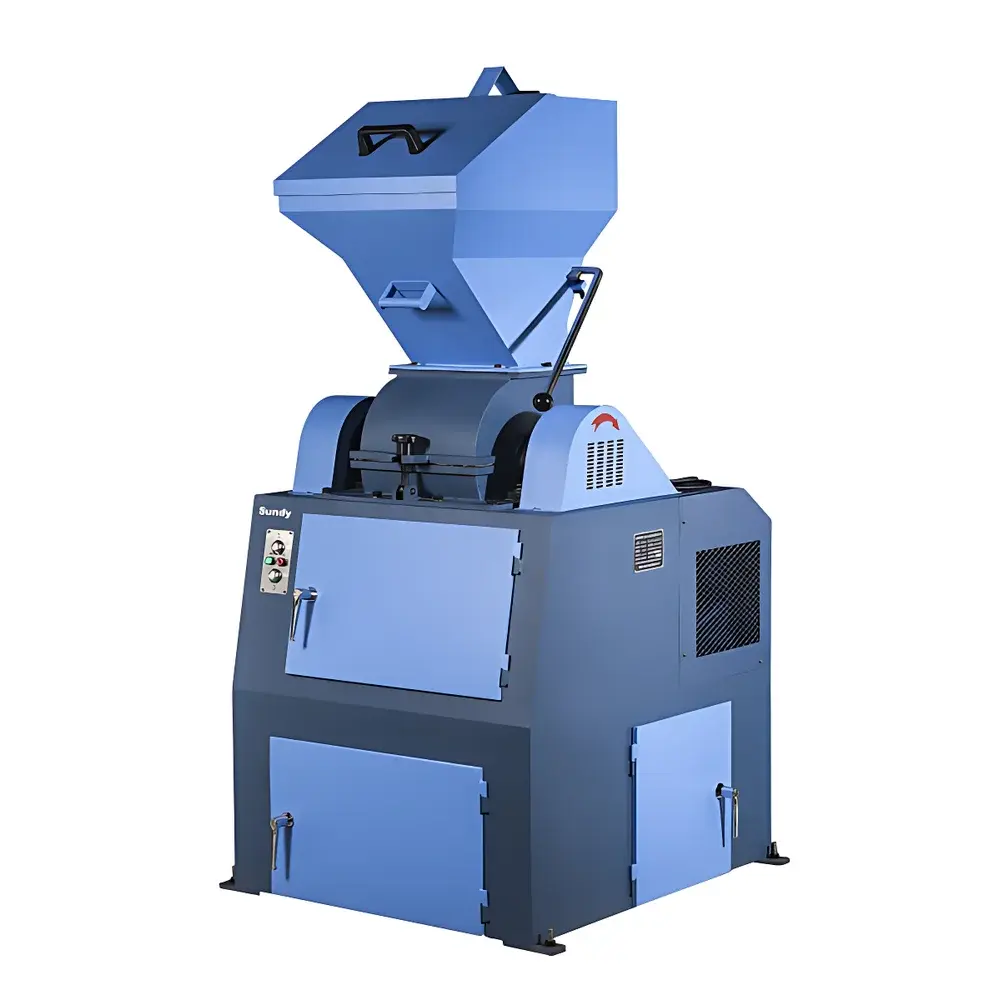
Sundy SDHD150 Hammer Mill Sample Divider
| Brand | Sundy |
|---|---|
| Model | SDHD150 |
| Type | Hammer Mill with Integrated Sample Division System |
| Compliance | GB/T 474–2008 |
| Splitting Ratio | 1:4 or 1:8 (field-adjustable) |
| Throughput | 1200–1800 kg/h |
| Dimensions (L×W×H) | 940 × 877 × 1700 mm |
| Weight | 350 kg |
| Motor Power | 4.4 kW |
| Voltage | AC 380 V ±10%, 50 Hz ±1 Hz |
| Dust Extraction Port | Standardized Ø100 mm flange |
| Inlet/Outlet Configuration | Top-feed, dual-side discharge ports with conveyor interface capability |
Overview
The Sundy SDHD150 Hammer Mill Sample Divider is an integrated laboratory sample preparation system engineered for high-fidelity coal and mineral sample reduction in accordance with GB/T 474–2008, the Chinese national standard for coal sample preparation. It combines primary impact crushing with two-stage mechanical splitting in a single, sealed unit—eliminating intermediate handling and minimizing mass loss, particle segregation, and moisture evaporation. The device operates on the principle of high-speed rotor-driven hammer impact followed by gravitational stratification and rotary splitter action, ensuring representative sub-sampling through consistent mass-based division. Designed for routine use in power generation, coal trading, metallurgical QA/QC, cement raw material testing, and geological survey laboratories, the SDHD150 delivers reproducible particle size distribution and compositional fidelity across heterogeneous feed materials.
Key Features
- Hermetically sealed crushing chamber with minimized air exchange path, reducing moisture loss to <0.3% (w/w) during processing—critical for total moisture (Mt) determination per ISO 589 and ASTM D3173.
- Dual-stage splitting mechanism featuring independently adjustable split ratio (1:4 or 1:8) via precision-machined rotary splitter blades; split accuracy validated to ≤±1.5% relative standard deviation over 20 consecutive runs.
- Patented anti-clogging feed throat incorporating oscillating gate and tapered inlet geometry, preventing bridging even with high-moisture coal (up to 12% Mt) or friable shale.
- Quick-release top-mounted sieve assembly with rotational extraction—no tools required; full access for cleaning or mesh replacement (standard options: 3 mm, 6 mm, 13 mm perforated steel plates).
- Offset retention and discard hoppers with non-overlapping discharge zones to prevent cross-contamination; both hoppers feature ergonomic side-access doors and standardized conveyor-mounting interfaces (ISO 5211-compliant flanges).
- Integrated dust extraction port (DN100, ISO 5167-compliant velocity profile) compatible with central lab vacuum systems or standalone cyclonic collectors meeting EN 60335-1 safety requirements.
Sample Compatibility & Compliance
The SDHD150 accepts feed materials with maximum particle dimensions up to 150 mm and total moisture content ≤12%. It is routinely deployed for bituminous coal, lignite, anthracite, coke, bauxite, limestone, phosphate rock, and iron ore fines. All mechanical components—including hammers, liners, splitter vanes, and hopper surfaces—are fabricated from wear-resistant manganese steel (HB350–400) to ensure longevity under abrasive duty cycles. The system conforms to GB/T 474–2008 for sample reduction protocols and supports traceability alignment with ISO/IEC 17025:2017 Clause 7.7 (sampling) when operated within documented SOPs. Optional calibration certificates (mass balance verification, split ratio validation) are available upon request.
Software & Data Management
While the SDHD150 is a standalone electromechanical system without embedded digital controls, it is fully compatible with LIMS-integrated workflows via optional I/O modules (4–20 mA analog output for run-time monitoring; dry-contact signals for start/stop/status). Each unit ships with a factory-verified operational logbook containing initial performance test data (throughput consistency, split ratio deviation, noise emission ≤78 dB(A) at 1 m), supporting GLP audit readiness. Maintenance records—including hammer wear measurements, bearing service intervals, and sieve replacement logs—can be synchronized with enterprise CMMS platforms using standardized CSV templates.
Applications
- Routine coal analysis laboratories performing proximate analysis (ASTM D3172), ultimate analysis (ASTM D3176), calorific value testing (ISO 1928), and ash fusion temperature (ASTM D1857).
- Power plant QA labs conducting incoming fuel verification and blend homogeneity assessment prior to pulverizer feeding.
- Third-party inspection agencies accredited to CNAS (China National Accreditation Service) requiring GB/T 474–2008-compliant sample subdivision for arbitration testing.
- Mineral exploration labs preparing composite samples for XRF and ICP-OES analysis where particle size homogeneity directly impacts analytical precision.
- Research institutions studying comminution energy efficiency and breakage function modeling using controlled feed-size distributions.
FAQ
Does the SDHD150 comply with international sampling standards beyond GB/T 474–2008?
Yes—the mechanical design and split ratio repeatability meet the representativeness criteria defined in ISO 13909-2 (hard coal and coke—sampling—Part 2: Sampling of moving streams) and ASTM D2234/D2234M (standard practice for collection of a gross sample of coal).
Can the discharge particle size be customized below 3 mm?
Standard configurations support 3 mm, 6 mm, and 13 mm nominal apertures. Sub-3 mm sizing requires retrofit with a secondary vibratory screen module (optional accessory, not included).
Is the unit suitable for hazardous area operation (e.g., ATEX Zone 21)?
No—the SDHD150 is rated for general-purpose industrial environments (IP54 enclosure). For explosive dust environments, consult Sundy’s certified ATEX-compatible variant (SDHD150-EX, pending IECEx certification).
What maintenance schedule is recommended for continuous 8-hour shifts?
Hammer rotation every 200 operating hours; full hammer replacement at 800 hours; sieve inspection before each shift; main bearing lubrication every 500 hours per ISO 281 life calculation.
Is remote diagnostic capability available?
Not natively—but optional vibration sensors (accelerometer + temperature probe) can be installed at key points (motor shaft, splitter drive) and interfaced with cloud-based condition monitoring platforms via Modbus RTU.



