
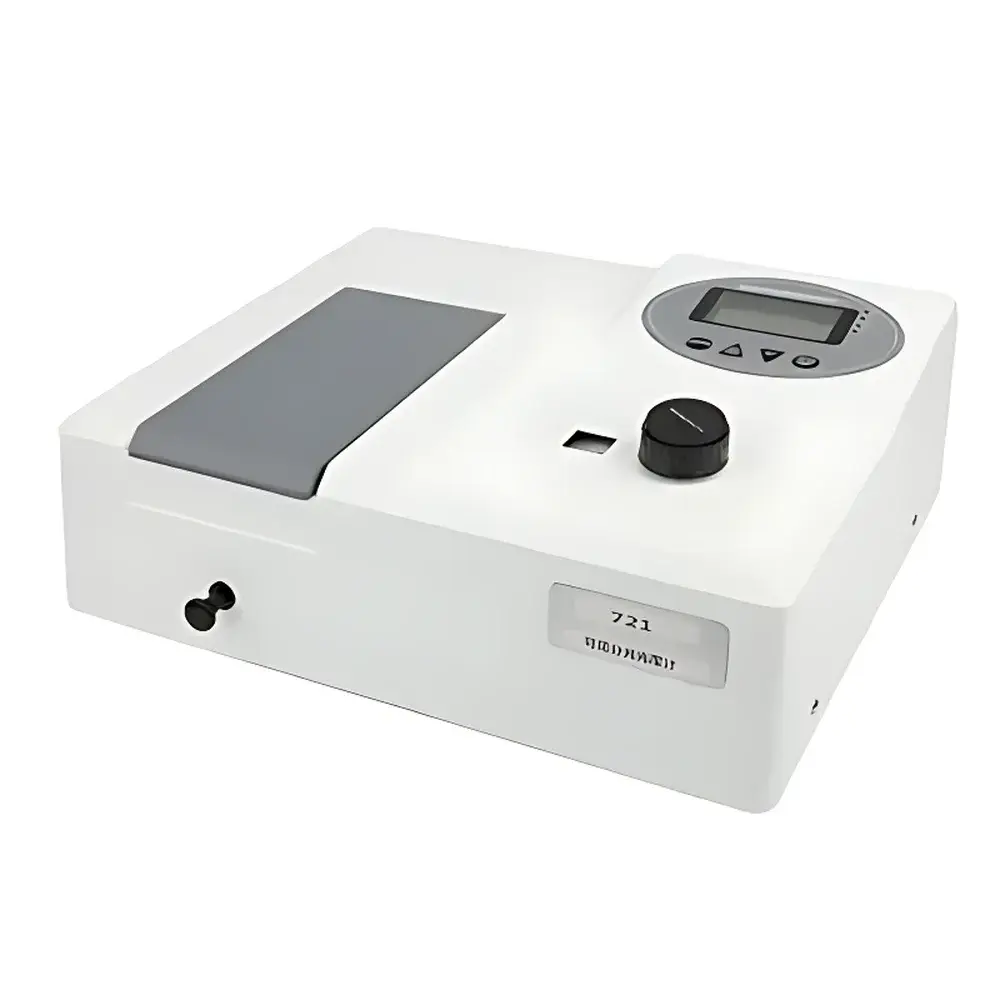
SUNNY HENGPING 722 Visible Spectrophotometer
| Brand | SUNNY HENGPING INSTRUMENT |
|---|---|
| Origin | Shanghai, China |
| Manufacturer Type | Direct Manufacturer |
| Instrument Type | Domestic |
| Model | 722 |
| Price Range | USD 0–750 |
| Optical Design | Single-Beam |
| Detector | Silicon Photocell |
| Wavelength Range | 325–1000 nm |
| Wavelength Scanning | Motorized Auto-Positioning |
| Spectral Bandwidth | 4 nm |
| Wavelength Accuracy | ±2 nm |
| Wavelength Repeatability | ≤1.0 nm (330–1000 nm) |
| Stray Light | ≤0.5% T at 360 nm |
| Display | Backlit LCD |
| Zero Adjustment | Automatic T=0% Calibration |
| Concentration Mode | Direct C-mode with User-Defined Factor Input |
| Power Supply | 220 V ±10%, 50 Hz |
| Dimensions | 470 × 350 × 200 mm |
| Weight | 8 kg |
Overview
The SUNNY HENGPING 722 Visible Spectrophotometer is a precision single-beam optical instrument engineered for quantitative absorbance and transmittance measurements in the visible spectral region (325–1000 nm). Based on classical Beer–Lambert law principles, it employs a self-collimating monochromator with a 1200-line/mm holographic grating to isolate discrete wavelengths, enabling reliable photometric analysis of colored solutions, dyes, enzymes, and other chromophoric analytes. Designed for routine laboratory use—rather than research-grade UV-Vis applications—the 722 operates exclusively in the visible range and excludes deep-UV capability (e.g., below 325 nm), making it especially suitable for educational labs, quality control in food and beverage production, environmental water testing, clinical biochemistry screening, and industrial pigment verification. Its robust mechanical architecture, integrated halogen lamp source (20 W / 12 V), and silicon photocell detector deliver stable baseline performance under standard ambient conditions.
Key Features
- Single-beam optical path with motorized wavelength auto-positioning for repeatable spectral selection
- 4 nm spectral bandwidth ensures adequate resolution for broad-band absorption peaks typical in dye, protein, and nutrient assays
- Backlit LCD display with intuitive menu navigation supports real-time monitoring of transmittance (%T), absorbance (A), and concentration (C) values
- Automatic zero adjustment (T = 0%) eliminates manual dark-current balancing and improves inter-operator consistency
- Concentration mode with user-definable calibration factor enables direct readout of sample concentration without manual calculation
- Calibrated wavelength accuracy of ±2 nm and repeatability better than 1.0 nm meet ASTM E275 and ISO 6223 requirements for routine spectrophotometric validation
- Stray light level ≤0.5% T at 360 nm satisfies USP criteria for visible-range instruments used in pharmaceutical excipient testing
Sample Compatibility & Compliance
The 722 accepts standard 10 mm pathlength cuvettes (glass or plastic) and is compatible with aqueous, organic, and mildly acidic/basic solutions commonly encountered in teaching labs and QC workflows. It complies with general safety standards IEC 61010-1 for electrical equipment used in laboratory environments. While not certified for GLP/GMP-regulated environments out-of-the-box, its stable photometric output, traceable wavelength calibration, and reproducible %T/A readings support internal method validation per ISO/IEC 17025. The instrument does not include audit trail or electronic signature functionality; therefore, it is intended for non-FDA 21 CFR Part 11 regulated applications unless augmented by external data logging systems.
Software & Data Management
The 722 operates as a standalone benchtop instrument with no built-in PC interface or proprietary software. All measurements are displayed and stored locally on the LCD screen only—no internal memory or USB export capability is provided. Users must manually record results or integrate the unit into third-party data acquisition systems via analog voltage output (if equipped with optional interface module). For institutions requiring digital traceability, integration with LabArchives, ELN platforms, or custom Python-based serial loggers (via RS-232 adapter) is feasible but requires external configuration. No firmware updates or remote diagnostics are supported.
Applications
- Educational laboratories: Teaching Beer–Lambert law fundamentals, calibration curve construction, and spectrophotometric titration
- Food & agriculture: Determination of nitrate, phosphate, and total phenolics in plant extracts and beverages
- Environmental testing: Quantification of iron, manganese, and chromium in wastewater using colorimetric reagents (e.g., 1,10-phenanthroline, diphenylcarbazide)
- Clinical biochemistry: Measurement of hemoglobin derivatives, bilirubin, and enzyme activity (e.g., alkaline phosphatase via p-nitrophenyl phosphate hydrolysis)
- Industrial QC: Color intensity assessment in dyestuffs, ink formulations, and polymer additives
- Metallurgy: Rapid screening of metal ion concentrations in leachates and plating baths
FAQ
Does the 722 support UV-range measurements below 325 nm?
No. The optical design, detector sensitivity, and lamp output are optimized for 325–1000 nm only. Deep-UV applications require dedicated deuterium-halogen dual-source instruments.
Is wavelength calibration traceable to NIST standards?
The factory calibration uses reference filters with certified peak wavelengths (e.g., holmium oxide glass); users may perform periodic verification using such standards, though formal NIST-traceable recalibration requires service by authorized SUNNY HENGPING technicians.
Can the 722 measure turbid or particulate samples?
It is not designed for turbidity correction or scattering compensation. For suspended solids, centrifugation or filtration prior to measurement is recommended to avoid stray light artifacts.
What maintenance is required for long-term stability?
Annual cleaning of the monochromator slit and optical surfaces with lens-grade tissue and isopropanol is advised. Lamp replacement is typically needed every 1,000–1,500 hours of operation.
Is the instrument compatible with Windows/macOS data acquisition software?
Not natively. Optional RS-232 or analog output modules enable connection to third-party DAQ systems, but driver support and protocol documentation must be obtained separately from SUNNY HENGPING.




