
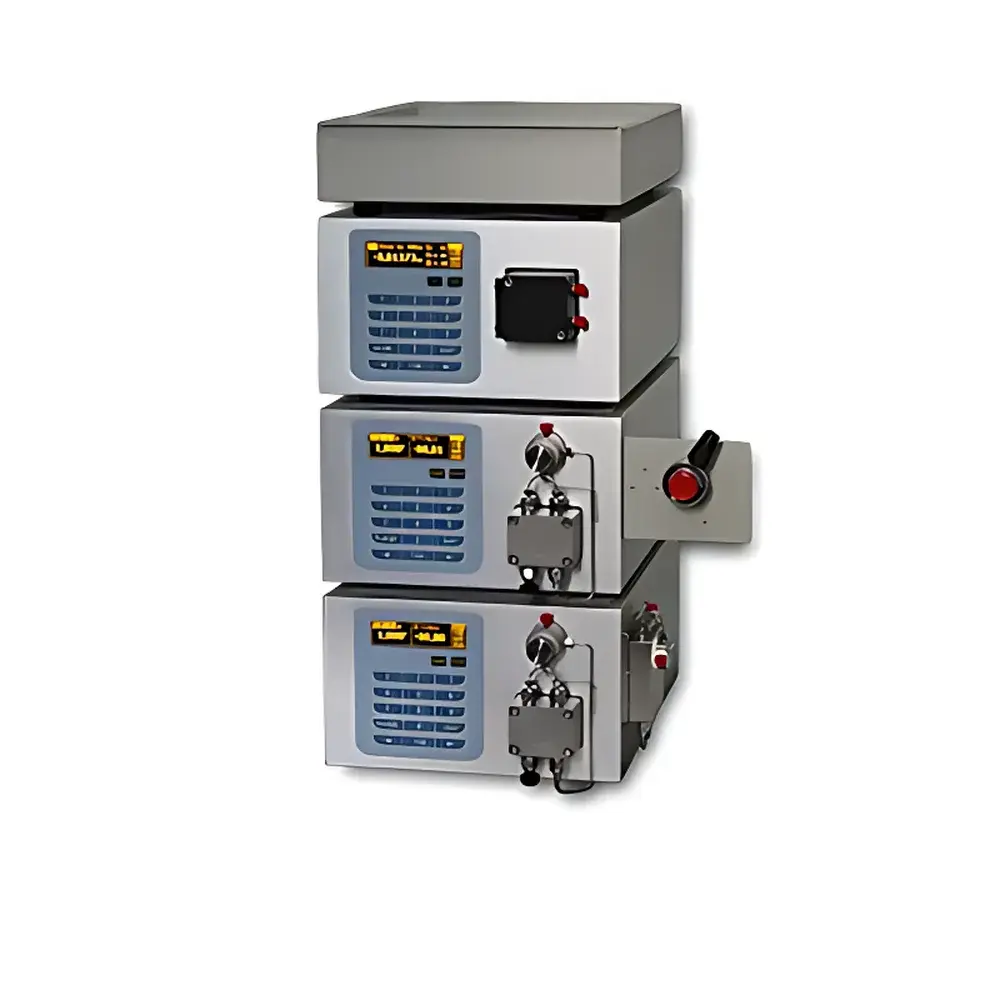
Sunny Hengping LC1620A High-Performance Liquid Chromatograph
| Brand | Sunny Hengping Instrument |
|---|---|
| Origin | Shanghai, China |
| Manufacturer Type | Direct Manufacturer |
| Regional Origin | Domestic (China) |
| Model | LC1620A |
| Instrument Category | Conventional HPLC System |
| Flow Rate Range | 0.001–9.999 mL/min |
| Maximum Pressure | 45 MPa |
| Autosampler Capacity | 0–120 positions |
| Injection Volume Range | 0–120 µL |
| Column Oven Temperature Range | Ambient +5°C to 100°C |
| UV-Vis Wavelength Range | 190–700 nm |
| Data Acquisition Frequency | 1 Hz |
Overview
The Sunny Hengping LC1620A is a fully integrated, conventional high-performance liquid chromatograph engineered for precision, reliability, and method robustness in routine QC, pharmaceutical stability testing, food safety analysis, and academic research laboratories. Based on classical reversed-phase, normal-phase, and ion-exchange HPLC principles, the system employs dual-piston reciprocating high-pressure pumps operating under precise gradient elution control, coupled with a low-dead-volume flow cell UV-Vis detector and a temperature-stabilized column compartment. Its architecture complies with fundamental design requirements outlined in ISO 17025 for analytical instrument validation and supports method transfer across labs using standardized mobile phase composition and retention time alignment protocols.
Key Features
- High-pressure binary pump with floating plunger support mechanism—reduces mechanical stress on seals and extends service life of critical wear components.
- Integrated CAN bus communication protocol ensures deterministic real-time coordination among pump, autosampler, detector, and column oven—minimizing timing jitter and enhancing system synchronization fidelity.
- Online plunger seal cleaning function using dual-seal configuration—effectively flushes buffer salt residues during gradient runs, mitigating crystallization-induced leakage and seal degradation.
- Real-time flow monitoring with dual-threshold alert logic: visual/audible alarm at warning threshold; automatic pump shutdown at critical pressure or flow deviation—protecting columns and safeguarding data integrity.
- UV-Vis detector featuring interchangeable deuterium/tungsten lamps and modular flow cell assembly—enabling rapid lamp replacement and cell cleaning without optical recalibration.
- Triple acquisition modes: dual-wavelength detection, wavelength-programmed scanning, and stop-flow spectral acquisition—supporting simultaneous quantitation of analytes with disparate absorption maxima and improved baseline stability (noise ≤ ±0.5 × 10⁻⁵ AU, drift ≤ ±5 × 10⁻⁴ AU/h).
Sample Compatibility & Compliance
The LC1620A accommodates standard 3.9–4.6 mm ID analytical columns (up to 250 mm length) and is compatible with C18, C8, phenyl-hexyl, HILIC, and amino-silica stationary phases. It supports aqueous-organic mobile phases containing volatile buffers (e.g., ammonium formate, ammonium acetate) and non-volatile salts (e.g., phosphate), provided appropriate post-run seal wash protocols are applied. The system meets essential functional requirements referenced in USP , EP 2.2.46, and ASTM D7593 for liquid chromatographic method execution. While not pre-certified for 21 CFR Part 11, its software architecture permits audit trail implementation, electronic signature integration, and secure user access controls when deployed within validated GxP environments under laboratory-defined SOPs.
Software & Data Management
Controlled via a Windows-based intelligent reverse-control workstation, the LC1620A enables full remote configuration of pump gradients, injection sequences, detector parameters, and oven setpoints. Raw chromatograms are stored in vendor-neutral .CDF format (compatible with OpenChrom and Chromeleon import modules). Data processing includes peak integration using tangent skim and valley-to-valley algorithms, calibration curve generation (linear, quadratic, weighted), and report export in PDF, Excel, and XML formats. Audit trail functionality—tracking user logins, method modifications, sequence edits, and result approvals—is configurable per GLP/GMP-aligned lab policies.
Applications
- Pharmaceutical QC: assay of active pharmaceutical ingredients (APIs), related substances testing per ICH Q2(R2), and dissolution profile comparison.
- Food & Beverage: quantification of preservatives (e.g., benzoic acid, sorbic acid), sweeteners (aspartame, sucralose), and mycotoxins (aflatoxin B1, ochratoxin A).
- Environmental Analysis: detection of polycyclic aromatic hydrocarbons (PAHs) in soil extracts and phenolic endocrine disruptors in wastewater effluents.
- Academic Research: separation and characterization of natural product fractions, polymer additive profiling, and chiral resolution using polysaccharide-based CSPs.
FAQ
What is the maximum operating pressure of the LC1620A pump unit?
The system is rated for continuous operation up to 45 MPa (6525 psi), with stable performance verified at 42 MPa per manufacturer specifications.
Does the LC1620A support gradient elution?
Yes—it features a high-precision binary gradient pump with ≤ ±2% gradient accuracy across water/acetonitrile and water/methanol solvent pairs.
Can the UV detector perform spectral scanning?
Yes—via stop-flow mode, the detector acquires full 190–700 nm spectra with ≤1 nm wavelength reproducibility, enabling peak purity assessment and library matching.
Is the autosampler compatible with 2-mL vials and 96-well microplates?
The 0–120 position tray supports both standard 12×75 mm screw-thread vials and ANSI/SLAS-compliant 96-well plates with programmable needle depth and wash cycle control.
What regulatory standards does the LC1620A comply with out-of-the-box?
It satisfies core instrumental performance criteria in ISO 17025, USP , and EP 2.2.46; full 21 CFR Part 11 compliance requires site-specific software configuration and procedural validation.
Related Products





