
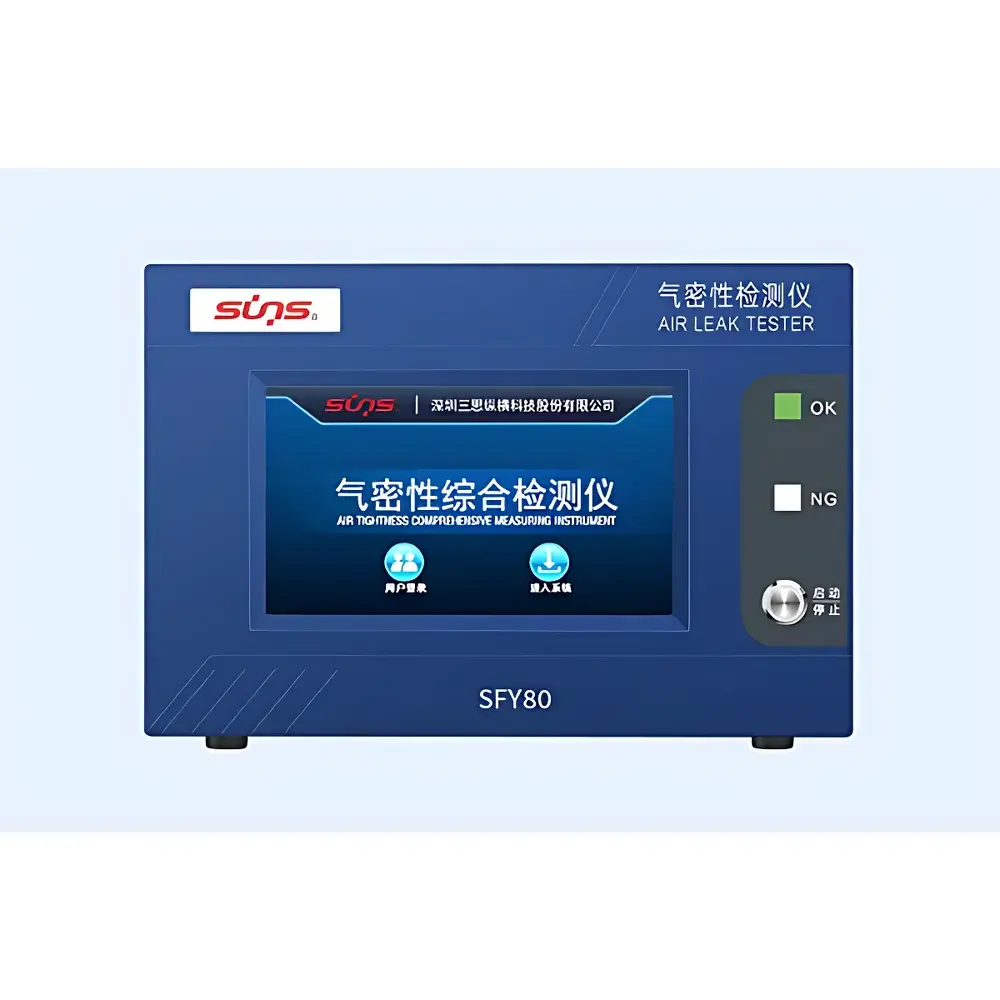
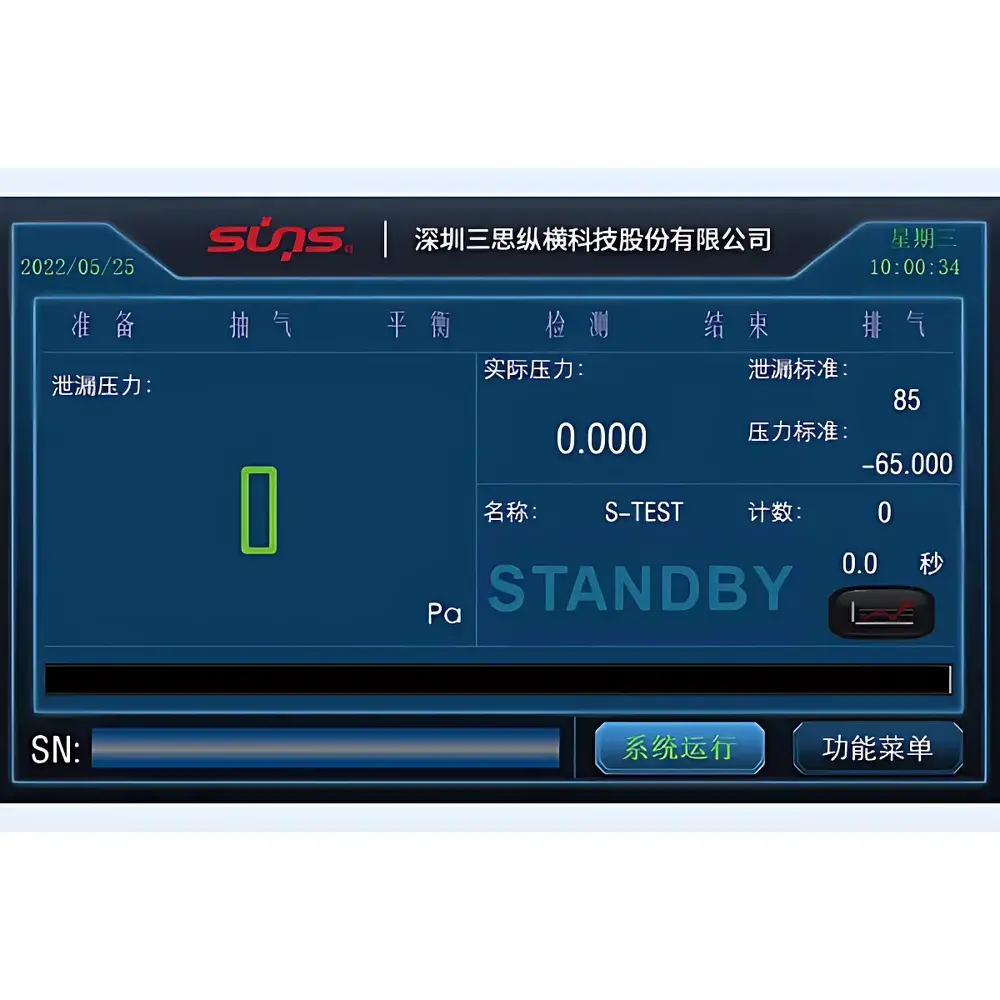
SUNS SFY80 Negative-Pressure Airtightness Tester
| Brand | SUNS |
|---|---|
| Origin | Shenzhen, China |
| Manufacturer Type | Original Equipment Manufacturer (OEM/ODM) |
| Origin Category | Domestic (China-made) |
| Model | SFY80 |
| Quotation | Available upon Request |
| Test Range | 5–50 kPa / 5–95 kPa |
| Timing Range | 0–999.9 s (user-configurable) |
| Pneumatic Supply | Clean, dry air at 0.4–0.8 MPa |
| Pressure Resolution | 1 Pa |
| Accuracy | ±0.2 % of Full Scale (F.S.) |
| Units | kPa, bar, psi, mmHg, mmH₂O |
| Channels | 1 (expandable to multi-channel configurations) |
| Communication Interfaces | RS-232 / RS-485 (selectable), RJ45 Ethernet |
| I/O Ports | 6 digital inputs, 6 digital outputs |
| Display | 7-inch LCD touchscreen |
| Power Supply | AC 110–240 V, 50/60 Hz |
| Operating Environment | 5–45 °C, ≤80 % RH (non-condensing) |
| Weight | 9.8–11 kg |
| Dimensions | 450 × 270 × 190 mm |
Overview
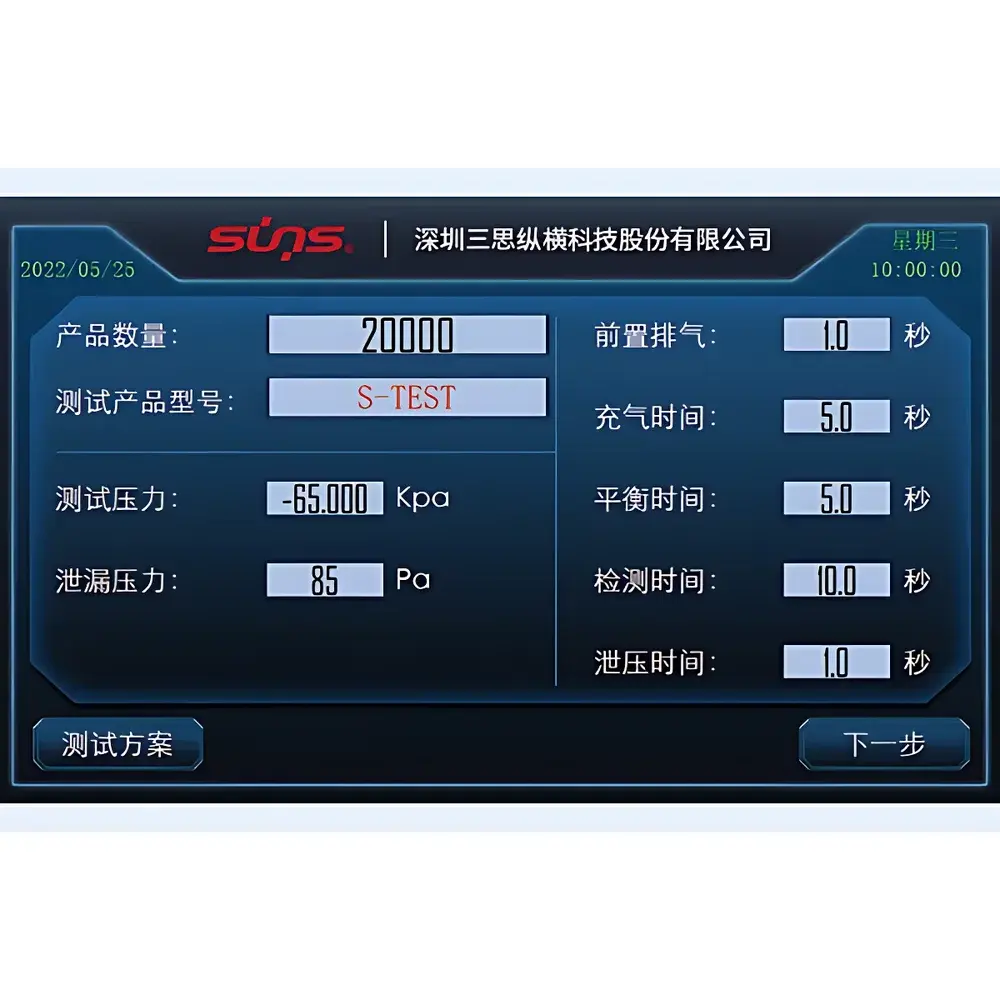
The SUNS SFY80 Negative-Pressure Airtightness Tester is an engineered solution for quantitative leak detection and seal integrity verification under controlled vacuum conditions. It operates on the principle of pressure decay measurement: a test specimen is isolated within a sealed chamber or fixture, evacuated to a user-defined negative pressure (vacuum) setpoint within the 5–95 kPa range, held for a programmable dwell time (0–999.9 s), and then monitored for pressure rise over a defined test interval. The rate of pressure change—converted into volumetric leak rate using thermodynamic compensation—is calculated in real time using embedded AI-driven algorithms. Designed for integration into automated production lines and QC laboratories, the SFY80 delivers metrologically traceable, repeatable results compliant with fundamental principles outlined in ISO 50001 (energy management), ISO 9001 (quality systems), and ASTM F2096 (standard test method for detecting gross leaks in packaging by internal pressurization). Its architecture supports deterministic response times (<100 ms sensor-to-display latency) enabled by a 32-bit RISC processor and 24-bit sigma-delta A/D converter.
Key Features
- High-fidelity pressure sensing: OEM SMC precision pressure regulator and imported piezoresistive pressure transducer with automatic ambient drift compensation—ensuring long-term zero stability across thermal gradients.
- Dual-range vacuum capability: Configurable test ranges (5–50 kPa and 5–95 kPa) optimized for both low-leak-rate validation (e.g., medical device housings) and high-throughput functional checks (e.g., consumer electronics enclosures).
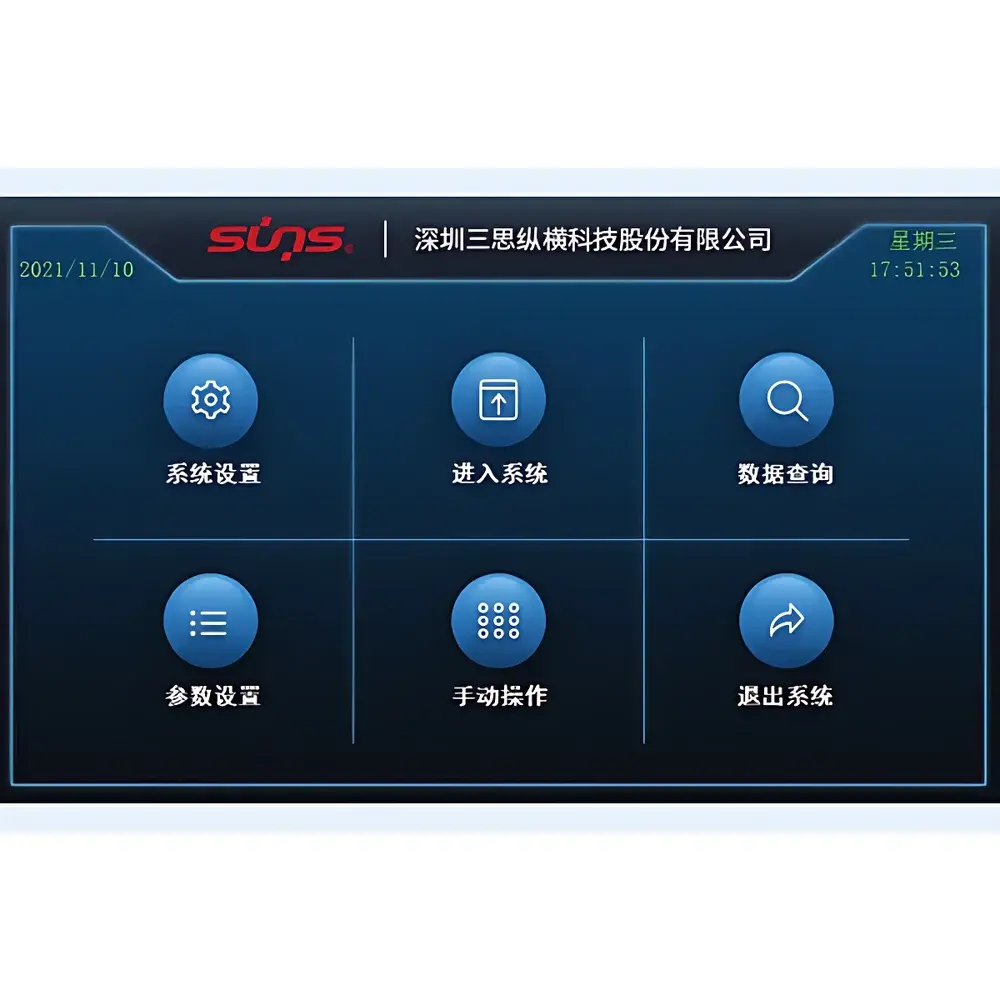
- Industrial-grade human-machine interface: 7-inch resistive LCD touchscreen with intuitive, OS-native navigation—designed for glove-compatible operation in cleanroom and factory-floor environments.
- Robust I/O architecture: Six opto-isolated digital inputs and six relay-based outputs enable direct interfacing with PLCs, pneumatic actuators, barcode scanners, and pass/fail signaling devices.
- Multi-protocol connectivity: Native support for Modbus RTU (RS-485), Modbus ASCII (RS-232), and TCP/IP Ethernet—facilitating seamless integration into MES, SCADA, and Industry 4.0 data lakes.
- Scalable channel topology: Single-channel base configuration; optionally expanded to 2-, 4-, or 8-channel rack-mounted systems via synchronized master-slave architecture—reducing per-unit labor cost without sacrificing per-test repeatability.
Sample Compatibility & Compliance
The SFY80 accommodates rigid and semi-rigid test objects including plastic housings, metal enclosures, sealed batteries, IV bags, syringe barrels, and automotive fluid reservoirs. Fixture design follows ISO 11607-2 guidelines for packaging validation and aligns with USP recommendations for non-destructive container closure integrity testing (CCIT). All firmware and calibration routines adhere to GLP/GMP documentation requirements—including audit-trail-enabled user login, timestamped event logging, and electronic signature support (21 CFR Part 11 ready when deployed with validated IT infrastructure). Calibration certificates are NIST-traceable and include uncertainty budgets per ISO/IEC 17025.
Software & Data Management
Embedded firmware features local data storage (≥10,000 test records with full metadata: operator ID, timestamp, fixture ID, pressure curve, pass/fail status). Optional cloud gateway module enables encrypted HTTPS upload to AWS IoT Core or private MQTT brokers. Raw pressure-vs.-time datasets export in CSV or XML format for statistical process control (SPC) analysis in Minitab or JMP. Barcode scanning triggers auto-population of part number, revision level, and test plan—enabling full traceability from raw material lot to finished goods shipment. Audit logs retain all parameter changes, result overrides, and calibration events for regulatory review.
Applications
- Electronics manufacturing: IP67/IP68 enclosure validation for smartphones, wearables, and IoT sensors.
- Medical device QA: Leak testing of infusion pumps, diagnostic cartridges, and Class II/III sterile packaging per ISO 11607.
- Automotive supply chain: Fuel cap assemblies, brake fluid reservoirs, and EV battery coolant manifolds.
- Consumer appliances: Vacuum-sealed food containers, coffee makers, and pressure cookers.
- Pharmaceutical packaging: Blister packs, vials, and pre-filled syringes undergoing CCIT per FDA guidance.
FAQ
What pressure standards does the SFY80 reference for calibration?
The instrument is calibrated against deadweight testers traceable to NIST SRM 2088 (pressure standards), with uncertainty budgets documented per ISO/IEC 17025.
Can the SFY80 be integrated into a Siemens S7 PLC environment?
Yes—via Modbus TCP over Ethernet or Modbus RTU over RS-485; ladder logic mapping tables and sample function block libraries are provided in the integration kit.
Is environmental temperature compensation applied during testing?
Yes—real-time thermal drift correction is performed using dual-point temperature sensing at the transducer housing and chamber interface.
Does the system support automated retest logic for marginal failures?
Yes—customizable pass/fail thresholds and conditional retest protocols (e.g., “fail → retest ×2 → final verdict”) are configurable in the test plan editor.
What is the maximum allowable ambient humidity for stable operation?
Operation is specified up to 80 % RH non-condensing; condensation inside the pressure manifold voids calibration validity and requires immediate desiccation and recalibration.



