
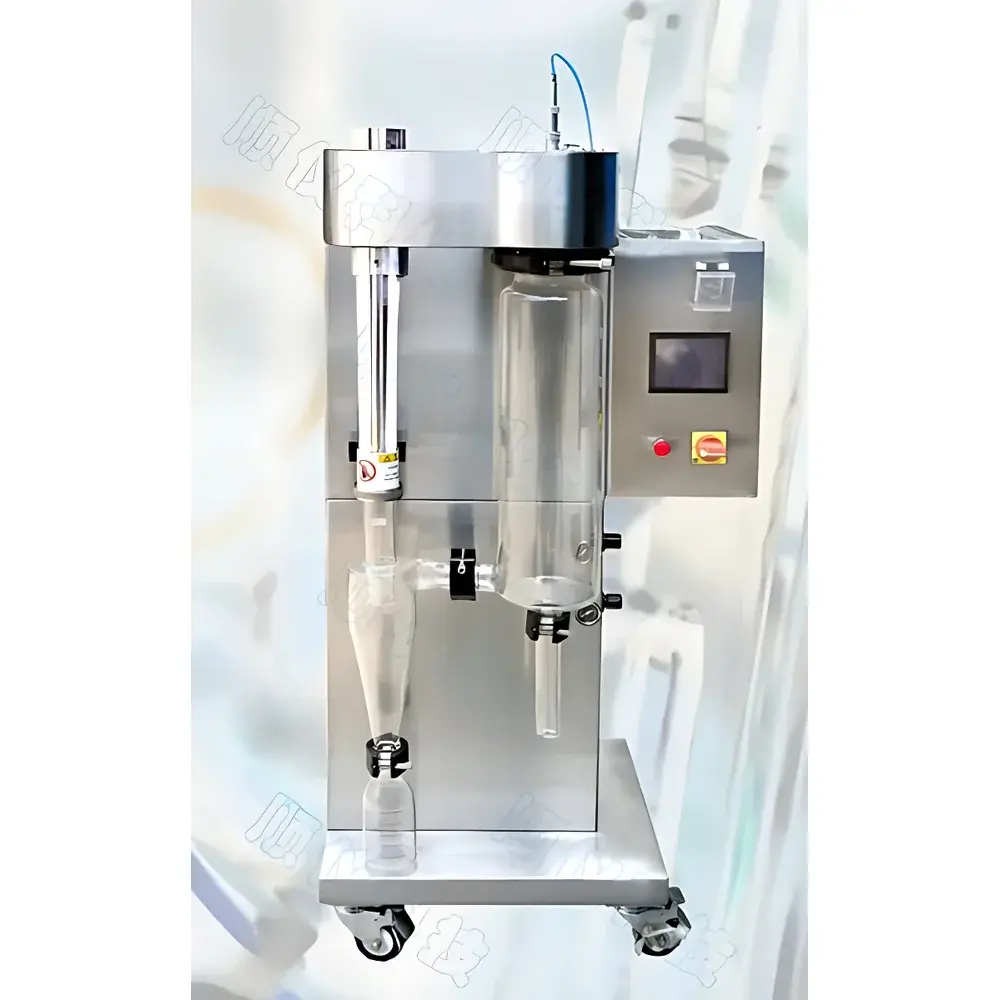
SUNYITECH SP-1500 Benchtop Spray Dryer
| Origin | Shanghai, China |
|---|---|
| Manufacturer Type | Authorized Distributor |
| Origin Category | Domestic (China) |
| Model | SP-1500 |
| Pricing | Upon Request |
| Evaporation Capacity | 1500 mL/h |
| Inlet Air Temperature Range | 30–280 °C |
| Outlet Air Temperature Range | 30–120 °C |
| Temperature Control Accuracy | ±1 °C |
| Drying Residence Time | 1.0–1.5 s |
| Feed Rate (Peristaltic Pump) | 30–2000 mL/h |
| Air Flow Rate | 0–330 m³/h (Max), 686 Pa Max Static Pressure |
| Compressor Output | 4.2 m³/h @ 2–5 bar, 0.2 kW |
| Two-Fluid Nozzle Standard Orifice | 0.75 mm (Optional: 0.5–2.0 mm) |
| Jet Cleaner (Needle Probe) Supply | Internal 2.3 bar Compressed Air, Adjustable Frequency |
| Power Supply | 3.5 kW, AC 220–240 V, 50/60 Hz, 13 A |
| Dimensions (L×W×H) | 650×500×1550 mm |
| Net Weight | 120 kg |
| Noise Level | <50 dB(A) |
| Construction | Borosilicate Glass (High-Temp Transparent), 316 Stainless Steel Nozzle, Full-Oil-Free Integrated Air Compressor |
Overview
The SUNYITECH SP-1500 Benchtop Spray Dryer is a self-contained, laboratory-scale spray drying system engineered for reproducible, scalable powder synthesis from liquid feedstocks—including aqueous solutions, organic solvents, suspensions, and emulsions. Operating on the principle of rapid solvent evaporation via concurrent-flow atomization, the SP-1500 introduces feedstock into a heated air stream using a two-fluid nozzle, where high-velocity compressed gas shears the liquid into fine droplets. With residence times tightly controlled between 1.0 and 1.5 seconds and inlet temperatures adjustable from 30 °C to 280 °C, the system enables precise thermal management critical for thermolabile compounds—such as proteins, peptides, probiotics, and nanostructured drug carriers. Its compact footprint (650 × 500 × 1550 mm), integrated oil-free air compressor, and fully enclosed borosilicate glass drying chamber eliminate dependency on external utilities, making it suitable for ISO Class 5–7 cleanroom-adjacent labs, QC environments, and early-stage formulation development.
Key Features
- Full-color 7-inch capacitive touchscreen interface with bilingual (English/Chinese) menu navigation and real-time parameter visualization—including inlet/outlet temperature, feed rate, airflow, and nozzle pressure.
- PID-based closed-loop temperature control ensures ±1 °C thermal stability across the full inlet temperature range (30–280 °C), minimizing batch-to-batch variability in particle morphology and residual moisture.
- Optically transparent high-borosilicate glass drying tower, cyclone separator, and collection vessel allow direct visual monitoring of atomization behavior, droplet trajectory, wall deposition, and powder accumulation—enabling immediate process diagnostics and optimization.
- Two-fluid nozzle assembly fabricated from electropolished 316 stainless steel; standard 0.75 mm orifice (with optional 0.5–2.0 mm variants) delivers narrow, near-normal particle size distribution (PSD) and high powder flowability.
- Automated jet-cleaning (‘needle probe’) system with user-adjustable impact frequency and internal 2.3 bar regulated air supply prevents nozzle clogging during continuous operation with viscous or particulate-laden feeds.
- Calibrated peristaltic feed pump supports precise volumetric delivery from 30 mL/h (minimum experimental volume) up to 2000 mL/h, facilitating micro-scale feasibility studies and dose-sparing API processing.
- Interlocked safety architecture: heater activation is hardware-gated by fan operational status; inlet air filtration (HEPA-grade pre-filter) safeguards sample integrity against ambient particulates.
- Integrated oil-free scroll compressor (<50 dB[A] acoustic emission) eliminates hydrocarbon contamination risk—critical for pharmaceutical, nutraceutical, and catalyst applications requiring strict purity compliance.
Sample Compatibility & Compliance
The SP-1500 accommodates a broad spectrum of feed materials: water- and ethanol-based solutions, polymer melts (e.g., PLGA, HPMC), colloidal nanosuspensions, protein hydrolysates, bacterial cultures, and ceramic precursors. Its inert glass-wetted path and 316SS nozzle meet USP and ISO 10993-1 biocompatibility screening prerequisites. While not certified for GMP manufacturing, the system supports GLP-aligned documentation workflows—including timestamped parameter logging, operator ID tagging, and audit-ready event records—facilitating data traceability per FDA 21 CFR Part 11 Annex 11 expectations. All electrical components comply with IEC 61010-1 safety standards; CE marking applies to the full system configuration.
Software & Data Management
The embedded SUNYITECH temperature and process control firmware provides non-volatile storage of up to 100 method templates, each preserving setpoints for temperature ramping profiles, feed rate gradients, and needle probe timing sequences. Raw sensor data (temperature, pressure, RPM, flow) are logged at 1 Hz resolution and exportable via USB to CSV format for post-processing in MATLAB, JMP, or Python-based statistical analysis pipelines. Optional Ethernet connectivity enables remote monitoring through secure HTTP(S) endpoints—compatible with institutional LIMS integration via RESTful API adapters. No proprietary software installation is required; all configuration and diagnostics occur natively on the device touchscreen.
Applications
- Pharmaceutical R&D: Production of inhalable dry powders (DPIs), amorphous solid dispersions, and lyoprotected biologics with controlled residual moisture (<2.5% w/w).
- Food Science: Encapsulation of omega-3 oils, probiotics, and flavor compounds using maltodextrin or gum arabic matrices.
- Materials Engineering: Synthesis of spherical metal oxide nanoparticles (e.g., SiO₂, TiO₂, LiFePO₄) for battery cathodes and catalytic supports.
- Academic Research: Fundamental studies of droplet drying kinetics, crust formation dynamics, and glass transition effects under varying relative humidity and thermal gradients.
- Agrochemical Development: Formulation of water-dispersible granules (WDGs) and controlled-release pesticide carriers.
FAQ
What is the minimum sample volume required for a valid drying run?
The system supports feed volumes as low as 30 mL when operated at the lowest peristaltic pump speed (30 mL/h), enabling efficient use of precious APIs or novel excipients.
Can the SP-1500 handle organic solvents such as acetone or methanol?
Yes—provided appropriate ventilation, explosion-proof electrical ratings (not included as standard), and solvent-compatible gasket materials (e.g., Viton® seals, available as an option). Consult the Safety Manual before solvent selection.
Is the collected powder sterile after drying?
No. The SP-1500 is not a sterilizing device. Sterility must be assured upstream (aseptic feed preparation) or downstream (gamma irradiation, filtration); the system itself maintains ISO 8 (Class 100,000) ambient cleanliness only.
How often does the nozzle require maintenance or replacement?
Under typical aqueous feed conditions, nozzle inspection is recommended every 50 operational hours; replacement intervals exceed 500 hours for 316SS nozzles operating below 200 °C inlet temperature.
Does the system support 21 CFR Part 11-compliant electronic signatures?
While the onboard firmware logs operator IDs and timestamps, full Part 11 compliance—including electronic signature validation, role-based access control, and immutable audit trails—requires deployment within a validated LIMS or ELN environment.



