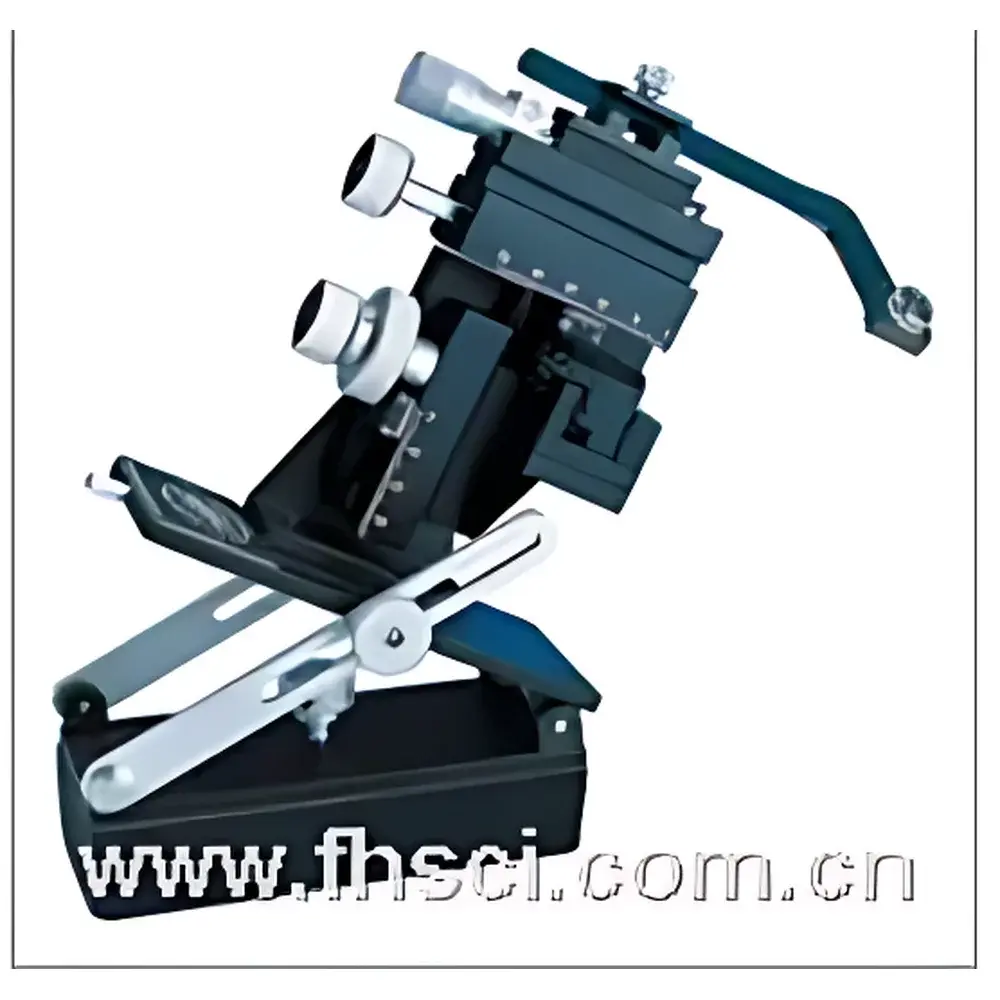
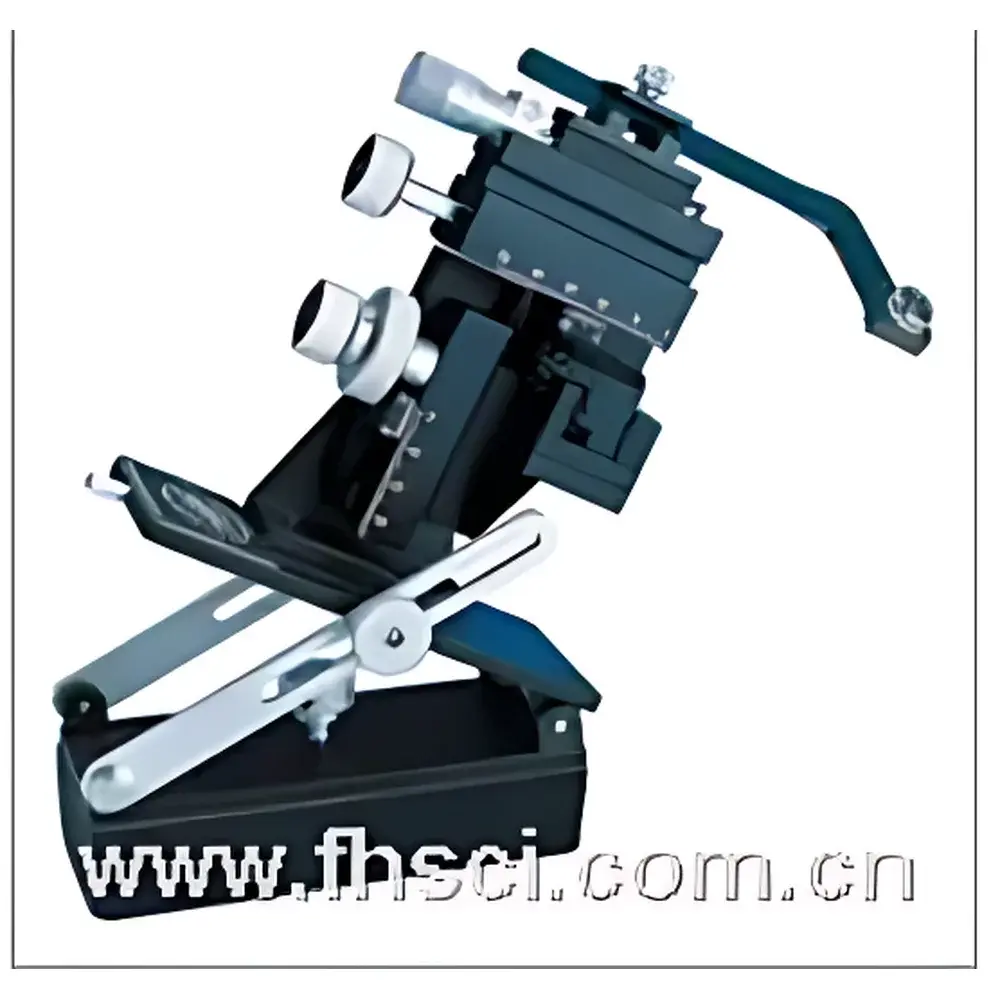
Sutter M3301 Manual Micromanipulator
| Brand | Sutter |
|---|---|
| Origin | USA |
| Model | M3301 |
| Weight | 550 g |
| Transport Weight | 1.4 kg |
| X-Axis Travel | 10 mm & 37 mm (dual-range configuration) |
| Y-Axis Travel | 25 mm |
| Z-Axis Travel | 25 mm |
| X-Axis Resolution | 0.01 mm (fine) / 0.1 mm (coarse) |
| Y/Z-Axis Resolution | 0.1 mm |
| Mounting Interface | Standard 12 mm clamp & Electrode Holder M3301EH |
| Handedness | Left- and Right-Hand Configurations Available |
| Guidance System | Precision V-groove rails with roller bearings |
| Structural Material | Stainless steel moving components |
| Optical Compatibility | Designed for integration with upright/inverted microscopes up to 250× magnification |
Overview
The Sutter M3301 Manual Micromanipulator is a precision-engineered mechanical positioning system designed for high-fidelity, tactile-controlled manipulation of microelectrodes, glass pipettes, force probes, and other sub-millimeter tools under optical microscopy. Built upon over four decades of Sutter Instrument’s expertise in neurophysiology and patch-clamp instrumentation, the M3301 operates on a robust mechanical principle: dual-stage micrometer-driven translation via hardened stainless steel lead screws, V-groove linear guides, and preloaded roller bearings—ensuring minimal backlash, thermal drift, and hysteresis across all three orthogonal axes (X, Y, Z). Its design prioritizes ergonomic accessibility and visual independence: all controls are consolidated onto a single 8 cm rear-mounted panel, enabling blind operation during critical electrophysiological recordings or live-cell microinjection procedures. Weighing only 550 g, the unit achieves exceptional rigidity-to-mass ratio, minimizing vibration coupling while maintaining compatibility with standard microscope stages and vibration isolation platforms.
Key Features
- Precision dual-range X-axis travel: 10 mm fine range (0.01 mm resolution) and 37 mm coarse range (0.1 mm resolution), enabling both nanoliter-scale electrode positioning and rapid macro-adjustment.
- V-groove rail guidance system with hardened steel rollers ensures repeatable, friction-stable motion with 100,000 actuation cycles.
- Stainless steel drive components—including lead screws, bushings, and carriage plates—provide long-term dimensional stability and corrosion resistance in humid laboratory environments.
- Ergonomic rear-panel control layout allows intuitive thumb-and-index finger operation without visual monitoring—critical during simultaneous microscope viewing and real-time physiological recording.
- Modular mounting architecture supports direct attachment to standard 12 mm diameter microscope stage rods or custom adapter plates; includes integrated M3301EH electrode holder for secure 1.0–1.5 mm OD glass pipette clamping.
- Available in left- and right-hand configurations to accommodate dominant-hand workflow preferences in patch-clamp rigs, intracellular recording setups, and developmental biology microinjection stations.
Sample Compatibility & Compliance
The M3301 is routinely deployed in GLP-compliant electrophysiology laboratories, academic neuroscience cores, and preclinical pharmacology facilities. It interfaces seamlessly with glass micropipettes (patch, sharp, or blunt), tungsten or platinum-iridium electrodes, fiber optic cannulae, and microinjection needles. While the device itself is purely mechanical and contains no electronic or software components, its construction adheres to ISO 9001-certified manufacturing protocols at Sutter’s Novato, CA facility. The stainless steel and anodized aluminum housing meets USP Class VI biocompatibility requirements for incidental contact with biological samples. No regulatory submission (e.g., FDA 510(k)) applies, as the M3301 is classified as a Class I general-purpose laboratory instrument under 21 CFR §862.2100.
Software & Data Management
As a fully manual, non-motorized manipulator, the M3301 requires no firmware, drivers, or software integration. Positional data is not digitally recorded or transmitted; instead, users document settings via calibrated micrometer dials with engraved 0.01 mm increments. This analog architecture eliminates electromagnetic interference (EMI) concerns common in sensitive low-noise electrophysiology recordings (e.g., single-channel patch clamp, extracellular field potential mapping). Laboratories requiring traceable positional metadata may integrate the M3301 into validated paper-based or LIMS-linked procedural logs—consistent with ALCOA+ principles for manual instrumentation in regulated environments.
Applications
- Whole-cell and cell-attached patch-clamp electrophysiology on cultured neurons, brain slices, and stem-cell-derived cardiomyocytes.
- Intracellular microinjection of dyes (e.g., Alexa Fluor, Lucifer Yellow), plasmids, CRISPR ribonucleoprotein complexes, or morpholinos into zebrafish embryos, Xenopus oocytes, or mammalian cells.
- Single-fiber electromyography (SFEMG) needle placement and neuromuscular junction mapping.
- Microdissection of embryonic tissue sections under differential interference contrast (DIC) or Hoffman modulation contrast optics.
- Calibration reference tool for validating automated micromanipulator systems prior to closed-loop robotic experiments.
FAQ
Is the M3301 compatible with inverted microscopes?
Yes—the compact footprint (120 × 85 × 110 mm) and 12 mm rod-mount design allow stable integration on most commercial inverted stands, including Nikon Ti2, Zeiss Axio Observer, and Leica DMi8 platforms.
Can the M3301 be used in Faraday cages?
Absolutely—its entirely non-electronic construction eliminates EMI/RFI emissions and susceptibility, making it ideal for low-noise voltage-clamp and extracellular recording inside shielded enclosures.
What maintenance is required?
Annual cleaning of V-grooves with isopropyl alcohol and light lubrication of lead screws using Dow Corning Molykote 1000 grease is recommended; no recalibration is necessary due to mechanical zero retention.
Does Sutter provide calibration certificates?
No formal NIST-traceable calibration is offered, as the M3301 is a Class I mechanical instrument; however, micrometer dial linearity is verified to ±0.005 mm per 10 mm travel during final QA testing.
Is the M3301 suitable for high-humidity incubator environments?
The stainless steel drivetrain and anodized aluminum housing resist oxidation, but prolonged exposure to >80% RH is discouraged; use with environmental chamber adapters is advised for long-term incubator-based experiments.