
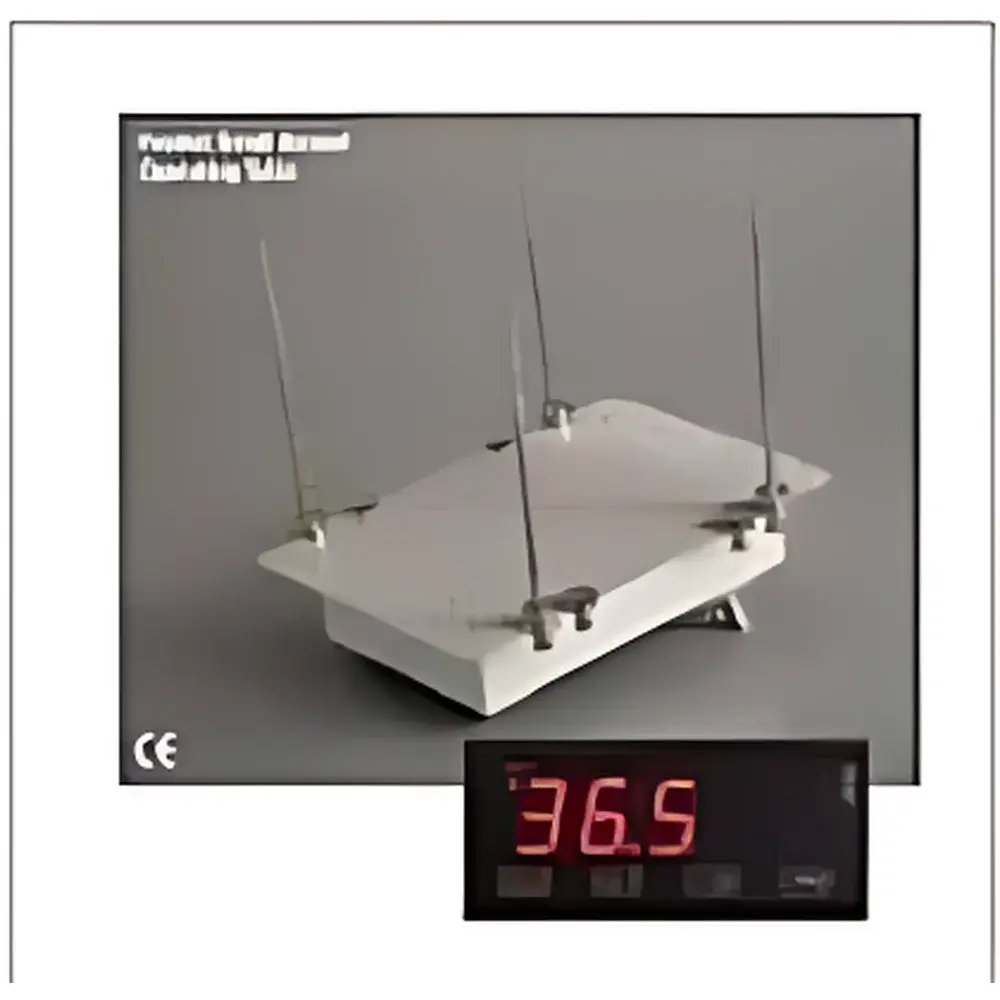
Harvard Apparatus Heated Small Animal Surgical Table
| Brand | Harvard Apparatus |
|---|---|
| Origin | USA |
| Model | Heated Animal Small Table |
| Heating Power | 40 W |
| Heating Surface Area | 23 × 33 cm (9 × 13 in) |
| Includes One Set of Animal Restraint Accessories | 6 Adjustable Restraint Rods and Multiple Clamps |
| Supplier Type | Authorized Distributor |
| Origin Category | Imported Instrument |
Overview
The Harvard Apparatus Heated Small Animal Surgical Table is an engineered platform designed to maintain physiological thermal homeostasis during acute in vivo procedures involving rodents and other small laboratory mammals. It operates on the principle of conductive surface heating—delivering controlled, uniform thermal energy across a defined anatomical support zone to mitigate perioperative hypothermia, a well-documented confounding variable in cardiovascular, neurophysiological, and pharmacokinetic studies. Unlike passive warming systems, this table integrates a regulated 40 W resistive heating element beneath a thermally stable, chemically inert stainless-steel or high-density polymer surface (23 × 33 cm), enabling precise thermal management without airflow disturbance or electromagnetic interference. Its compact footprint and foldable base architecture support seamless integration into stereotaxic rigs, intravital microscopy setups, and laminar flow surgical stations while preserving ergonomic access for both manual and instrument-assisted interventions.
Key Features
- Regulated conductive heating system with stable thermal output (±0.5 °C repeatability under standard lab conditions)
- Dedicated 23 × 33 cm (9 × 13 in) heated surface area—optimized for mice (20–30 g), rats (200–500 g), and juvenile rabbits
- Foldable, low-profile base with non-slip rubber feet for rapid reconfiguration and space-efficient storage
- Integrated restraint system comprising six corrosion-resistant, threaded aluminum rods (length-adjustable up to 12 cm) and multiple anodized aluminum clamps compatible with standard rodent ear bars, limb holders, and tail fixation mounts
- Electrical safety compliance with UL 61010-1 and IEC 61010-1 for laboratory use; CE-marked for EU deployment
- No internal battery or wireless components—designed for continuous AC-powered operation in GLP-compliant vivarium environments
Sample Compatibility & Compliance
This surgical table supports acute terminal and survival surgeries in species including Mus musculus, Rattus norvegicus, Mesocricetus auratus, and Oryctolagus cuniculus. The restraint geometry accommodates supine, prone, lateral, and head-fixed positioning. All contact surfaces are autoclavable (up to 121 °C, 15 psi, 20 min) or compatible with EPA-registered disinfectants (e.g., 70% ethanol, 0.5% sodium hypochlorite). The device conforms to NIH Guide for the Care and Use of Laboratory Animals requirements for thermal support during anesthesia, and its mechanical design aligns with AVMA Guidelines on Euthanasia (2020) for procedural stability. No embedded firmware or data logging—ensures full auditability in AAALAC-accredited facilities undergoing IACUC review.
Software & Data Management
The Heated Small Animal Surgical Table is a hardware-only platform with no onboard microcontroller, firmware, or digital interface. Temperature regulation is achieved via analog thermostatic control; no software installation, license management, or cybersecurity protocols are required. This architecture eliminates validation overhead associated with FDA 21 CFR Part 11 or ISO/IEC 17025 digital record-keeping mandates. Users document thermal settings manually in bound lab notebooks or electronic lab notebooks (ELNs) per institutional SOPs. Calibration verification is performed annually using NIST-traceable contact thermometers (e.g., Fluke 54II) at three spatial points across the heated surface.
Applications
- Intracerebral injection and stereotaxic surgery requiring stable cranial immobilization and normothermic maintenance
- Intravital imaging (two-photon, confocal) where ambient air currents from forced-air warmers would degrade optical resolution
- Cardiovascular catheterization and echocardiography in conscious or anesthetized rodents
- Peripheral nerve electrophysiology recordings requiring minimal mechanical drift and thermal artifact suppression
- Pharmacodynamic studies assessing drug-induced thermoregulatory shifts (e.g., TRPV1 agonists/antagonists)
- Teaching laboratories conducting standardized surgical technique training under IACUC-approved curricula
FAQ
Does this table include temperature feedback control or digital display?
No. It utilizes open-loop analog thermostatic regulation. Users set approximate power level via front-panel potentiometer; surface temperature must be verified externally with a calibrated probe.
Can the restraint rods be replaced with third-party accessories?
Yes—rods feature standard M4 threading and 10 mm pitch, compatible with most commercially available rodent restraint components meeting ISO 9001 manufacturing specifications.
Is the heating surface resistant to common anesthetic agents such as isoflurane or ketamine/xylazine solutions?
Yes. The surface material resists degradation from repeated exposure to halogenated ethers, alcohols, and aqueous pharmaceutical solutions when cleaned per manufacturer guidelines.
What electrical input does the unit require?
Standard 100–240 VAC, 50/60 Hz, fused at 1 A. No grounding adapter required; supplied with IEC C13 inlet.
Is service and calibration support available outside the United States?
Yes—Harvard Apparatus maintains authorized service partners in the EU, Canada, Australia, Japan, and Singapore. Calibration certificates issued by local partners are traceable to national metrology institutes (e.g., UKAS, DAkkS, JCSS).



