
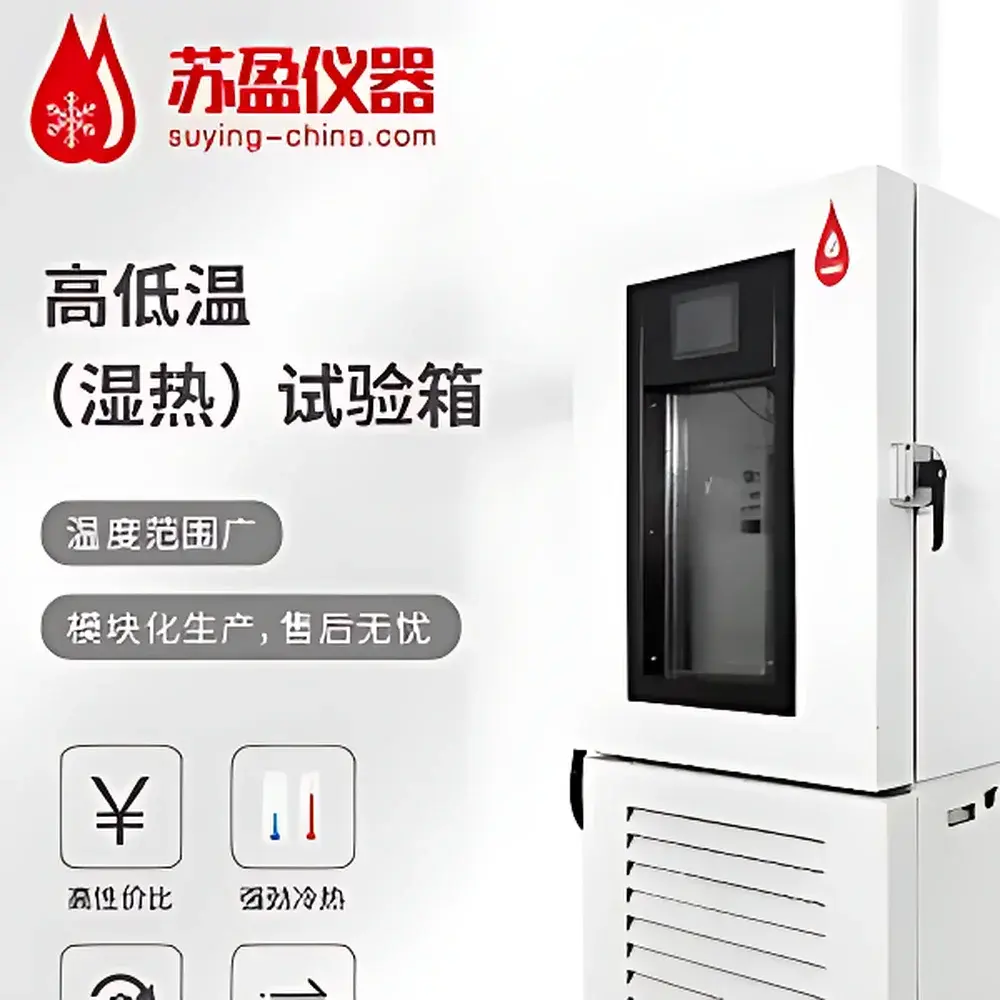
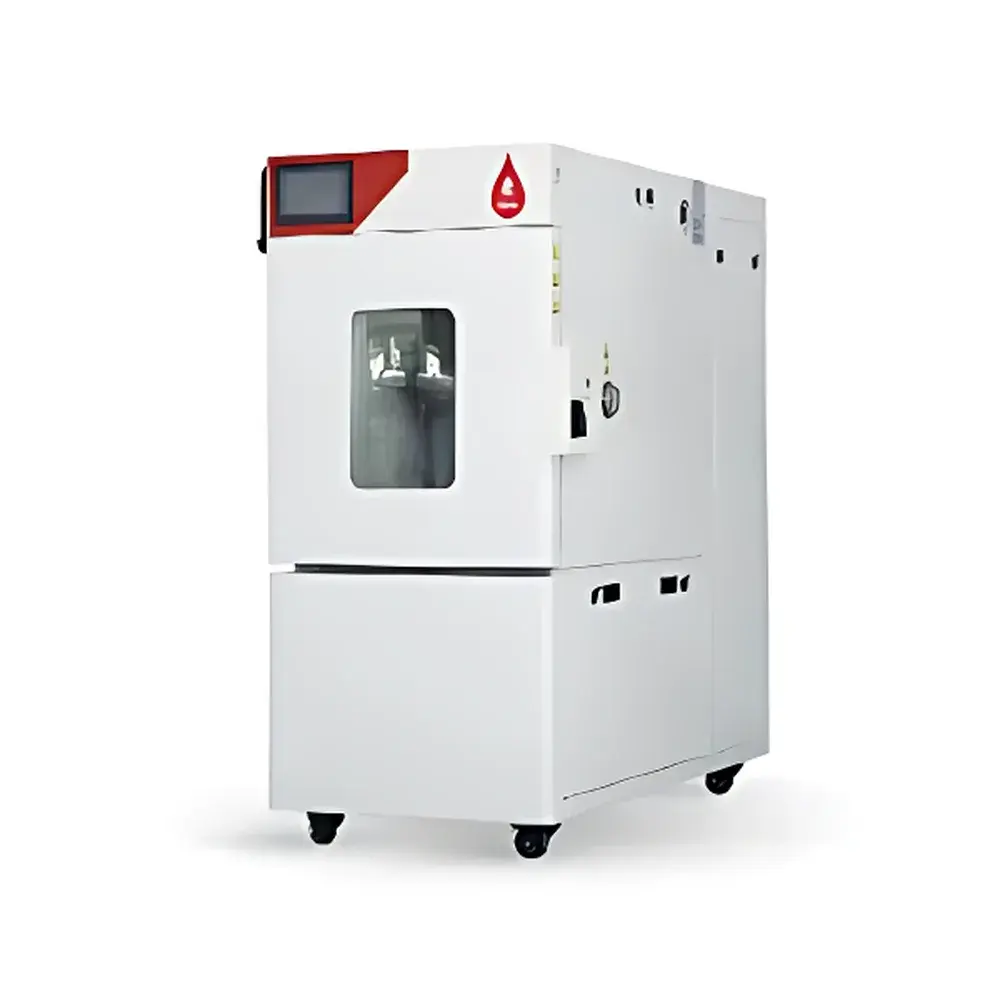
Suying GDJS Series High-Low Temperature & Humidity Environmental Test Chamber
| Brand | Suying |
|---|---|
| Origin | Shanghai, China |
| Manufacturer Type | Authorized Distributor |
| Country of Origin | China |
| Model Range | GDJS-100 / GDJS-225 / GDJS-500 / GDJS-800 / GDJS-010 |
| Temperature Range | −70 °C to +150 °C (configurable) |
| Humidity Range | 30–98 % RH |
| Temp. Uniformity | ±2 °C |
| Temp. Stability | ±0.5 °C |
| Humidity Deviation | +2 / −3 % RH |
| Heating Rate | 1.0–3.0 °C/min |
| Cooling Rate | 0.7–1.0 °C/min |
| Control Resolution | 0.1 °C / 1 % RH |
| Power Supply | AC 380 V ±10 %, 50 Hz, 3-phase 5-wire |
| Compliance | GB/T 2423.1–2008, GB/T 2423.2–2008, GB/T 2423.3–2006, GB/T 2423.4–2008 |
Overview
The Suying GDJS Series High-Low Temperature & Humidity Environmental Test Chamber is an engineered environmental simulation system designed for rigorous reliability validation and accelerated life testing of materials, electronic components, aerospace subsystems, and precision instrumentation under controlled thermal and hygrothermal stress conditions. Based on the fundamental principles of convective heat transfer, vapor-phase mass transport, and closed-loop PID-controlled refrigeration/dehumidification cycles, the chamber delivers stable, repeatable, and traceable environmental profiles across a wide operational envelope—from extreme cryogenic lows (−70 °C) to high-temperature extremes (+150 °C), coupled with programmable relative humidity control (30–98 % RH). Its dual-purpose architecture supports both static temperature/humidity conditioning and dynamic cycling protocols—including rapid ramping, dwell-hold sequences, and complex multi-step profiles—making it suitable for qualification per international standards such as IEC 60068-2, MIL-STD-810, and JEDEC JESD22-A104.
Key Features
- Robust dual-wall construction: Inner chamber fabricated from electropolished SUS304 stainless steel mirror finish; outer shell formed from A3 carbon steel with phosphating and electrostatic powder coating for corrosion resistance and long-term dimensional stability.
- High-efficiency refrigeration system featuring original French Tecumseh hermetic compressors, optimized for low-noise operation and extended service life; employs either single-stage or cascade (two-stage) refrigeration circuits depending on selected temperature range (e.g., −70 °C models utilize cascade design).
- Independent heating, humidification, and dehumidification subsystems—enabling precise decoupled control, reduced cross-interference, and improved system longevity.
- Advanced air circulation architecture with multi-blade centrifugal fans and aerodynamically optimized ductwork ensures uniform temperature distribution (±2 °C) and rapid thermal recovery (<3 min after door opening) per IEC 60068-3-5 requirements.
- Intuitive 5.7-inch color touchscreen controller with bilingual (English/Chinese) interface, capable of storing up to 100 user-defined test programs with 1000 segments and 999 loops; supports real-time curve plotting, data logging, and remote monitoring via RS-232/RS-485 interfaces.
- Integrated safety architecture including over-temperature cutoff, compressor high-pressure protection, motor overload relay, water-level sensing with auto-shutoff, leakage current detection, and power-failure memory retention.
Sample Compatibility & Compliance
The GDJS chamber accommodates diverse sample configurations through standardized internal dimensions (ranging from 100 L to 1000 L working volume) and optional through-wall ports (50 mm or 100 mm diameter) for external power/signal interfacing. Its interior geometry and airflow design minimize thermal stratification, ensuring representative exposure for heterogeneous loads—including PCB assemblies, sealed enclosures, optical sensors, polymer composites, and battery modules. The system conforms to national and industry-specific environmental test standards, including GB/T 2423.1–2008 (cold), GB/T 2423.2–2008 (dry heat), GB/T 2423.3–2006 (damp heat, steady state), and GB/T 2423.4–2008 (damp heat, cyclic). While not certified to ISO/IEC 17025, its measurement traceability path aligns with metrological best practices for in-house QC laboratories operating under GLP or GMP frameworks.
Software & Data Management
The embedded microprocessor-based controller provides full programmability with segment-based ramp/soak logic, automatic dew-point calculation for condensation avoidance, and adaptive PID tuning to maintain setpoint fidelity during transient load changes. Logged data—including chamber temperature, humidity, compressor status, and alarm events—is timestamped and exportable via USB or serial link in CSV format for post-test analysis. Optional PC-based software enables centralized fleet management, automated report generation (PDF/Excel), and integration into enterprise MES or LIMS platforms. For regulated environments, optional audit trail functionality complies with FDA 21 CFR Part 11 requirements when deployed with appropriate IT infrastructure and procedural controls.
Applications
- Accelerated aging studies of elastomers, adhesives, and conformal coatings under combined thermal-hygric stress.
- Thermal shock screening of surface-mount devices (SMDs), MEMS sensors, and automotive ECUs.
- Pre-conditioning of lithium-ion cells prior to electrical performance evaluation per UN 38.3 Section 4.4.
- Environmental stress screening (ESS) of avionics hardware during HALT/HASS development phases.
- Validation of packaging integrity for sterile medical devices under ISO 11607-1 accelerated aging conditions.
- Material compatibility testing for vacuum-compatible components exposed to outgassing-induced condensation risks.
FAQ
What temperature and humidity ranges are supported?
The GDJS series offers configurable temperature spans from −20 °C to +150 °C (standard), −40 °C to +150 °C (extended), −60 °C to +150 °C (low-temp), or −70 °C to +150 °C (ultra-low), paired with 30–98 % RH humidity control.
Is the controller compatible with third-party test management software?
Yes—the RS-232 and RS-485 communication ports support Modbus RTU protocol, enabling seamless integration with LabVIEW, MATLAB, or custom SCADA systems for automated test sequencing and data acquisition.
How is calibration traceability maintained?
Users are advised to perform periodic verification using NIST-traceable PT100 reference probes; Suying provides calibration certificates upon request for factory-installed sensors, aligned to national metrology institute standards.
Can the chamber be customized for non-standard test volumes or port configurations?
Yes—Suying accepts OEM and ODM requests for bespoke chamber geometries, additional viewing windows, specialized insulation, or integrated vibration tables, subject to engineering feasibility review and lead-time adjustment.
What maintenance intervals are recommended for optimal performance?
Compressor oil and refrigerant levels should be verified annually; condenser coils require quarterly cleaning; humidity reservoirs must be drained and sanitized monthly; and sensor calibration is recommended every six months under continuous operation.



