SVT Laser MBE System – Pulsed Laser Molecular Beam Epitaxy Platform
| Origin | USA |
|---|---|
| Manufacturer Type | Authorized Distributor |
| Origin Category | Imported |
| Model | Laser MBE |
| Pricing | Available Upon Request |
Overview
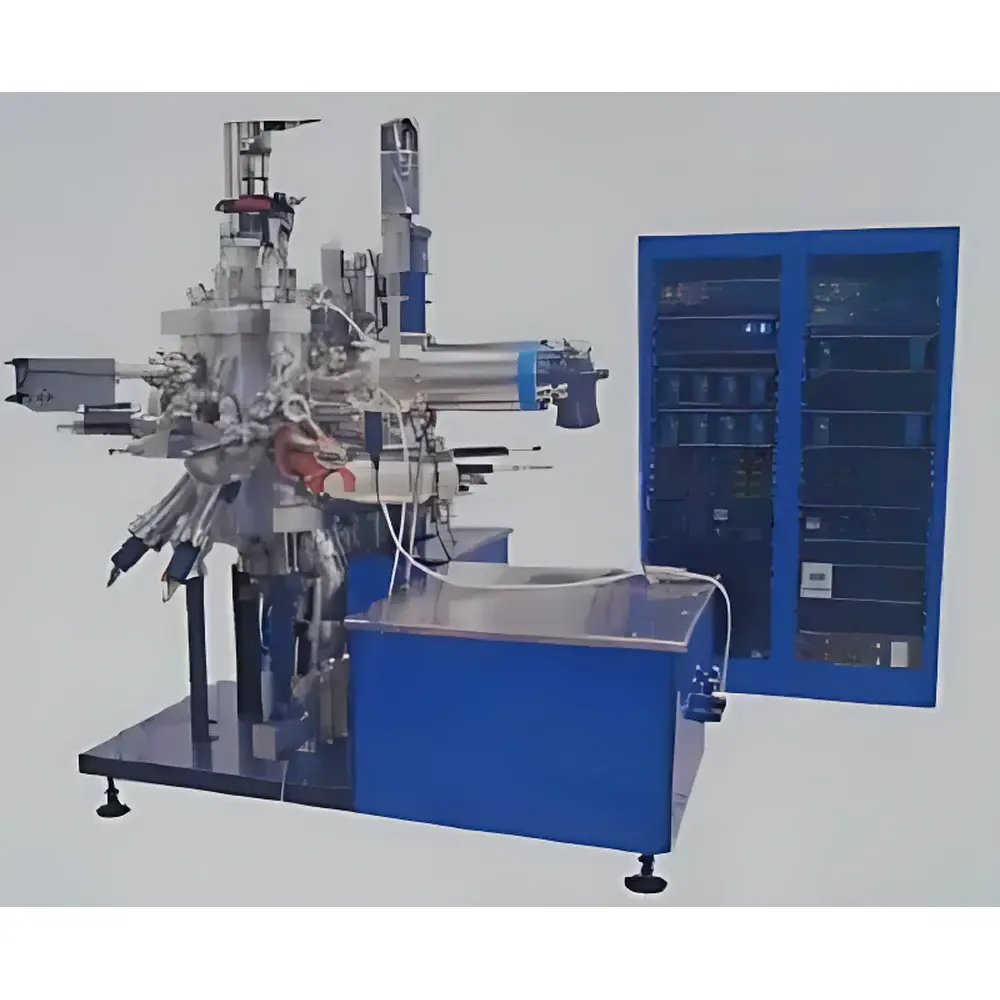
The SVT Laser MBE System is a hybrid ultra-high-vacuum (UHV) thin-film growth platform that integrates the precision of molecular beam epitaxy (MBE) with the material versatility of pulsed laser deposition (PLD). Engineered for atomic-layer-resolved synthesis of complex functional oxides and multi-element compounds, this system enables controlled stoichiometric transfer from solid targets—particularly critical for high-melting-point ceramics, transition-metal oxides, and metastable phases incompatible with conventional thermal evaporation. The core architecture employs a dual-source paradigm: conventional effusion cells (e.g., electron-beam evaporators, RF plasma sources) coexist with up to six independently rotatable PLD targets, each coupled to a high-repetition-rate excimer laser (typically KrF or ArF, 248 nm or 193 nm). Growth occurs under UHV conditions (<1 × 10⁻¹⁰ Torr base pressure), ensuring minimal contamination and enabling in situ surface-sensitive characterization during deposition.
Key Features
- Ultra-high vacuum chamber with all-metal sealing, turbomolecular pumping complemented by cryogenic or ion-getter pump options for oxygen-compatible operation
- Integrated multi-mode source array: electron-beam evaporators, RF plasma sources, ozone delivery system for reactive oxidation, and thermal effusion cells
- Six motorized, ultra-precise rotating PLD target holders with real-time angular position feedback and programmable dwell time per target
- High-stability excimer laser subsystem (≥10 Hz repetition rate, pulse energy stability ±1.5% over 8 hours) with beam homogenization and shutter-integrated optics
- In situ monitoring suite: reflection high-energy electron diffraction (RHEED) with phosphor screen and CCD acquisition, calibrated pyrometry (600–1800 °C range), quartz crystal microbalance (QCM) thickness monitor with sub-monolayer resolution, and atomic absorption beam flux monitors for elemental flux quantification
- Modular chamber design supporting custom port configurations, substrate heater/cooling stages (up to 1000 °C heating, LN₂ cooling), and optional load-lock integration
Sample Compatibility & Compliance
The Laser MBE System supports substrates up to 2 inches in diameter (standard) with optional upgrades for 3-inch wafers. It accommodates single-crystal insulators (e.g., SrTiO₃, LaAlO₃), semiconductors (Si, GaAs), and metallic templates (Ni, Pt) with precise azimuthal alignment capability. All UHV components comply with ASTM F1373 (Standard Practice for Leak Testing Vacuum Systems) and ISO 20484 (Vacuum Technology — Vocabulary). Chamber materials and gasketing meet ASTM B164 (nickel-copper alloy specifications) and are certified oxygen-compatible per CGA G-4.1. The system architecture supports GLP/GMP-aligned workflows through hardware-enforced interlocks, audit-trail-capable control software, and optional 21 CFR Part 11-compliant electronic signature modules.
Software & Data Management
Control is managed via SVT’s proprietary MBEWorks™ platform—a deterministic real-time operating system running on industrial-grade embedded controllers. The interface provides synchronized logging of >200 process parameters (laser fluence, cell temperatures, RHEED intensity oscillations, QCM rates, pressure transients) at 100 Hz sampling. Data export conforms to HDF5 and CSV formats; metadata includes timestamped calibration certificates, instrument configuration snapshots, and user-defined experiment annotations. Optional cloud-based data archiving complies with ISO/IEC 27001 information security standards. Remote diagnostics and firmware updates are supported via TLS-encrypted channels with role-based access control.
Applications
This platform is deployed in academic and industrial research laboratories for the synthesis and fundamental study of quantum materials, including but not limited to: high-temperature superconducting cuprates (e.g., YBCO, LSCO), multiferroic oxides (BiFeO₃, YMnO₃), transparent conducting oxides (ITO, AZO), topological insulator heterostructures (Bi₂Se₃/Sb₂Te₃), electro-optic waveguide films (LiNbO₃, KTP), and spintronic interfaces (La₀.₇Sr₀.₃MnO₃/STO). Its ability to co-deposit volatile and refractory elements with independent flux control makes it uniquely suited for combinatorial library synthesis and phase-diagram mapping under thermodynamically constrained growth conditions.
FAQ
What vacuum level is achievable with standard pumping configuration?
Base pressure ≤1 × 10⁻¹⁰ Torr is routinely achieved using a combination of a 1200 L/s turbomolecular pump, titanium sublimation pump, and non-evaporable getter (NEG) cartridge.
Can the system grow stoichiometric complex oxides like SrTiO₃ without oxygen plasma assistance?
Yes—when combined with the integrated ozone delivery system (0–100 sccm, 5–15 wt% O₃ in O₂) and RHEED-guided growth mode selection, stoichiometric oxide growth is reproducibly achieved even for highly volatile cations.
Is remote training and technical support available post-installation?
SVT provides comprehensive on-site commissioning, followed by biannual remote calibration verification, quarterly software updates, and 24/7 priority engineering support with SLA-backed response times.
Are custom chamber modifications possible for specialized in situ characterization?
Yes—SVT offers mechanical and electrical integration of X-ray photoelectron spectroscopy (XPS), angle-resolved photoemission spectroscopy (ARPES), or scanning tunneling microscopy (STM) feedthroughs under NDA-protected engineering review.