
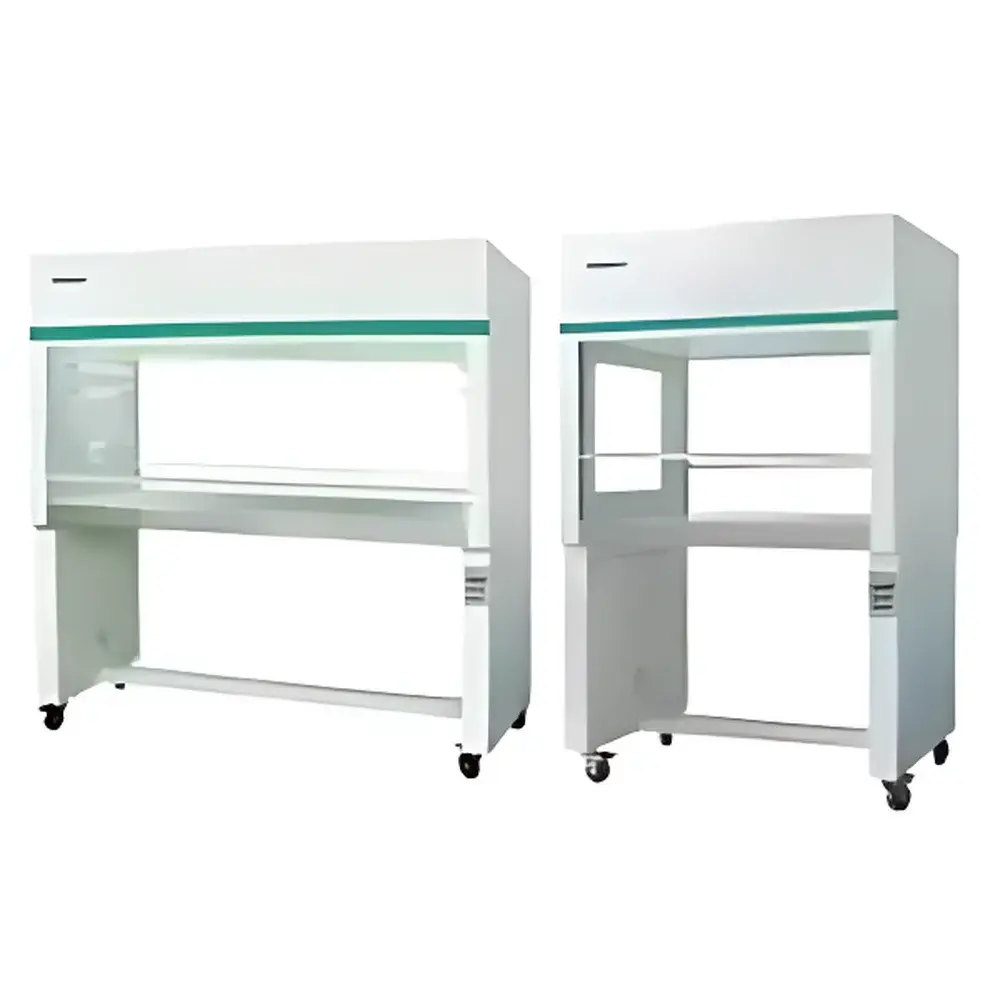
SW-CJ-2FD Vertical Laminar Flow Clean Bench
| Origin | Jiangsu, China |
|---|---|
| Manufacturer Type | Authorized Distributor |
| Product Origin | Domestic (China) |
| Model | SW-CJ-2FD |
| Instrument Category | Vertical Flow Clean Bench |
| Cleanliness Class | ISO 5 (Class 100 per US Federal Standard 209E) |
| Noise Level | ≤62 dB(A) |
| User Capacity | Dual-Operator, Single-Face Configuration |
| Airflow Pattern | Vertical Unidirectional Laminar Flow |
| Work Surface Material | Electropolished Stainless Steel (304) |
| Cabinet Construction | Powder-Coated Steel |
| Average Air Velocity | ≥0.3 m/s (adjustable via dual-speed touch-control fan system) |
| Illumination | ≥300 lx (14 W fluorescent ×2) |
| UV Sterilization | 8 W germicidal lamp ×2 (interlocked with lighting and safety door switch) |
| Microbial Contamination | ≤0.5 CFU/plate (90 mm Petri dish, 4-hour exposure) |
| Power Supply | 220 V AC / 50 Hz |
| Input Power | 500 VA |
| Net Weight | 170 kg |
| Working Area Dimensions (W×D×H) | 1360 × 690 × 520 mm |
| Overall Dimensions (W×D×H) | 1500 × 730 × 1600 mm |
| HEPA Filter Specification | 610 × 610 × 50 mm ×2 (≥99.995% @ 0.3 µm) |
Overview
The SW-CJ-2FD Vertical Laminar Flow Clean Bench is an ISO 5-certified (Class 100 per US Federal Standard 209E) personnel-protective workstation engineered for non-hazardous applications requiring particulate-free environments. Unlike biological safety cabinets, this clean bench provides unidirectional vertical laminar airflow—generated by a low-turbulence, high-efficiency blower system—to sweep airborne contaminants away from the operator and across the work surface. Air is drawn through pre-filters, conditioned, and then passed through two certified HEPA filters (610 × 610 × 50 mm, ≥99.995% efficiency at 0.3 µm) before entering the work area at a uniform, adjustable velocity of ≥0.3 m/s. The unit operates in open-front configuration with a quasi-enclosed stainless steel work surface, minimizing cross-contamination risk while maintaining ergonomic accessibility for two operators working side-by-side on a single-face layout. It is not suitable for handling biohazards or volatile chemicals; its design strictly complies with ISO 14644-1 for cleanroom performance validation and aligns with general laboratory infrastructure requirements under GLP-aligned facility standards.
Key Features
- Vertical laminar airflow architecture optimized for particle-free sample handling, media preparation, and aseptic assembly in pharmaceutical QC labs, cell culture facilities, and electronics manufacturing cleanrooms.
- Dual-operator, single-face configuration with 1360 mm wide working area—designed to accommodate collaborative workflows without compromising ISO 5 integrity.
- Electropolished 304 stainless steel work surface—seamless, non-porous, and corrosion-resistant—ensuring easy decontamination and long-term compliance with cleaning validation protocols (e.g., residue testing per ASTM E3106).
- Dual-speed touch-control fan system with real-time airflow regulation—enabling precise adjustment between operational modes to maintain consistent velocity (≥0.3 m/s) across varying filter loading conditions.
- Interlocked UV germicidal irradiation system (8 W ×2) and fluorescent lighting (14 W ×2)—preventing simultaneous activation to eliminate operator UV exposure risk, meeting IEC 61000-4-2 EMC and IEC 62471 photobiological safety requirements.
- Powder-coated steel enclosure with acoustic dampening—achieving ≤62 dB(A) noise emission at 1 m distance, supporting sustained use in shared laboratory environments without auditory fatigue.
Sample Compatibility & Compliance
The SW-CJ-2FD is validated for use with non-volatile, non-toxic samples including microbiological agar plates, sterile vials, optical components, semiconductor wafers, and lyophilized reagents. It does not provide personnel or environmental protection against aerosolized pathogens or chemical vapors; therefore, it must not be substituted for Class II biological safety cabinets when handling Risk Group 2+ agents. The unit conforms to ISO 14644-1:2015 (Cleanrooms and associated controlled environments), US Federal Standard 209E (repealed but still referenced for Class 100 equivalence), and general electrical safety requirements per GB 4793.1–2007 (equivalent to IEC 61010-1). Documentation includes factory-issued filter certification reports, airflow uniformity test records, and illumination intensity verification—supporting audit readiness for ISO/IEC 17025-accredited laboratories.
Software & Data Management
This clean bench operates as a standalone mechanical system with no embedded microprocessor or digital interface. All operational parameters—including fan speed, UV cycle timing, and lighting status—are managed manually via tactile switches. While no software integration is provided, its design supports external environmental monitoring systems: optional analog voltage outputs (0–10 V DC) can be added to interface with building management systems (BMS) for real-time airflow logging. Maintenance logs—including HEPA filter replacement dates, UV lamp service intervals (recommended every 1,000 hours), and annual ISO 5 recertification—must be retained per GLP Annex 11 principles and internal quality procedures. No FDA 21 CFR Part 11 compliance is applicable, as the device performs no data acquisition or electronic record generation.
Applications
- Aseptic preparation of culture media and reagents in academic and industrial microbiology laboratories.
- Assembly and inspection of precision optical assemblies where sub-micron particulate control is critical.
- Handling of sensitive electronic components during PCB prototyping and microelectronics packaging.
- Preparation of sterile pharmaceutical dosage forms in non-GMP pilot-scale environments.
- Supporting ISO 5 staging areas adjacent to Class A filling lines—used for component staging, tooling setup, and gowning support prior to entry into higher-grade zones.
- Cell line maintenance and transfection procedures where biosafety level 1 (BSL-1) containment suffices.
FAQ
Is the SW-CJ-2FD suitable for handling infectious agents or genetically modified organisms?
No. This unit provides only product protection—not personnel or environmental protection—and must not be used for BSL-2 or higher work.
What is the recommended HEPA filter replacement interval?
Under continuous operation, replace filters every 12–18 months or when static pressure differential exceeds 250 Pa—verified using a calibrated manometer.
Can the unit be integrated into a central exhaust system?
No. The SW-CJ-2FD is a recirculating vertical flow bench; it does not connect to ducted exhaust and must operate in ambient room air.
Does it comply with ISO 14644-3 for as-built certification?
Yes—when installed per manufacturer-specified clearances (minimum 300 mm rear/side clearance, no ceiling obstructions), it meets ISO 14644-3:2019 testing requirements for airflow visualization, particle count, and uniformity.
What documentation is supplied for regulatory audits?
Factory calibration certificates for airflow velocity and illumination, HEPA filter test reports (EN 1822-3), and electrical safety compliance statements are included with each unit shipment.



