
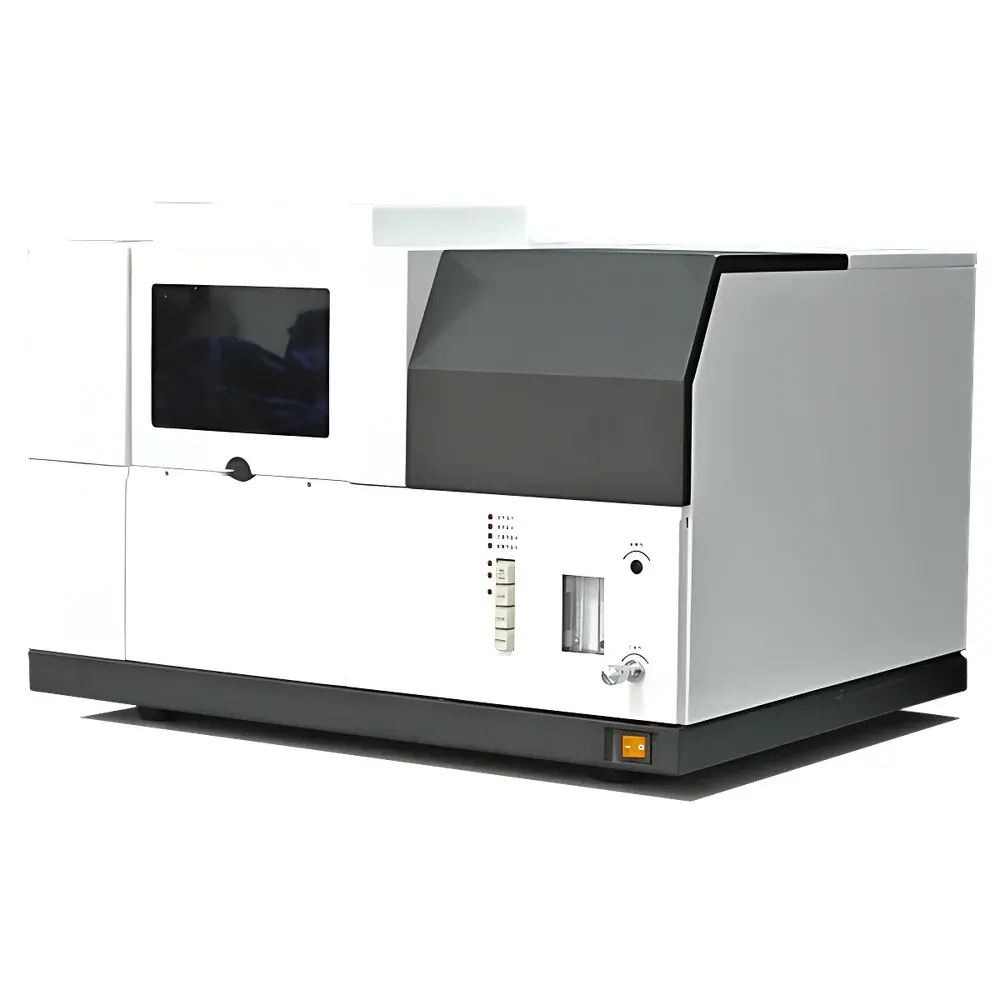
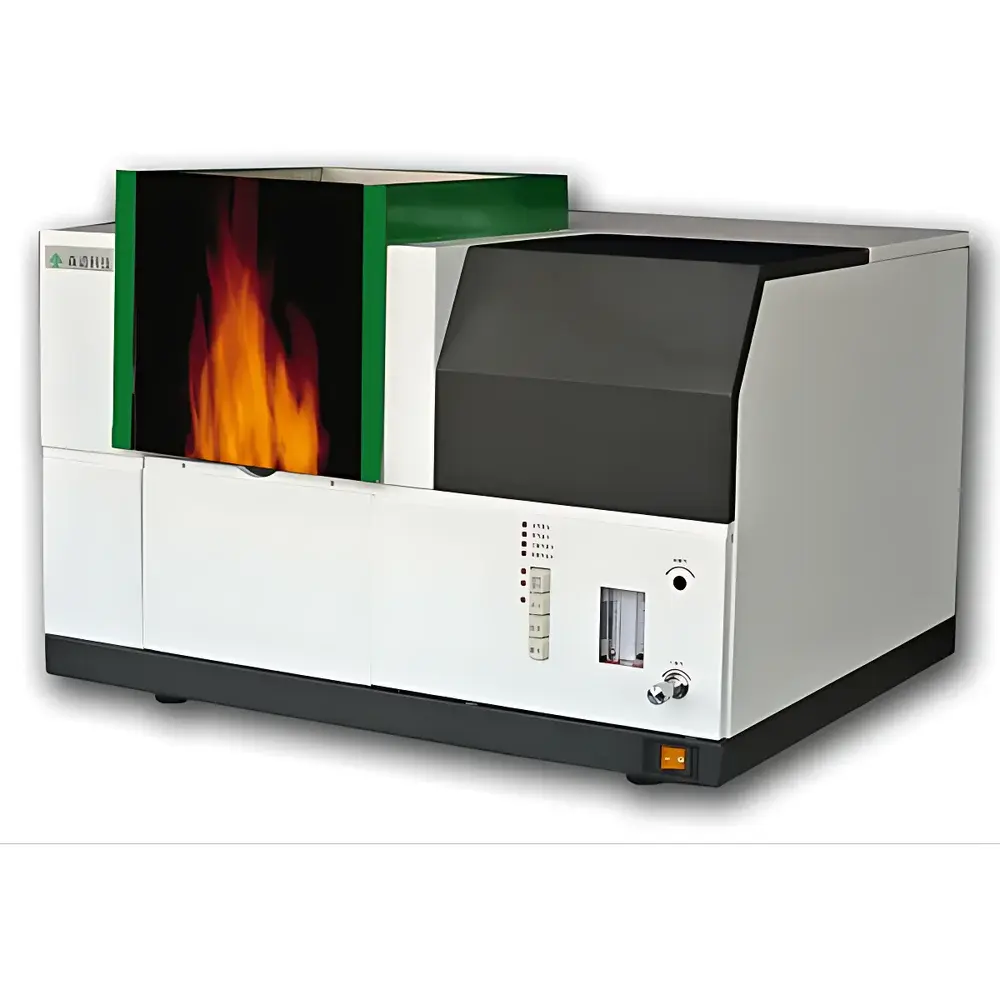
Synpec AA4510 Flame Atomic Absorption Spectrophotometer
| Brand | Synpec |
|---|---|
| Origin | Shanghai, China |
| Manufacturer Type | Direct Manufacturer |
| Instrument Type | Flame AAS |
| Monochromator | Plane Grating |
| Optical System | Single-Beam |
| Detector | Photomultiplier Tube (PMT) |
| Background Correction | D₂ Lamp + Self-Absorption Method |
| Spectral Resolution | 0.2 nm |
| Sensitivity | ≤0.025 µg/mL for 1% absorption |
| RSD (Precision) | ≤0.5% |
| Cu Detection Limit | ≤0.006 µg/mL |
| Wavelength Range | 190–900 nm |
| Wavelength Accuracy | ±0.2 nm across full range |
| Wavelength Repeatability | ±0.1 nm |
| Spectral Bandwidth Options | 0.1, 0.2, 0.4, 1.0, 1.2, 2.0 nm |
| Baseline Drift (Static) | ≤0.002 ABS/30 min (Cu) |
| Baseline Drift (Dynamic, Ignition) | ≤0.004 ABS/30 min (Cu) |
| Mn Doublet Resolution | Resolves 279.5/279.8 nm with valley-to-peak energy ratio <30% at 0.2 nm SBW |
| Lamp Holder | 4-lamp turret (6-lamp optional) |
| Flame Burner Heads | 100 mm air–acetylene |
| Safety Interlocks | Automatic gas cutoff on low pressure, power failure, flameout, or burner mismatch |
| Dimensions | 700 × 500 × 430 mm |
| Weight | 80 kg |
| Grating Density | 1800 lines/mm |
Overview
The Synpec AA4510 is a benchtop flame atomic absorption spectrophotometer engineered for routine elemental quantification in environmental, pharmaceutical, food safety, and industrial quality control laboratories. It operates on the fundamental principle of atomic absorption spectroscopy: ground-state free atoms in a flame absorb characteristic wavelengths of light emitted by element-specific hollow cathode lamps. The instrument measures the attenuation of this narrow-band radiation to determine analyte concentration via Beer–Lambert law correlation. Designed as a single-beam system with a high-efficiency plane grating monochromator (1800 lines/mm), the AA4510 delivers stable baseline performance, precise wavelength selection (190–900 nm), and robust spectral resolution—verified by its ability to resolve the manganese doublet at 279.5/279.8 nm with a valley-to-peak energy ratio under 30% at 0.2 nm spectral bandwidth. Its dual background correction architecture—combining deuterium lamp continuum correction and self-absorption (HCL-based) methods—ensures accurate measurement in complex matrices where molecular absorption or scattering may otherwise distort results.
Key Features
- Four-lamp turret (expandable to six-lamp configuration) enables rapid multi-element analysis without manual lamp replacement or realignment.
- Six-step adjustable spectral bandwidth (0.1, 0.2, 0.4, 1.0, 1.2, 2.0 nm) allows optimization of sensitivity versus selectivity per analyte and matrix.
- Dual-mode background correction: D₂ lamp for broad-band correction and self-absorption method for high-precision correction at specific wavelengths—meeting ASTM E1553 and ISO 8288 requirements for background interference mitigation.
- Integrated flame safety system with hardware-level interlocks: automatic fuel gas shutoff triggered by flameout detection, supply pressure drop below threshold, power interruption, or burner head misalignment.
- Modular burner assembly supports both standard 100 mm air–acetylene and optional 50 mm nitrous oxide–acetylene configurations for enhanced atomization efficiency of refractory elements (e.g., Al, Si, V).
- Optimized optical path design minimizes stray light and thermal drift; static baseline stability ≤0.002 ABS/30 min (Cu) ensures reproducible calibration over extended analytical sessions.
Sample Compatibility & Compliance
The AA4510 is validated for aqueous liquid samples prepared via acid digestion (EPA Method 200.2, ISO 11885) or direct dilution. It accommodates standard 18-mm borosilicate glass or quartz sample tubes and interfaces seamlessly with autosamplers (optional). All operational parameters—including lamp current, slit width, burner height, and flame stoichiometry—are programmable and stored within method files, supporting audit-ready GLP/GMP workflows. The instrument complies with key regulatory frameworks: its software architecture supports user access control, electronic signature, and audit trail functionality aligned with FDA 21 CFR Part 11 requirements when paired with Synpec’s certified AA Workstation v3.x. Data integrity is reinforced through timestamped method logs, raw signal archiving, and immutable result export (CSV, PDF, XML).
Software & Data Management
Controlled via Windows-based Synpec AA Workstation software, the AA4510 offers intuitive method development, real-time signal visualization, and automated calibration curve generation (linear, quadratic, or forced-zero). The platform includes dedicated modules for hydride generation AAS (HG-AAS) integration—enabling As, Se, Sb, Bi, and Hg analysis with pre-installed reaction protocols and timing templates. Method storage capability allows users to save and recall complete analytical sequences—including lamp settings, calibration standards, integration parameters, and QC checks—reducing setup time between batches. Raw data are stored in a relational database with configurable backup policies; reports include full metadata (operator ID, instrument serial number, calibration date, uncertainty estimates per ISO/IEC 17025 Annex A.3), and support LIMS export via ODBC or HL7-compliant APIs.
Applications
- Environmental monitoring: Quantification of heavy metals (Pb, Cd, Cr, Ni, Zn, Cu) in wastewater, soil extracts, and drinking water per EPA 7000B and ISO 11885.
- Pharmaceutical excipient testing: Trace metal verification in APIs and carriers against ICH Q2(R2) and USP / limits.
- Food and feed analysis: Determination of essential (Fe, Zn, Cu) and toxic (As, Pb) elements in cereals, dairy, and animal feed per AOAC 984.27 and EN 15510.
- Geochemical screening: Rapid assessment of base metals in rock digests and leachates for exploration labs operating under ISO 17025 accreditation.
- Industrial process control: In-line QC of plating baths, catalyst residues, and polymer additives where sub-ppb detection limits and ≤0.5% RSD are critical for specification compliance.
FAQ
Is the AA4510 compatible with graphite furnace accessories?
No—the AA4510 is a dedicated flame AAS system. Synpec offers the AA4520 variant for combined flame/graphite furnace operation.
Can the instrument be integrated into a laboratory network for remote monitoring?
Yes. The AA Workstation supports TCP/IP communication and can be accessed remotely via secure RDP or VNC clients; audit trail data are synchronizable with centralized lab informatics platforms.
What maintenance intervals are recommended for the PMT detector and burner head?
The photomultiplier tube requires annual sensitivity verification using a reference lamp; burner heads should be inspected and cleaned after every 500 analyses or when carbon buildup affects flame stability.
Does the software support IQ/OQ/PQ documentation packages for regulated environments?
Yes—Synpec provides vendor-validated installation qualification (IQ), operational qualification (OQ), and performance qualification (PQ) templates compliant with ISO/IEC 17025 and GxP standards, including test protocols and acceptance criteria for wavelength accuracy, linearity, and detection limit verification.





