
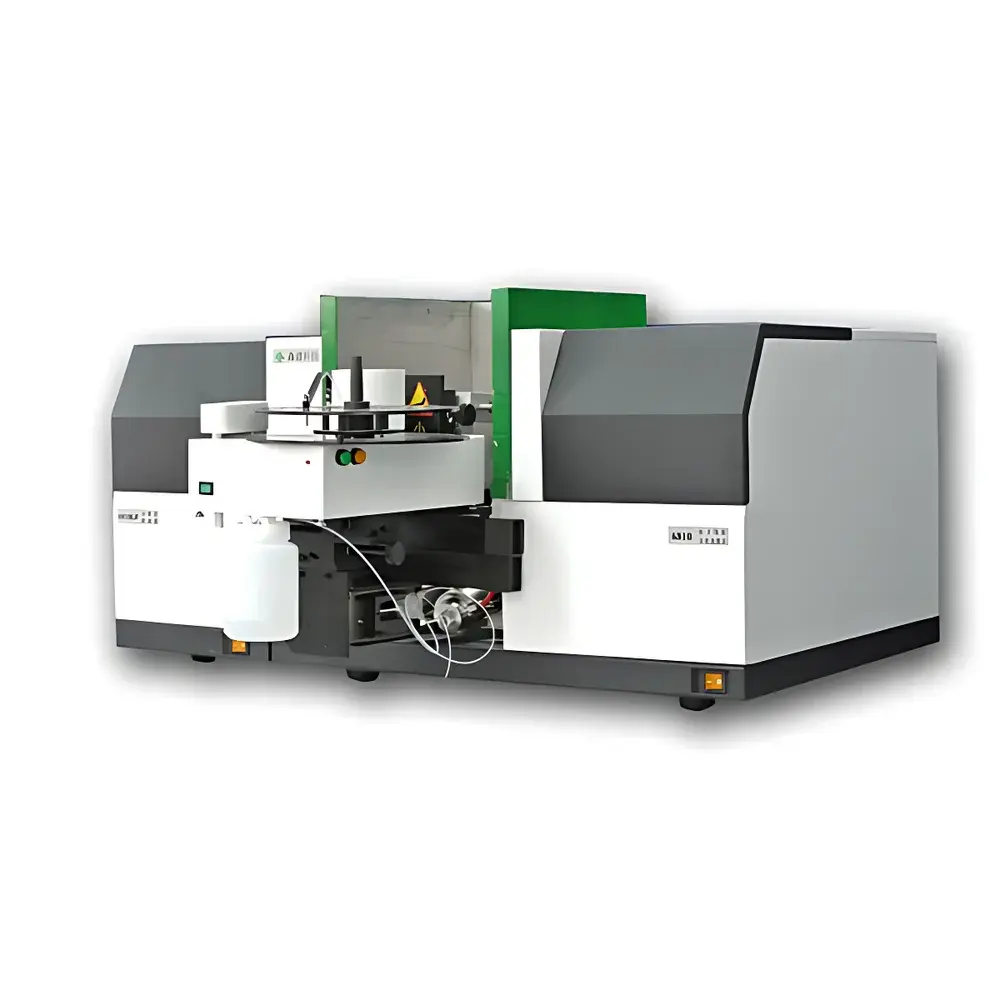
Synpec AA6810 Flame/Graphite Furnace Integrated Atomic Absorption Spectrophotometer
| Brand | Synpec |
|---|---|
| Origin | Shanghai, China |
| Manufacturer Type | Direct Manufacturer |
| Instrument Type | Flame + Graphite Furnace AAS |
| Monochromator | Plane Grating |
| Optical System | Single-Beam |
| Detector | Photomultiplier Tube (PMT) |
| Background Correction | Deuterium Lamp + Self-Reversal |
| Resolution | 0.2 nm |
| Sensitivity | ≤0.5% (Cu, Absorbance >0.8 AU) |
| Repeatability (RSD) | <0.5% |
| Detection Limit (Cu) | <0.004 µg/L |
| Detection Limit (Cd) | <0.3 pg |
| Characteristic Mass (Cd) | ≤0.4×10⁻¹² g |
| Characteristic Mass (Cu) | ≤10×10⁻¹² g |
| Temperature Control Accuracy | ≤1% |
| Max Ramp Rate | ≥3000 °C/s |
| Furnace Temp Range | Room Temp to 3000 °C |
| Dimensions | 700 × 550 × 440 mm |
| Weight | 80 kg |
| Power Supply | 220 V AC |
| Peak Power | 6000 W |
| Safety Features | Overcurrent Protection, Argon Pressure Monitoring, Overtemperature Cut-off |
Overview
The Synpec AA6810 Flame/Graphite Furnace Integrated Atomic Absorption Spectrophotometer is a dual-mode analytical platform engineered for trace elemental quantification across concentration ranges spanning parts-per-trillion (ppt) to parts-per-million (ppm). It integrates flame atomic absorption spectroscopy (FAAS) and electrothermal atomization graphite furnace AAS (GFAAS) into a single optical bench and control architecture—eliminating mechanical reconfiguration of atomizers, realignment of optical paths, or recalibration between modes. This co-located design ensures consistent wavelength registration, photometric stability, and inter-method comparability under ISO/IEC 17025 and ASTM E2022–21 guidelines. The system employs line-source hollow cathode lamp (HCL) excitation with single-beam optics and a plane grating monochromator delivering 0.2 nm spectral resolution—sufficient to resolve adjacent atomic lines per USP and EN 14802 requirements. Atomization occurs either in an air-acetylene or nitrous oxide-acetylene flame (for higher-temperature elements), or within a pyrolytically coated graphite tube subjected to programmable thermal cycles up to 3000 °C at ramp rates ≥3000 °C/s.
Key Features
- Integrated dual-atomizer architecture: Seamless transition between flame and graphite furnace operation without manual realignment or hardware swapping.
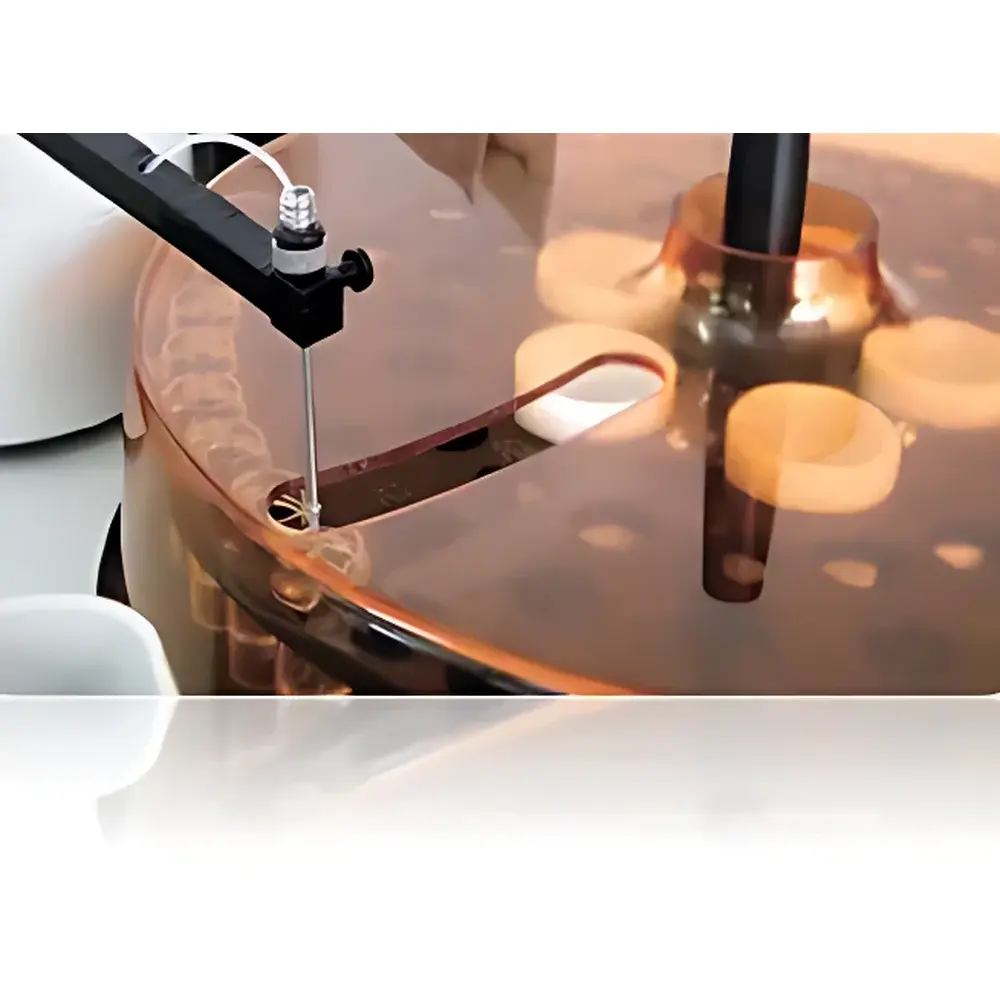
- 85-position autosampler with integrated syringe-based micro-dosing: Enables unattended analysis of up to 85 samples per run; accommodates matrix-matched standards, blanks, and replicates.
- 6–8 lamp turret with multi-lamp preheating capability: Reduces warm-up delay and improves long-term intensity stability for multi-element workflows.
- Dual-gas control system: Independent regulation of inner-tube (purge) and outer-tube (shield) argon flows; inner gas ceases during atomization to enhance analyte residence time and signal intensity while preserving tube integrity.
- Real-time graphite furnace video monitoring system: Coaxial CCD camera with coaxial illumination provides live visualization of sample deposition, drying, charring, atomization, and residue formation—supporting method optimization, operator training, and root-cause analysis of memory effects or tube degradation.
- Comprehensive safety architecture: Real-time monitoring of argon pressure, graphite tube current, furnace temperature, and cooling water flow; automatic shutdown on deviation from preset thresholds per IEC 61010-1.
Sample Compatibility & Compliance
The AA6810 supports aqueous, organic, and digested biological/environmental matrices—including soil extracts (EPA Method 7000B), wastewater (ISO 11885), clinical specimens (CLSI C38-A2), and food digests (AOAC 984.27). Its background correction employs both deuterium arc and self-reversal techniques, enabling accurate compensation for structured molecular absorption and scattering in complex matrices. The instrument complies with regulatory data integrity expectations: audit trails record all parameter changes, method executions, and calibration events; user access levels are configurable per FDA 21 CFR Part 11 Annex 11 principles. Full GLP/GMP documentation packages—including IQ/OQ/PQ protocols, calibration certificates traceable to NIST SRMs, and uncertainty budgets—are available upon request.
Software & Data Management
Synpec AAS Control Suite v4.x provides intuitive workflow-driven operation—from method setup and sequence definition to real-time signal visualization and post-run quantitation. All spectra, time-resolved absorbance curves, and furnace thermal profiles are stored in vendor-neutral .csv and .xml formats. Integration with LIMS via ASTM E1384-compliant interfaces enables automated result transfer. Software validation documentation includes risk assessments, test scripts, and summary reports aligned with GAMP 5 Category 3/4 classification. Raw data files retain full metadata (lamp ID, slit width, integration time, gas flow setpoints, temperature program steps) to support retrospective review and regulatory inspection.
Applications
- Environmental testing: Quantification of Cd, Pb, As, Ni, and Cr in drinking water (EPA 200.9), sediments (EPA 6010D), and airborne particulates (NIOSH 7300).
- Clinical toxicology: Measurement of blood lead (CLIA-waived), urinary cadmium (ISO 17294-2), and serum copper/zinc ratios.
- Pharmaceutical quality control: Elemental impurity screening per ICH Q3D Stage 4 guidelines, including catalyst residue analysis in APIs.
- Food safety: Detection of toxic elements in infant formula (FDA FVM 2022), rice (Codex Alimentarius STAN 193), and seafood (EU Regulation 1881/2006).
- Geological and metallurgical assays: Analysis of base metals in ore concentrates and leachates using high-temperature N₂O–C₂H₂ flame conditions.
FAQ
Does the AA6810 require separate optical alignment when switching between flame and graphite furnace modes?
No. The integrated atomizer module maintains fixed spatial registration relative to the monochromator exit slit and detector focal plane, eliminating need for recalibration or manual adjustment.
Is the multimedia furnace viewing system compatible with third-party image analysis software?
Yes. Video streams are output via standard USB 3.0 UVC protocol; frame-grabbed TIFF sequences and time-stamped AVI exports are natively supported.
What certification documentation is provided for regulatory submissions?
Factory-issued certificates of conformance, NIST-traceable wavelength and photometric accuracy verification reports, and optional 21 CFR Part 11 compliance packages—including electronic signature implementation and audit trail configuration reports—are available.
Can the instrument be operated in a regulated laboratory under ISO/IEC 17025 accreditation?
Yes. The AA6810 meets ISO/IEC 17025:2017 clause 6.4.10 (equipment suitability) and 6.4.11 (verification of fitness for purpose) when used with validated methods and documented calibration procedures.
What maintenance intervals are recommended for the graphite furnace components?
Pyrolytic graphite tubes are rated for ≥500 firings under optimized temperature programs; platform inserts require replacement after ~2000 cycles. Autosampler syringes and capillaries should be inspected weekly and replaced quarterly under continuous use.
Related Products





