
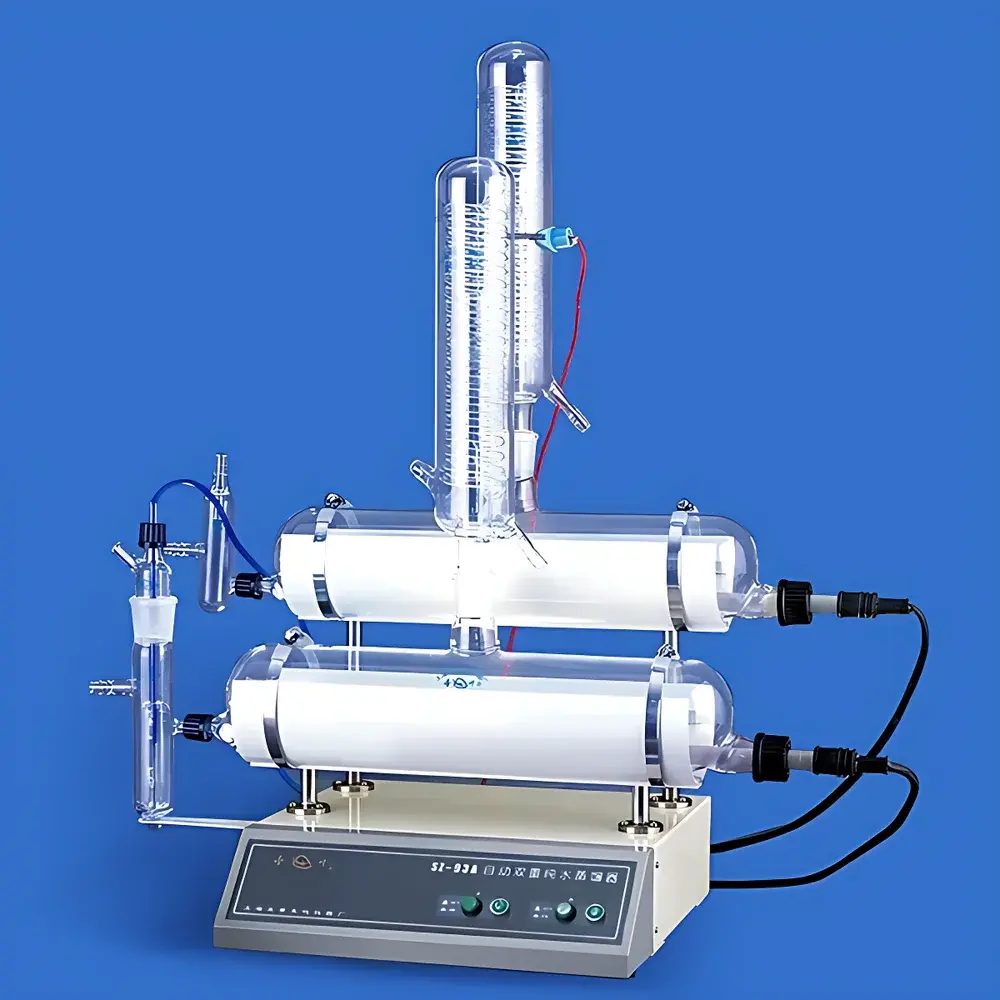
SZ-93A Automatic Dual-Stage Glass Distillation Apparatus for High-Purity Water Production
| Brand | Jinye |
|---|---|
| Origin | Shanghai, China |
| Manufacturer Type | Direct Manufacturer |
| Model | SZ-93A |
| Output Rate | 1600 mL/h |
| Compliance | CE-marked design principles, GLP-compatible operation |
Overview
The SZ-93A Automatic Dual-Stage Glass Distillation Apparatus is an engineered solution for laboratories requiring consistent, high-purity water free from volatile organics, ions, particulates, and microbial contaminants. Based on classical two-stage vapor condensation methodology, the system operates via sequential distillation: raw feed water (e.g., deionized or tap water) is first vaporized in a primary boiling chamber, condensed, and collected as first-distillate; this intermediate product then undergoes a second controlled vaporization and condensation cycle in an isolated secondary stage. This dual-pass thermal separation achieves residual conductivity ≤ 0.5 µS/cm at 25 °C—meeting ASTM D1193 Type I specifications for reagent-grade water and supporting ISO/IEC 17025-compliant analytical workflows. Constructed entirely of borosilicate 3.3 glass (DIN ISO 3585), the apparatus eliminates metal leaching and ensures chemical inertness across pH 1–14 and temperatures up to 300 °C.
Key Features
- Automated dual-stage distillation with integrated level-sensing float valves and thermal cut-off protection at both boiling chambers
- Energy-efficient insulation jacket reducing standby heat loss by >40% versus conventional single-shell designs
- Modular glass assembly with standardized ISO-KF 25 and ISO-KF 40 flange interfaces for rapid disassembly, cleaning, and validation
- Stainless steel 316L support frame with anti-slip rubber feet and integrated drip tray for spill containment
- Front-panel digital temperature display (±0.5 °C accuracy) monitoring both boiler zones independently
- No external cooling water required: air-cooled vertical condenser with optimized fin geometry enables continuous operation at ambient ≤35 °C
Sample Compatibility & Compliance
The SZ-93A accepts feed water with total dissolved solids (TDS) ≤ 500 ppm and chlorine content ≤ 2 ppm—compatible with standard municipal supplies pre-treated via activated carbon filtration. It is not intended for seawater, brine, or solvent-laden waste streams. All wetted surfaces comply with USP for Class VI plastics equivalency (glass-only contact path). The unit’s operational protocol supports audit-ready documentation per FDA 21 CFR Part 11 when paired with validated external data loggers. Routine performance verification follows ASTM D1193 Annex A1 (electrical conductivity test) and ISO 3696:1987 Clause 4 (resistivity measurement). Calibration intervals are defined per laboratory SOPs but recommended quarterly for GLP environments.
Software & Data Management
As a standalone analog-electromechanical instrument, the SZ-93A does not incorporate embedded firmware or network connectivity. However, its electrical interface includes a 0–10 V analog output port (configurable as boiler temperature or flow status signal), enabling integration into centralized lab monitoring systems (e.g., Siemens Desigo CC, LabVantage LIMS) via optional signal converters. For full traceability, users may connect calibrated external thermocouple loggers (Type K, NIST-traceable) to record time-stamped temperature profiles during each distillation batch. All maintenance records—including glassware replacement dates, seal inspections, and cleaning logs—must be retained per ISO/IEC 17025 clause 8.3 and GMP Annex 15 requirements.
Applications
- Preparation of Type I ultrapure water for HPLC mobile phase preparation, IC analysis, and trace metal assays (e.g., ICP-MS sample dilution)
- Manufacturing of calibration standards in environmental testing labs (EPA Method 1631, ISO 17294-2)
- Pharmaceutical QC labs producing water for injection (WFI)-grade reference material under USP
- Academic research requiring low-background water for radiochemical synthesis and neutron activation analysis
- Calibration of conductivity meters and TOC analyzers where certified reference water is mandated
FAQ
What feed water quality is required to achieve ASTM Type I purity?
Feed water must have TDS ≤ 500 ppm and free chlorine ≤ 2 ppm. Pre-filtration through granular activated carbon (GAC) and 5-µm sediment filter is strongly recommended.
Can the SZ-93A produce water compliant with USP Purified Water or WFI monographs?
It produces water meeting ASTM D1193 Type I and ISO 3696 Grade 1 specifications. For USP Purified Water or WFI, additional post-distillation polishing (e.g., 0.22 µm sterilizing filtration, UV oxidation) and system validation per USP are mandatory.
How often should the glass components be inspected for stress cracks or etching?
Visual inspection before each use is required. Full dimensional and hydrostatic pressure verification per DIN EN 1555-3 is advised every 6 months in high-throughput labs.
Is the unit suitable for continuous 24/7 operation?
Yes—designed for unattended overnight runs with auto-shutoff triggered by low-level detection in the secondary boiler. Maximum recommended duty cycle: 18 hours/day with ≥6-hour cooldown interval.
Does the apparatus meet RoHS or REACH substance restrictions?
All non-glass materials (stainless steel 316L, silicone gaskets, and phenolic resin knobs) are RoHS 2011/65/EU and REACH SVHC-free, with full declaration available upon request.



