
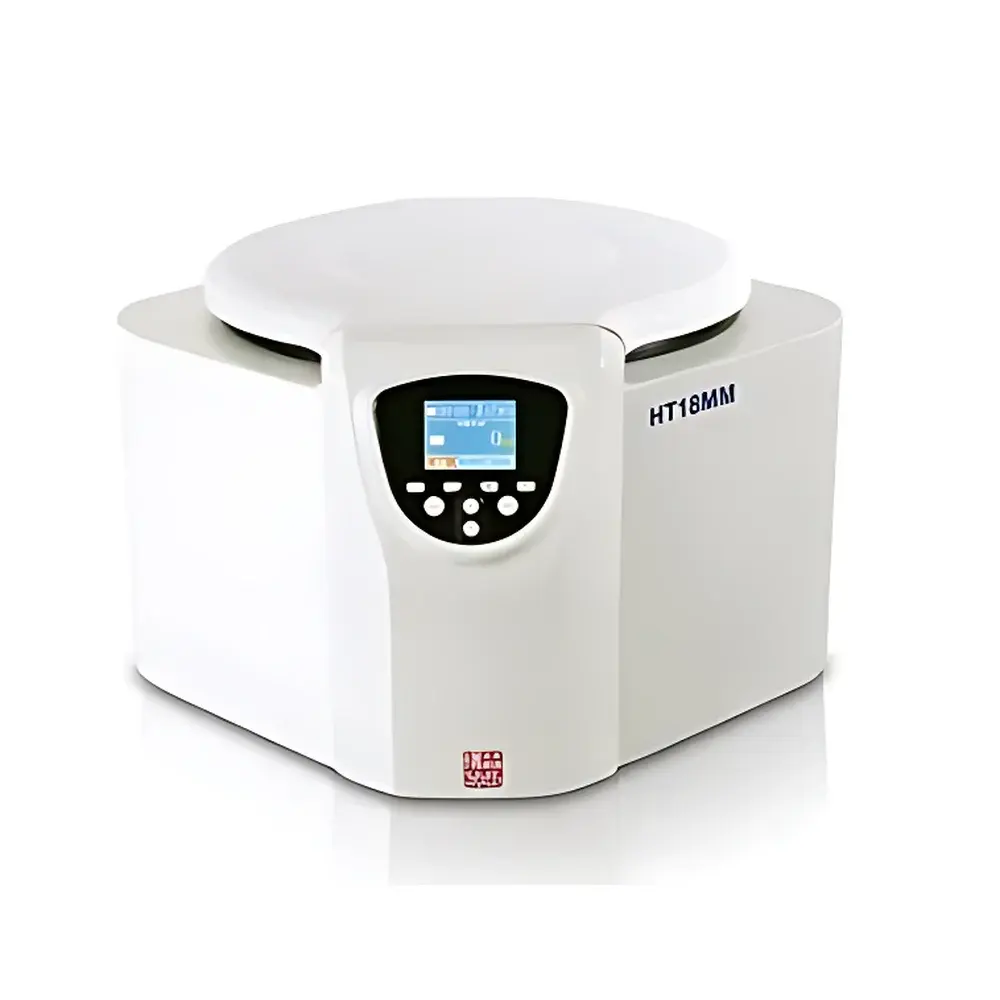
H/T12MM Blood Centrifuge
| Max Speed | 4000 rpm |
|---|---|
| Max RCF | 2200 ×g |
| Dimensions | 500×450×280 mm |
| Power | 200 W |
| Voltage | AC 220 V, 50 Hz |
| Weight | 20 kg |
| Application Class | Clinical Hematology & Immunohematology |
| Rotor Compatibility | SERO (RBC washing), HLS (lymphocyte separation), Blood Typing Card Rotors (24-well, 8-well, 6-well) |
| Compliance | Designed for CLIA-, CAP-, and ISO 15189-aligned workflows |
Overview
The H/T12MM Blood Centrifuge is a dedicated clinical centrifuge engineered for precision sedimentation in hematology, immunohematology, and diagnostic serology laboratories. It operates on the principle of differential sedimentation under controlled gravitational force (RCF), enabling reproducible separation of blood components—including erythrocytes, leukocytes, platelets, serum, plasma, and immune complexes—based on density, size, and shape. With a maximum rotational speed of 4000 rpm and an achievable relative centrifugal force (RCF) of 2200 ×g, the instrument delivers optimal pelleting efficiency for large cellular organelles and viral particles while preserving cell membrane integrity during gentle washing cycles. Its mechanical design prioritizes stability at low-to-moderate speeds, minimizing vibration-induced sample disturbance—a critical requirement for microcolumn gel card assays and antigen–antibody agglutination kinetics.
Key Features
- Dedicated rotor architecture supporting three clinically validated configurations: SERO rotors for ABO/Rh typing and red blood cell (RBC) washing; HLS rotors for lymphocyte isolation and mononuclear cell preparation; and standardized blood typing card rotors compatible with 6-, 8-, and 24-well microcolumns.
- Precision digital control system with programmable protocols—up to 7 preconfigured methods stored internally—enabling rapid selection of time, speed, and acceleration/deceleration profiles without manual recalibration.
- Brushless DC motor ensures consistent torque delivery across operational load ranges, contributing to long-term speed accuracy (±10 rpm) and minimal thermal drift during extended runs.
- Compact footprint (500×450×280 mm) and lightweight chassis (20 kg) facilitate benchtop integration in space-constrained clinical labs, emergency departments, and point-of-care testing environments.
- Integrated safety interlocks include automatic lid lock detection, imbalance sensing (<5 g tolerance), and over-speed cut-off compliant with IEC 61010-2-020 requirements for laboratory equipment.
Sample Compatibility & Compliance
The H/T12MM is optimized for whole blood, anticoagulated specimens (EDTA, citrate, heparin), serum, plasma, and diluted cell suspensions used in routine blood bank testing. It supports standard vacuum collection tubes (e.g., BD Vacutainer®, Greiner Bio-One), microhematocrit capillaries, and commercially available gel cards (e.g., DiaMed ID-Card®, Ortho BioVue®). The device meets essential performance criteria referenced in ASTM E2500-13 (Good Practice for Specification and Verification of Analytical Instruments) and aligns with ISO 15189:2022 clause 5.3.2 regarding equipment suitability for intended medical testing. While not certified as an FDA 510(k)-cleared IVD device, its operational parameters conform to CLSI EP05-A3 guidelines for centrifuge verification in clinical laboratories.
Software & Data Management
The H/T12MM operates via embedded firmware with no external PC dependency. All run logs—including date/time stamp, selected program number, actual RCF, duration, and error codes—are retained in non-volatile memory for up to 500 cycles. Audit trail functionality enables traceability for GLP/GMP-regulated environments when paired with lab information systems (LIS) via optional RS-232 interface (available upon request). No proprietary software installation is required; configuration and diagnostics are accessible through intuitive front-panel navigation with LED status indicators. Firmware updates are performed via USB flash drive using manufacturer-provided binaries—ensuring compliance with FDA 21 CFR Part 11 data integrity expectations where electronic records are archived.
Applications
- Blood group serology: RBC sensitization, indirect antiglobulin test (IAT), and direct antiglobulin test (DAT) preparation via standardized washing cycles.
- Microcolumn gel technology: High-fidelity separation in ID-Micro Typing System® and similar platforms requiring precise sedimentation velocity control.
- Lymphocyte and PBMC isolation: Gentle pelleting of mononuclear cells from peripheral blood using HLS rotor protocols (2000 ×g, 180 min).
- Platelet depletion: Selective removal of platelets prior to serum-based autoantibody assays (e.g., anti-dsDNA ELISA) using low-force spin conditions (1000 ×g, 3–60 min).
- Serum/plasma harvesting: Rapid clarification of coagulated or anticoagulated samples for downstream immunoassays, electrophoresis, or molecular analysis.
FAQ
What is the maximum capacity per run for the SERO rotor?
The SERO rotor accommodates up to 12 standard 12×75 mm test tubes (e.g., 5 mL whole blood), or 6 microtubes (1.5 mL) depending on tube adapter configuration.
Does the H/T12MM support temperature control?
No—the H/T12MM is a non-refrigerated centrifuge. For applications requiring thermal stabilization (e.g., complement-sensitive assays), ambient lab temperature control (18–25°C) is recommended.
Can this centrifuge be used for virus pelleting?
Yes—within its specified RCF range (up to 2200 ×g), it is suitable for concentrating enveloped viruses and large viral particles (e.g., influenza, adenovirus) from clarified supernatants, though ultracentrifugation (>100,000 ×g) remains necessary for small non-enveloped viruses.
Is rotor calibration traceable to national standards?
Each rotor undergoes factory balancing and RCF validation against NIST-traceable tachometer references; calibration certificates are provided with initial shipment and may be renewed annually through authorized service centers.
What maintenance intervals are recommended?
Routine cleaning of the chamber and rotor surfaces after each use; biannual inspection of drive coupling and brake assembly; annual full performance verification including speed accuracy, RCF consistency, and timer deviation assessment per ISO/IEC 17025 Annex B.



