
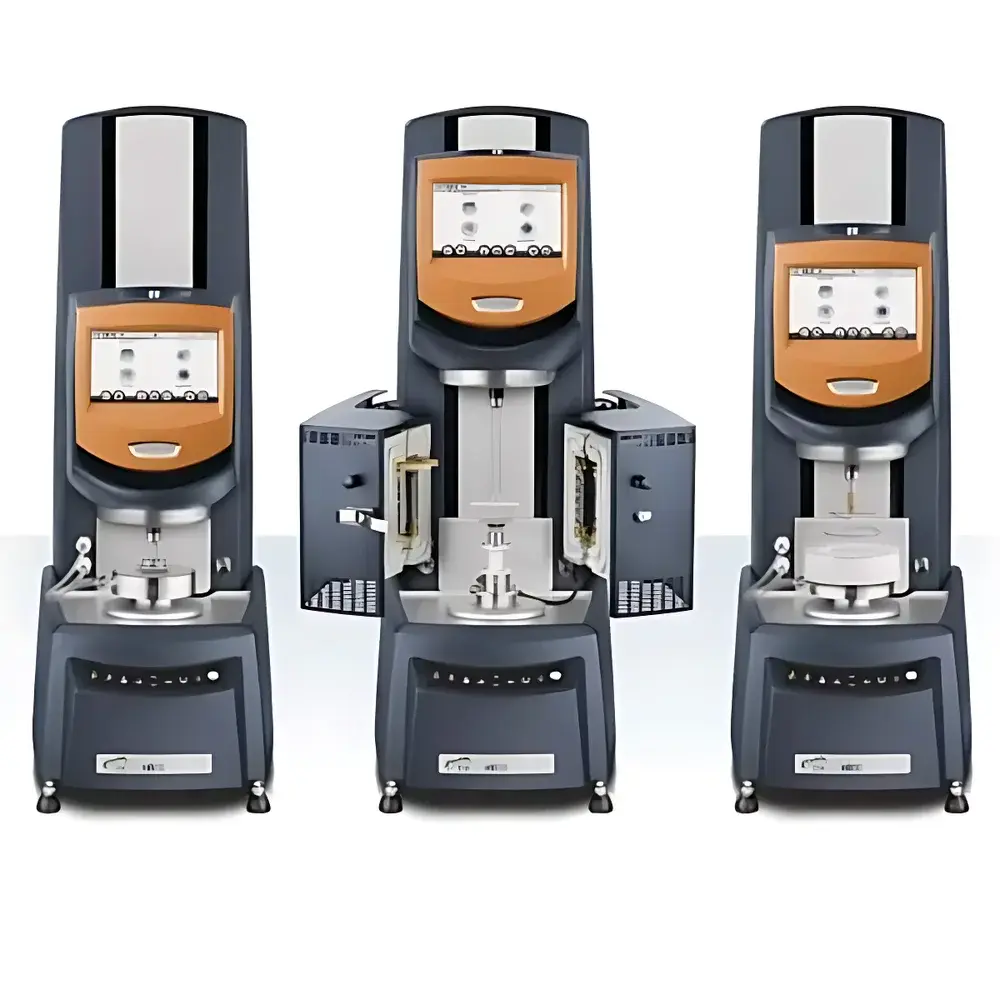
TA Instruments Discovery Hybrid Rheometer HR 20
| Brand | TA Instruments |
|---|---|
| Origin | USA |
| Manufacturer Type | Authorized Distributor |
| Product Category | Imported Instrument |
| Model | Discovery Hybrid Rheometer HR 20 |
| Instrument Type | Rotational Rheometer |
| Thrust Bearing | Magnetic Levitation Thrust Bearing |
| Temperature Range | −40 to 200 °C |
| Frequency Range | 1.0 × 10⁻⁷ to 100 Hz |
| Minimum Angular Velocity | 0 rad/s |
| Maximum Torque | 200 mN·m |
| Maximum Angular Velocity | 300 rad/s |
| Torque Resolution | 0.1 nN·m |
Overview
The TA Instruments Discovery Hybrid Rheometer HR 20 is an advanced rotational rheometer engineered for high-fidelity viscoelastic characterization of complex fluids and soft solids under precisely controlled thermal and mechanical conditions. Built upon a hybrid air-bearing/magnetic levitation architecture, it combines the stability of a true air-bearing system with the ultra-low friction and zero mechanical wear of magnetic levitation thrust support—enabling true zero-torque baseline operation and exceptional sensitivity across both steady shear and dynamic oscillatory modes. The instrument operates on the principle of controlled stress or strain imposition in Couette, parallel-plate, cone-and-plate, or custom geometries, measuring the resulting torque and angular displacement to compute fundamental rheological functions: storage modulus (G′), loss modulus (G″), complex viscosity (η*), yield stress, thixotropy, and time-dependent relaxation spectra. Its design targets laboratories requiring traceable, reproducible data for R&D, quality control, and regulatory submissions—particularly where low-torque sensitivity, wide frequency coverage, and broad thermal operability are critical.
Key Features
- Hybrid Air-Bearing + Magnetic Levitation Thrust Bearing: Eliminates mechanical contact in the axial direction, delivering sub-nN·m torque resolution and long-term calibration stability without bearing degradation.
- Extended Dynamic Range: Covers torque from 0.1 nN·m to 200 mN·m (12 orders of magnitude) and angular velocity from static (0 rad/s) to 300 rad/s (~2865 rpm), supporting both ultra-weak gel networks and highly filled suspensions.
- Broad Thermal Capability: Integrated Peltier and liquid-circulation temperature control enables precise regulation from −40 °C to 200 °C, compatible with cryogenic accessories and high-temperature convection ovens.
- Ultra-Wide Frequency Sweep: Validated dynamic testing from 1.0 × 10⁻⁷ Hz (11.6 days per cycle) to 100 Hz, facilitating full linear viscoelastic region (LVER) mapping and multi-decade relaxation spectrum reconstruction.
- Modular Geometry Support: Accepts standard and custom tooling—including solvent-trap plates, serrated cones, vane spindles, and extensional fixtures—ensuring representative measurement for heterogeneous, particulate-laden, or wall-slipping samples.
- Real-Time Strain Control (RTC): Closed-loop strain actuation ensures accurate deformation history during transient tests such as creep, recovery, and large-amplitude oscillatory shear (LAOS), independent of sample compliance.
Sample Compatibility & Compliance
The HR 20 accommodates diverse sample classes: polymer melts and solutions, pharmaceutical gels and suspensions, food emulsions and pastes, battery slurries, cosmetic formulations, and cementitious systems. Its geometry flexibility and low-torque sensitivity minimize wall slip and edge fracture artifacts common in structured materials. The system complies with ASTM D4402 (viscosity of asphalt binders), ISO 6721-10 (dynamic mechanical properties), and USP (rheological characterization of semisolid dosage forms). When configured with audit-trail-enabled software and electronic signatures, it supports GLP and GMP environments aligned with FDA 21 CFR Part 11 requirements for data integrity and traceability.
Software & Data Management
TRIOS™ software provides intuitive workflow-driven experiment design, real-time data visualization, and automated reporting templates compliant with laboratory information management systems (LIMS). It includes built-in modules for time–temperature superposition (TTS), Cox–Merz equivalence validation, LAOS Fourier transform analysis (FT-LAOS), and model fitting (e.g., Maxwell, Kelvin–Voigt, Burgers). All raw sensor data—including torque, angle, temperature, and normal force—is recorded at ≥1 kHz sampling rate with hardware timestamping. Data files are stored in open HDF5 format, enabling third-party analysis via Python, MATLAB, or R. Full audit trail logs capture user actions, parameter changes, calibration events, and instrument status—essential for regulatory audits and method validation documentation.
Applications
- Characterization of temperature-dependent gelation kinetics in thermoresponsive hydrogels
- Yield stress quantification and flow curve modeling of non-Newtonian industrial coatings
- Linear and nonlinear viscoelastic analysis of polymer melts prior to extrusion processing
- Stability assessment of oil-in-water emulsions under thermal cycling and shear history
- Quality-by-Design (QbD) development of topical drug delivery vehicles
- Relaxation spectrum extraction for predictive modeling of long-term creep behavior in elastomers
- Thixotropic loop analysis and structural recovery kinetics in lithium-ion battery cathode slurries
FAQ
What distinguishes the HR 20’s hybrid bearing system from conventional air bearings?
The magnetic levitation thrust bearing eliminates axial mechanical contact entirely, removing stiction and hysteresis inherent in traditional air bearings—resulting in superior zero-torque fidelity and extended calibration intervals.
Can the HR 20 perform extensional rheology?
Yes—when equipped with the optional Extensional Viscosity Fixture (EVF), it supports uniaxial extensional measurements up to Hencky strain rates of 0.1 s⁻¹ using filament stretching rheometry (FSR) protocols.
Is temperature calibration traceable to NIST standards?
All temperature modules include factory calibration certificates traceable to NIST, and optional on-site verification kits allow user-performed interval checks per ISO/IEC 17025 guidelines.
How is data security ensured in regulated environments?
TRIOS supports role-based access control, electronic signatures, and immutable audit trails—fully configurable to meet ALCOA+ principles (Attributable, Legible, Contemporaneous, Original, Accurate, Complete, Consistent, Enduring, Available) for FDA and EMA submissions.
What maintenance is required for the magnetic levitation system?
None—unlike mechanical bearings, the magnetic levitation system has no consumable parts, requires no lubrication, and is not subject to wear under normal operating conditions.



