
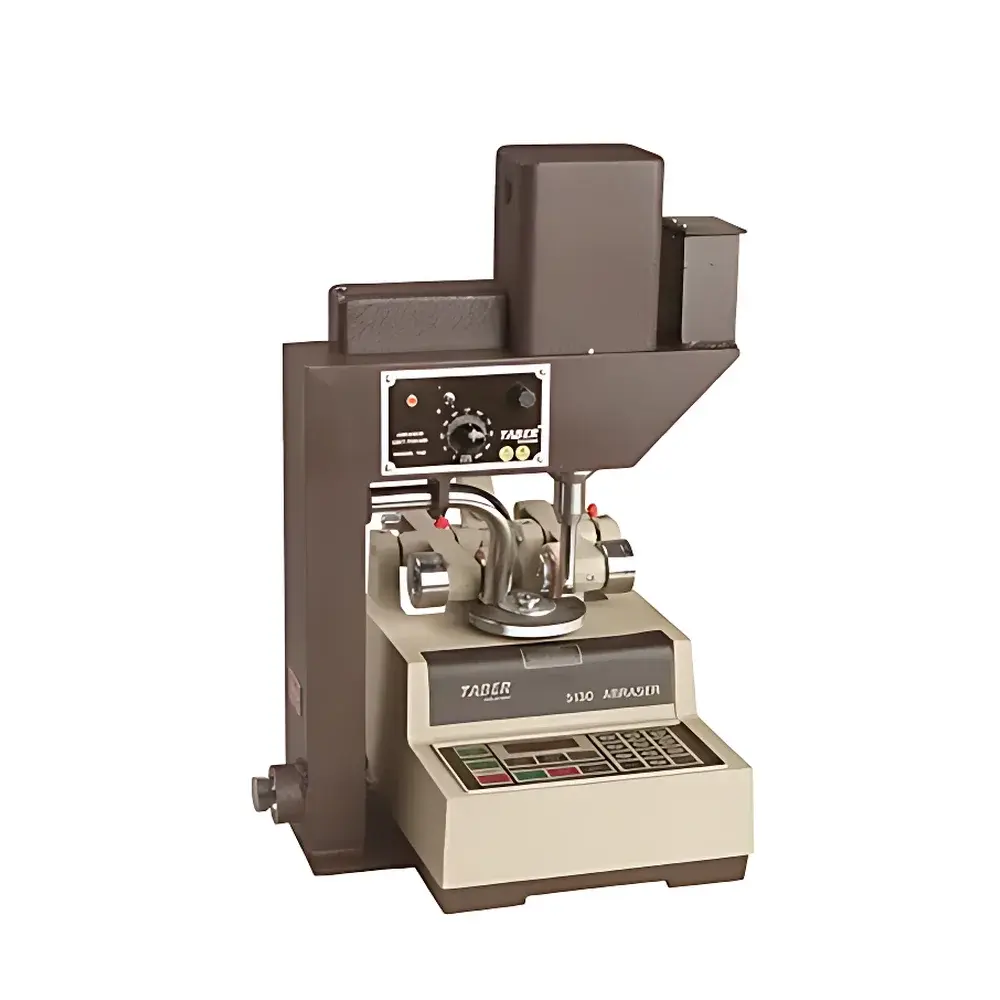
Taber Grit Feeder-255 Abrasive Flow Control System
| Brand | Taber Instruments (USA) |
|---|---|
| Origin | USA |
| Model | Grit Feeder-255 |
| Abrasive Capacity | 4500 g |
| Mounting Flexibility | Left- or Right-Side Installation |
| Adjustable Nozzle Height | Up to +40 mm via Cantilever Extension Kit |
| Compatible Testers | Taber Rotary Wear Testers (Model 5135, 5155) |
| Standard Abrasive | Taber S-41 #240 Aluminum Oxide |
| Calibration Reference | Taber S-38 Standard Calibration Plate |
| Compliance | EN 14354, ISO 24338 Method B (with Alodur ESK 240) |
| Dust Extraction Interface | Integrated vacuum port for synchronization with tester’s vacuum system |
Overview
The Taber Grit Feeder-255 is an engineered abrasive delivery subsystem designed exclusively for integration with Taber rotary wear testers—specifically the Model 5135 and dual-station Model 5155. It implements a controlled, gravity-fed abrasive flow mechanism to simulate three-dimensional abrasive wear induced by discrete particulate media under dynamic rotational conditions. Unlike standalone abrasion testers, the Grit Feeder-255 does not perform mechanical wear directly; rather, it ensures precise, repeatable introduction of standardized abrasive particles onto the test specimen surface during rotation. Its operational principle relies on calibrated gravitational discharge through an adjustable nozzle positioned immediately upstream of the rotating abrading wheel (e.g., S-39 leather wheel), enabling particle adhesion to the wheel surface and subsequent rolling/sliding contact with the specimen. This configuration replicates real-world degradation mechanisms observed in flooring, coated substrates, and architectural surfaces subjected to grit-laden foot traffic or environmental particulates. The system operates in strict synchrony with the host tester’s motor and vacuum subsystem—ensuring simultaneous start/stop of rotation, abrasive feed, and debris evacuation.
Key Features
- 4500 g high-capacity abrasive reservoir with precision-machined alignment module for repeatable positioning relative to the abrading wheel axis
- Manually adjustable nozzle height (+40 mm maximum extension via optional cantilever kit), accommodating specimens up to 25 mm thick without compromising abrasive trajectory integrity
- Bilateral mounting capability—configurable on either left or right side of Taber 5135/5155 testers, enabling dual-feed operation when paired with a second Grit Feeder unit on the Model 5155
- Integrated vacuum interface at the base of the grit fill port, synchronized with the tester’s vacuum pump to remove excess abrasive and wear debris in real time
- Tool-free, screw-based mechanical registration ensuring sub-millimeter positional repeatability across test campaigns
- Designed for use with Taber-certified S-41 #240 aluminum oxide abrasive—a proprietary formulation with tightly controlled particle size distribution (PSD) and bulk density to ensure inter-laboratory reproducibility
Sample Compatibility & Compliance
The Grit Feeder-255 supports flat, rigid, or semi-rigid planar specimens (typically 100–110 mm diameter, thickness ≤25 mm) mounted on standard Taber test plates. It is validated for use with leather (S-39), rubber (CS-10), and textile abrading wheels per ASTM D4060 and ISO 5470-1. For regulatory compliance, the system meets requirements of EN 14354 (resilient floor coverings) and ISO 24338 Method B when operated with Alodur ESK 240 abrasive—requiring pre-sieving through an 80-mesh sieve and conditioning at 82 °C for 60 minutes followed by controlled cooling in a temperature- and humidity-stabilized environment (23 °C ±2 °C, 50% RH ±5%). All abrasive handling procedures align with GLP documentation standards, including traceable calibration using the Taber S-38 reference plate for volumetric flow rate verification.
Software & Data Management
While the Grit Feeder-255 itself contains no embedded electronics or firmware, its operation is fully coordinated with Taber’s proprietary test control software (v5.2+). The software enables synchronized triggering of rotation, vacuum activation, and abrasive dispensing initiation—eliminating manual timing dependencies. Audit trails log cycle count, elapsed time, and operator ID per test sequence in accordance with FDA 21 CFR Part 11-compliant data integrity protocols. Raw mass loss, thickness measurements, and calculated Taber Wear Index (TWI = mg loss per 1000 cycles) are exportable in CSV and PDF formats. Optional integration with LIMS platforms supports automated result ingestion and cross-test statistical analysis (ANOVA, coefficient of variation).
Applications
The system is routinely deployed in QC laboratories for evaluating wear resistance of resilient floor coverings (vinyl, linoleum, rubber), decorative laminates, powder-coated metals, automotive interior trim, and protective coatings on wood composites. Its ability to deliver consistent abrasive loading enables comparative ranking of material formulations under identical kinematic conditions. In R&D settings, it supports accelerated life-cycle modeling—correlating TWI values with field performance data from pedestrian traffic studies. Dual-feed configurations on the Model 5155 allow parallel evaluation of two distinct abrasive types or specimen batches, reducing inter-test variability and improving throughput efficiency.
FAQ
What abrasive is required for routine operation?
Taber S-41 #240 aluminum oxide is the factory-specified abrasive. Substitution with generic #240 Al₂O₃ is not recommended due to uncontrolled PSD and density variance affecting flow rate and wear kinetics.
Can the Grit Feeder-255 be used without a Taber rotary tester?
No. It lacks independent drive, vacuum, or control logic—it functions solely as a synchronized peripheral to Taber Models 5135 or 5155.
How often must the vacuum filter be serviced?
Inspect after every 10 test cycles; clean or replace if >70% clogged, as indicated by reduced suction pressure or visible abrasive accumulation in the collection belt.
Is calibration traceable to NIST standards?
Yes—mass loss measurements require NIST-traceable analytical balances (±0.1 mg resolution); abrasive flow calibration uses the S-38 plate certified against ISO 17025-accredited reference materials.
Does the system support ISO 24338 Method A?
No. Method A specifies pneumatic abrasive delivery; the Grit Feeder-255 implements gravity-fed flow per Method B only.





