
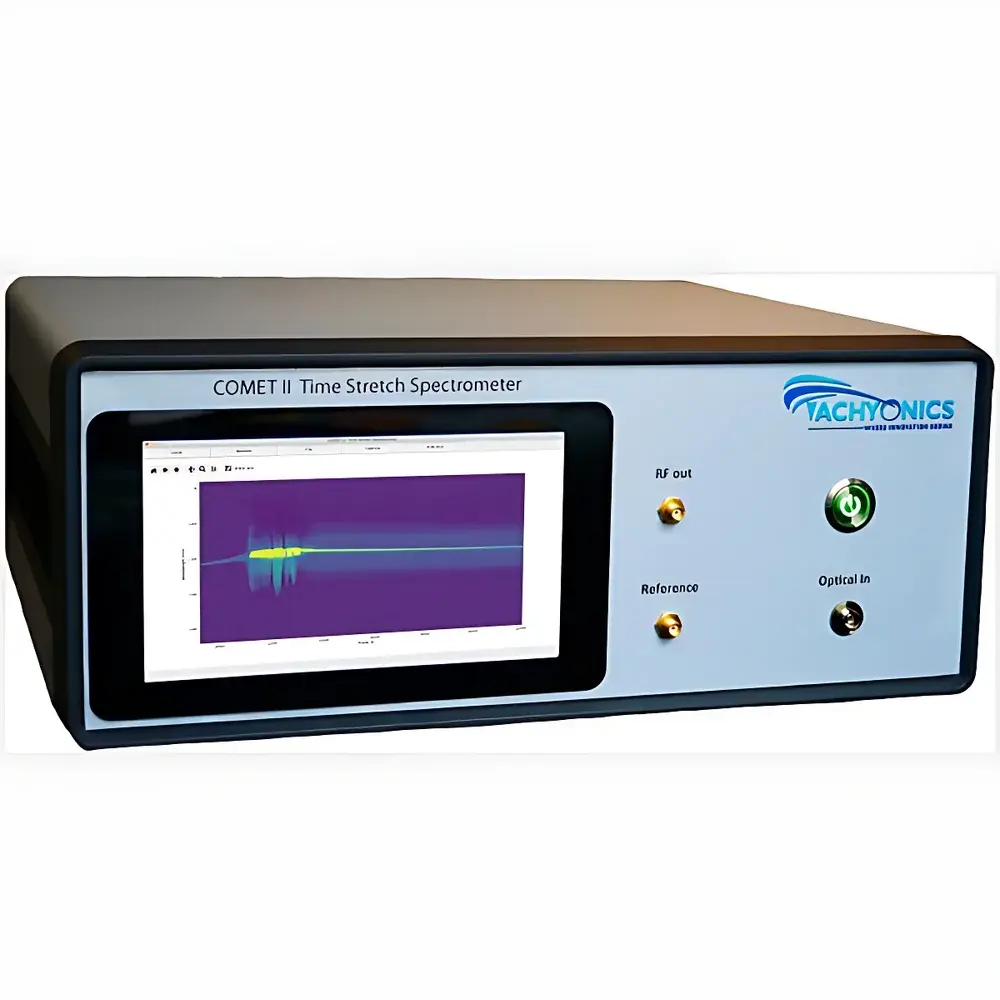
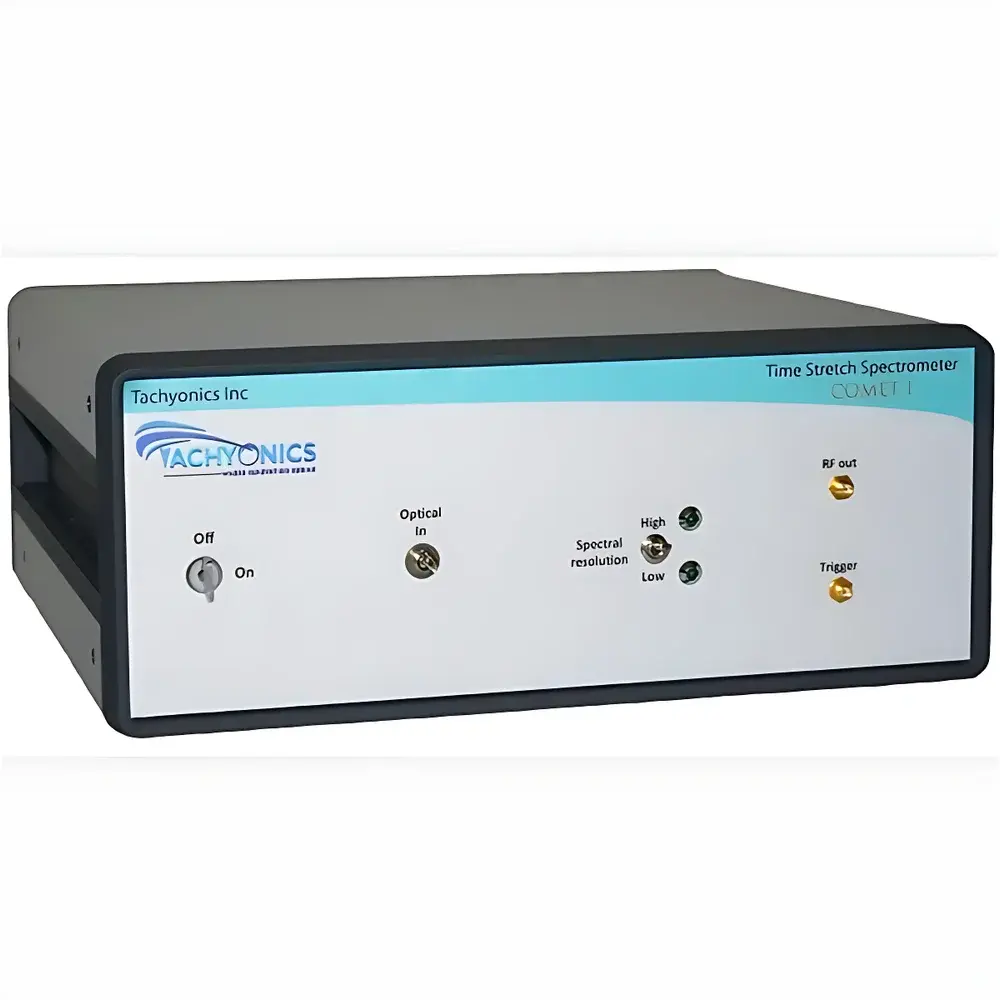
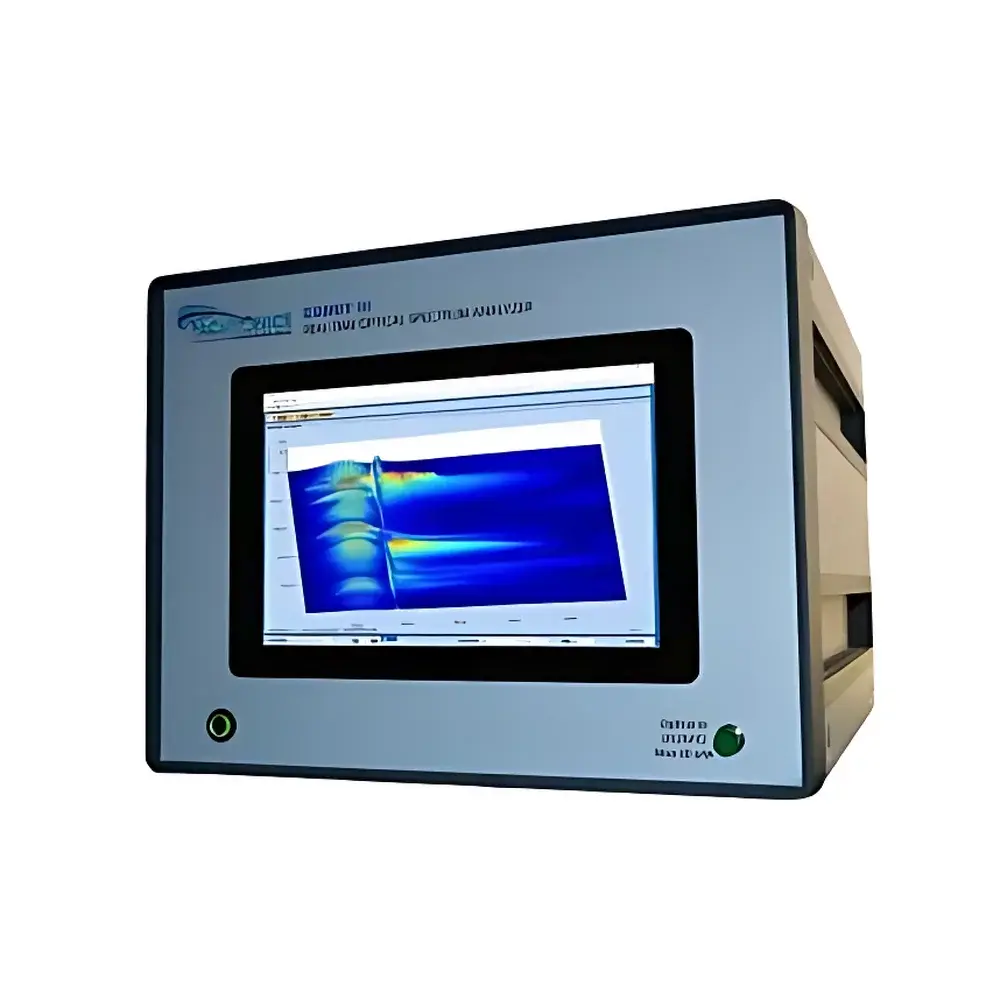
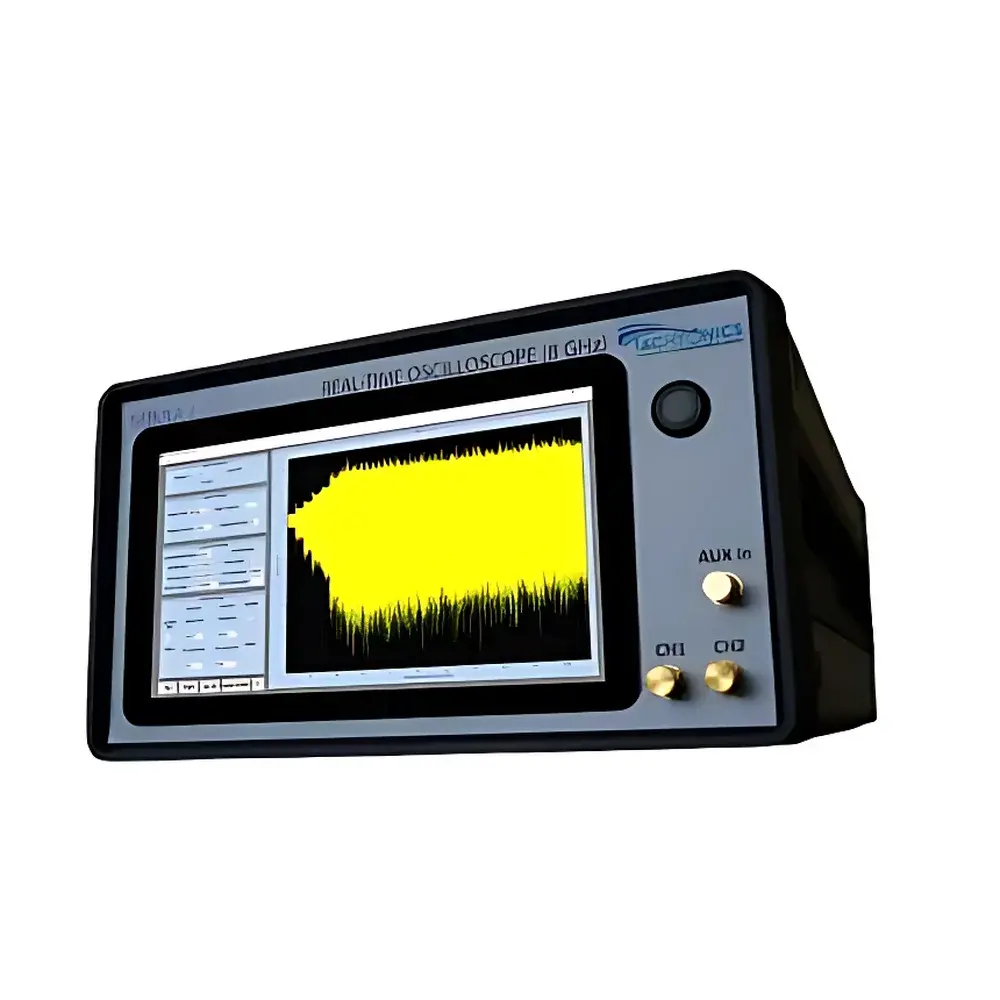
Tachyonics COMET I / COMET II / COMET III / Nebula I Time-Stretch Ultrafast Spectrometers and High-Speed Oscilloscopes
| Brand | Tachyonics |
|---|---|
| Origin | USA |
| Model(s) | COMET I, COMET II, COMET III, Nebula I |
| Spectral Range | 650–1000 nm & 1000–1650 nm |
| Detector Type | Photonic time-stretch + high-speed digitizer |
| Spectral Resolution | >10 pm (2 configurable options for COMET I |
| Temporal Resolution | >15 fs |
| Sensitivity | down to 50 µW (max input power: 10 mW) |
| Single-Shot Temporal Window | <300 ps |
| Time-Bandwidth Product (TBWP) | <20,000 (2 or 7 selectable configurations) |
| Input Fiber | SMF-28, FC/APC |
| Intensity Accuracy | ±3% |
| Power Supply | 90–270 VAC, 50/60 Hz |
| Dimensions & Weight | COMET I: 14.33" × 5.79" × 13.03", 10 lbs |
| COMET II | same footprint, 15 lbs |
| COMET III | 14.33" × 11.04" × 15.39", 20 lbs |
| Integrated Hardware | COMET II — embedded PC + 7" HD touchscreen + 5G Wi-Fi hotspot |
Overview
The Tachyonics COMET Series represents the state-of-the-art in single-shot, real-time ultrafast spectroscopy based on photonic time-stretch (PTS) architecture. Unlike conventional scanning or dispersive spectrometers—whose acquisition speed is fundamentally limited by mechanical or electronic dwell times—the COMET instruments encode spectral information onto a temporally stretched optical waveform, which is then digitized at high bandwidth using GHz-class oscilloscopes or integrated digitizers. This enables true single-event capture of non-repetitive, stochastic, or rare optical transients with frame rates up to 1 billion frames per second (1 GHz), surpassing the speed of the next fastest commercial spectrometer by three orders of magnitude. The system operates without any moving parts or wavelength scanning, delivering absolute wavelength calibration across its full operational range (650–1000 nm and 1000–1650 nm). Its design leverages over a decade of proprietary PTS engineering, incorporating low-noise broadband amplifiers, dispersion-engineered chirped fiber Bragg gratings, and high-fidelity balanced photodetection to preserve signal fidelity while achieving >15 fs temporal resolution and >10 pm spectral resolution. Each variant—COMET I, COMET II, and COMET III—is engineered for precision, reproducibility, and scalability in demanding research environments including nonlinear optics, ultrafast photonics, and statistical light-field analysis.
Key Features
- True single-shot, scan-free spectral acquisition at up to 1 GHz frame rate—no averaging or repetition required
- Real-time absolute wavelength calibration across dual spectral bands (650–1000 nm and 1000–1650 nm)
- Selectable spectral resolution: 2 configurations for COMET I; 7 user-selectable resolutions (including custom min/max) for COMET II and COMET III
- Configurable time-bandwidth product (TBWP) up to <20,000, enabling optimization for either high temporal resolution or broad spectral coverage
- Input polarization insensitivity and compatibility with standard SMF-28 fiber (FC/APC interface)
- Integrated real-time power monitoring with on-screen indicator (COMET II/III) to prevent detector saturation
- COMET II adds embedded computing, 7-inch HD capacitive touchscreen, and 5G Wi-Fi hotspot for cloud-offload and remote multi-instrument synchronization
- COMET III integrates a dual-channel 8 GHz real-time oscilloscope (10 GS/s, 8-bit), fully functional as a standalone instrument, alongside an Intel Core i9 workstation (64 GB RAM, 1 TB NVMe SSD)
- Nebula I provides a cost-optimized, high-fidelity 2-channel oscilloscope platform (up to 9 GHz BW, 20 GS/s, 1 Gpts/channel) with identical compute architecture
Sample Compatibility & Compliance
The COMET Series accepts free-space-coupled or fiber-pigtailed inputs via FC/APC connectors, supporting both continuous-wave and pulsed sources—including mode-locked lasers, Q-switched systems, supercontinuum generators, and photonic integrated circuits. Its polarization-insensitive front-end eliminates alignment sensitivity during setup. All models comply with IEC 61000-6-3 (EMI emission) and IEC 61000-6-2 (immunity) standards. The embedded software architecture supports audit-trail logging and user-access controls aligned with GLP and GMP documentation requirements. While not FDA-cleared as a medical device, COMET systems are routinely deployed in preclinical OCT and ultrafast biomedical imaging labs where traceability, metadata-rich acquisition, and raw data export (HDF5, MAT, CSV) are essential for regulatory submission preparation. Firmware and software updates follow ISO/IEC 17025-aligned version control and validation protocols.
Software & Data Management
The COMET software suite—developed in C++ with CUDA-accelerated signal processing kernels—enables real-time streaming, post-acquisition reconstruction, and statistical analysis of terabyte-scale spectral datasets. It implements parallelized inverse time-stretch algorithms to recover absolute spectra from stretched waveforms, including dispersion compensation, phase correction, and background subtraction. Users can apply custom mathematical operations (e.g., time-resolved PCA, wavelet denoising, intensity correlation mapping) directly within the GUI or via Python API (PyCOMET). Data export conforms to FAIR principles: all metadata—including laser parameters, digitizer settings, dispersion map, and calibration coefficients—are embedded in HDF5 files. The COMET II/III hotspot functionality enables secure TLS-encrypted upload to private cloud storage or HPC clusters for distributed batch processing. Remote operation is supported via SSH, RESTful API, or VNC-over-WiFi—fully compatible with LabVIEW, MATLAB, and Python-based automation frameworks.
Applications
- Non-repetitive dynamics in mode-locked lasers: soliton explosions, harmonic mode-locking transitions, and Q-switched instabilities
- Optical rogue wave generation and statistical characterization in microresonators and fiber cavities
- Modulation instability evolution in highly nonlinear fibers and integrated waveguides
- Real-time spectral interferometry for ultrafast pulse shaping and feedback control
- Time-resolved photoluminescence and carrier dynamics in 2D materials and perovskites
- Broadband RF photonics: microwave photonics spectrum analysis and analog-to-digital conversion beyond Nyquist limits
- High-speed optical coherence tomography (OCT) with single-shot axial scans
- Laser vibrometry and time-of-flight LIDAR with sub-picosecond timing resolution
- Ultrafast bioimaging: fluorescence lifetime mapping, stimulated Raman scattering (SRS) kinetics, and transient absorption spectroscopy
FAQ
What distinguishes time-stretch spectroscopy from conventional Fourier-transform or grating-based methods?
Time-stretch spectroscopy maps wavelength to time via chromatic dispersion before high-speed digitization—enabling single-shot capture of non-repetitive events without scanning. Conventional methods require ensemble averaging or mechanical tuning, limiting them to quasi-stationary signals.
Can COMET instruments measure absolute wavelength without external calibration sources?
Yes. Each COMET system performs factory calibration using NIST-traceable broadband references and embeds a dispersion map in firmware, enabling real-time absolute wavelength assignment across its full spectral range.
Is the COMET III’s integrated oscilloscope usable independently of the spectrometer function?
Yes. The dual-channel 8 GHz oscilloscope operates as a standalone instrument with full trigger, acquisition, and analysis capabilities via its native UI or SCPI command set.
What data formats are supported for export and third-party analysis?
HDF5 (with embedded metadata), MATLAB .mat, CSV, and binary raw traces—all accessible programmatically via Python, MATLAB, or LabVIEW APIs.
Does the system support synchronization with external lasers or delay stages?
Yes. All models provide SMA-trigger I/O (TTL-compatible), programmable delay (100 ps resolution), and IEEE-488 (GPIB) or Ethernet-based synchronization for multi-instrument experiments.




