
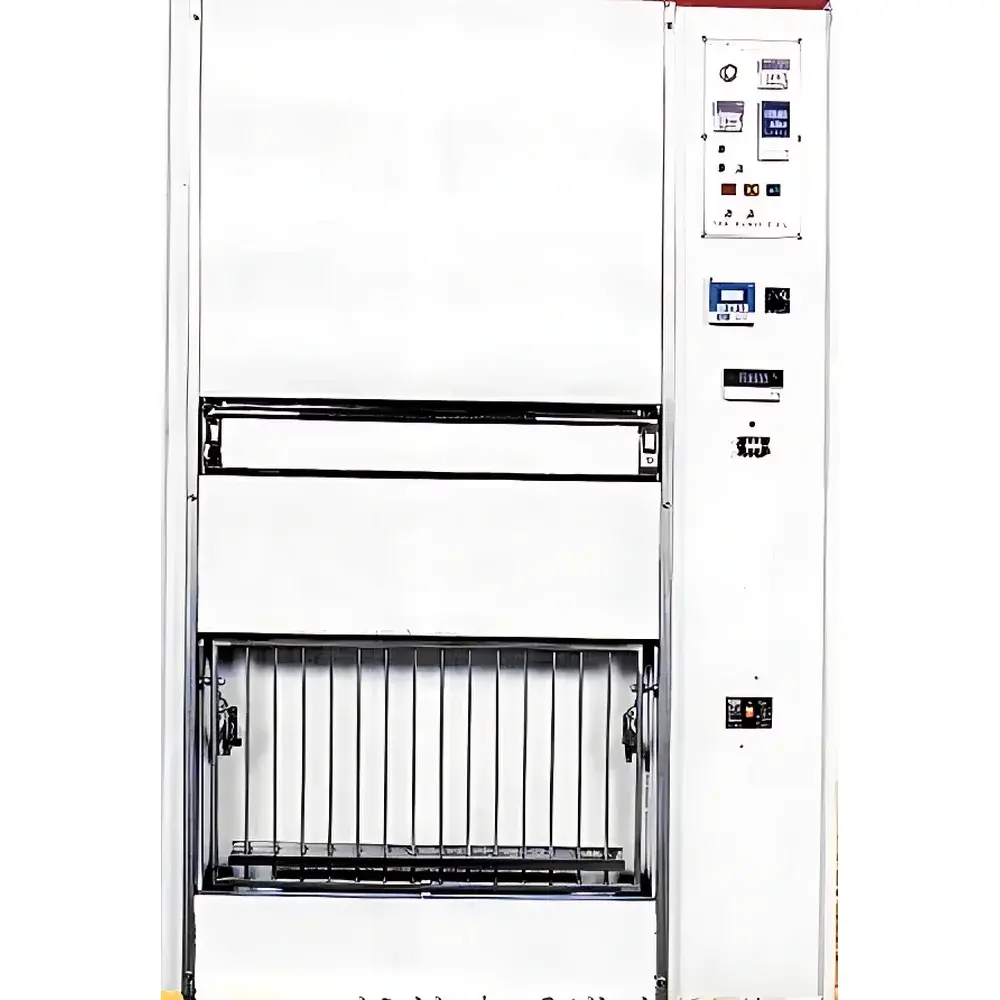
Taecheng TSA Pop-Up High-Temperature Drying Oven
| Brand | Taecheng |
|---|---|
| Origin | South Korea |
| Model | TSA-101 / TSA-102 / TSA-103 |
| Temperature Range | 0–540 °C |
| Temperature Uniformity | ±1.0 °C (at setpoint) |
| Temperature Stability | ±1.0 °C |
| Internal Chamber Dimensions | 200 × 200 × 200 cm |
| External Dimensions | 300 × 300 × 300 cm |
| Operating Ambient Temperature | 15–60 °C |
| Heating Power | 6.3 kW (9 × 0.7 kW heating plates) |
| Total Electrical Capacity | 7.85 kW |
| Power Supply | 3-phase, 220 V or 380 V |
| Airflow Rate | 25 m³/min |
| Adjustable Air Velocity | 1–5 m/s (standard operating velocity: 3 m/s) |
| Chamber Liner Material | SUS 316 stainless steel (1.5 mm thickness) |
| Sample Tray | 1 × SUS 304 tray with electric vertical lift mechanism |
| Safety Systems | Dual-stage overtemperature protection (digital controller + independent safety limiter), explosion-relief safety door with automatic power cutoff, intrinsically safe blower motor (1.5 kW inverter-driven, flameproof), ceramic fiber insulation (HEAT-LAB certified), sample surface temperature monitoring probe, motor thermal relay, tray locking mechanism, ambient air intake damper, audible alarm for fault conditions |
| Weight | ~600 kg |
| Mobility | Four swivel casters with locking brakes |
Overview
The Taecheng TSA Pop-Up High-Temperature Drying Oven is an industrial-grade thermal processing system engineered for precise, repeatable, and safe high-temperature drying, curing, aging, and preheating applications in R&D laboratories, quality control facilities, and pilot-scale manufacturing environments. Designed around a vertical pop-up chamber architecture, the oven integrates advanced thermal management principles—including forced convection via dual-stage SUS 304 centrifugal blowers, high-efficiency ceramic fiber insulation (certified to HEAT-LAB standards), and multi-point thermal stability control—to maintain uniform temperature distribution across its 200 × 200 × 200 cm internal workspace. Its operational range spans 0–540 °C, with a guaranteed temperature uniformity of ±1.0 °C at any setpoint within that range—validated per ISO 17025-compliant thermal mapping protocols using nine-point thermocouple arrays on standardized 200 × 300 mm reference plates. The system complies with IEC 61000-6-2 (EMC immunity) and IEC 61000-6-4 (EMC emission) standards, and its safety architecture aligns with EN 60519-1 (safety requirements for industrial electroheating equipment).
Key Features
- Vertical Pop-Up Chamber Design: Enables rapid, operator-safe access to samples without lateral obstruction; top-hinged door opens upward with mechanical counterbalance and integrated explosion-relief functionality.
- Dual Independent Temperature Control System: Primary digital PID controller (0–399 °C range) for process temperature, backed by a fully isolated secondary safety limiter (also 0–399 °C) with independent sensor input and automatic power cutoff upon deviation.
- High-Performance Forced Convection: 25 m³/min airflow generated by a 1.5 kW flameproof inverter-driven blower (SUS 304 construction); adjustable air velocity (1–5 m/s) ensures optimal heat transfer for diverse sample geometries and thermal mass profiles.
- Ceramic Fiber Insulation System: Full-chamber lining with low-conductivity, high-temperature ceramic fiber (rated to 1260 °C), minimizing thermal lag and external surface temperature rise—verified to remain <45 °C at ambient 25 °C per EN 60519-1 Clause 10.3.
- Electrically Actuated Sample Tray: Single SUS 304 tray with programmable vertical lift mechanism (±10 mm positioning resolution), enabling reproducible loading/unloading and compatibility with automated material handling interfaces.
- Comprehensive Safety Integration: Includes motor thermal overload relay, sample surface temperature monitoring probe, ambient air intake damper with manual calibration, acoustic fault alarm, and mechanically interlocked safety door that severs all power upon forced opening.
Sample Compatibility & Compliance
The TSA series accommodates samples up to 250 × 330 mm footprint and is routinely deployed for thermal validation of aerospace composites, battery electrode drying, catalyst calcination, metallurgical sintering pre-treatment, and polymer crosslinking studies. Its SUS 316 stainless steel interior (1.5 mm gauge) resists oxidation and halide-induced corrosion up to 540 °C, supporting GLP-compliant documentation workflows. All electrical components meet UL 508A and CE marking requirements. The oven supports audit-ready operation under FDA 21 CFR Part 11 when paired with optional data logging software featuring electronic signatures, audit trails, and user-access-level permissions. Calibration certificates traceable to NIST standards are available upon request.
Software & Data Management
While the base model features standalone digital controllers (PID temperature regulator + 0–999.9 s timer, both with 0.1-unit resolution), optional RS-485 Modbus RTU or Ethernet/IP connectivity enables integration into centralized SCADA or LIMS platforms. Third-party compliant software packages support real-time graphing, automated report generation (PDF/CSV), deviation alerts via email/SMS, and full-cycle thermal profile archiving—including ramp/soak/hold sequences with timestamped event logs. Data integrity safeguards include write-protected storage, cyclic redundancy checks (CRC-16), and configurable backup intervals aligned with ISO/IEC 17025 clause 7.5.2.
Applications
- Accelerated thermal aging of polymeric encapsulants and conformal coatings (per ASTM D3045)
- Pre-sintering and binder burnout in powder metallurgy and ceramic green body processing
- Electrode drying for lithium-ion battery manufacturing (NMC, LFP, solid-state)
- Residual solvent removal from pharmaceutical granules (aligned with USP <1211>)
- Calibration and qualification of thermocouples, RTDs, and infrared sensors
- Thermal stress screening of PCB assemblies and automotive electronics (per JEDEC JESD22-A104)
FAQ
What is the maximum validated temperature uniformity across the chamber?
Temperature uniformity is ±1.0 °C at any stable setpoint between 50 °C and 540 °C, measured using nine calibrated Type K thermocouples on a 200 × 300 mm reference plate per ISO 17025 thermal mapping protocol.
Is the oven suitable for inert-atmosphere processing?
The standard configuration operates in ambient air; however, optional nitrogen purge ports (ISO-KF 25 flanges) and pressure-regulated gas inlet kits are available for controlled-atmosphere operation up to 0.5 bar gauge.
Can the system be integrated into a laboratory automation network?
Yes—via optional Modbus RTU (RS-485) or EtherNet/IP modules, supporting read/write access to setpoints, actual temperatures, timer status, alarm states, and event logs.
What maintenance intervals are recommended for the blower motor and heating elements?
Blower motor bearings require lubrication every 2,000 operational hours; heating plates should be visually inspected quarterly for discoloration or warping and electrically tested annually for insulation resistance (>1 MΩ @ 500 V DC).
Does the oven comply with GMP/GLP documentation requirements?
When equipped with the optional data logger and audit-trail-enabled software, the system meets ALCOA+ data integrity principles and supports 21 CFR Part 11 compliance through role-based access control, electronic signatures, and immutable record retention.



