
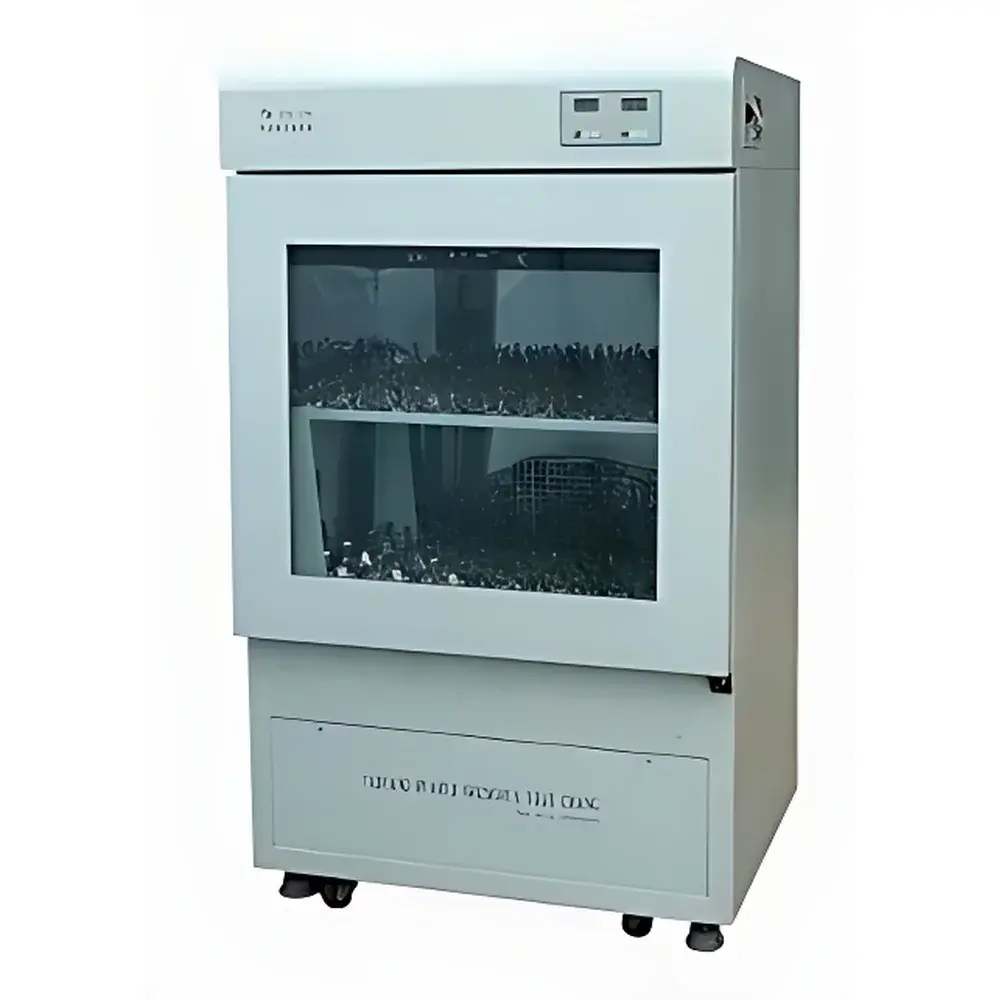
Taicang Jiangsu HZQ-X160 Dual-Layer Temperature-Controlled Orbital Shaker Incubator
| Origin | Jiangsu, China |
|---|---|
| Manufacturer Type | Authorized Distributor |
| Product Category | Domestic |
| Model | HZQ-X160 |
| Price | USD 2,200 (FOB) |
| Instrument Type | Air-Jacketed Temperature-Controlled Orbital Shaker |
| Timer Range | 0–999 min |
| Oscillation Frequency | 40–280 rpm |
| Orbit Diameter | 26 mm |
| Temperature Range | Ambient +5°C to 60°C |
| Temperature Accuracy | ±0.1°C |
| Temperature Uniformity | ±0.5°C |
| Tray Dimensions | 520 × 360 mm (per layer) |
| Capacity per Layer | 8 × 500 mL flasks or 12 × 250 mL flasks (spring mesh tray standard) |
| Display | LED digital interface |
| Power Input | 220 V, 50 Hz, 700 W |
| Overall Dimensions (W×D×H) | 600 × 620 × 1300 mm |
| Net Weight | 100 kg |
| Illumination | 8 W LED interior light |
| Cabinet Structure | Dual-layer vertical stainless-steel insulated chamber with reinforced support frame |
Overview
The Taicang Jiangsu HZQ-X160 Dual-Layer Temperature-Controlled Orbital Shaker Incubator is an engineered platform for simultaneous cultivation and agitation of biological samples under precisely regulated thermal and mechanical conditions. Designed around a robust air-jacketed heating system and a brushless DC motor-driven orbital motion mechanism, the unit delivers stable temperature control across two independent horizontal shaker decks—enabling parallel experiments with identical or differentiated setpoints. Its operation adheres to the fundamental principles of orbital shaking: circular motion with fixed 26 mm orbit diameter generating uniform shear forces ideal for suspension cultures, microbial growth, protein expression, and cell-based assays. Unlike water-bath shakers, the air-jacketed architecture ensures rapid thermal equilibration, reduced contamination risk, and compatibility with non-submersible vessels—including Erlenmeyer flasks, culture bottles, and multi-well plates mounted on universal spring trays.
Key Features
- Dual-layer vertical configuration with independently accessible upper and lower chambers—each equipped with identical oscillation and temperature control systems.
- Precision air-jacketed heating system maintaining ±0.1°C temperature accuracy and ±0.5°C uniformity across both layers within the operational range (ambient +5°C to 60°C).
- Brushless DC motor delivering smooth, low-vibration orbital motion at adjustable frequencies from 40 to 280 rpm—optimized for reproducible oxygen transfer and mixing efficiency in aerobic cultures.
- Standard 520 × 360 mm stainless-steel spring mesh trays per layer; compatible with common vessel configurations including 8 × 500 mL or 12 × 250 mL Erlenmeyer flasks.
- LED digital controller with intuitive keypad interface supporting timer programming (0–999 minutes), real-time display of setpoint/actual temperature and rpm, and automatic shutdown upon cycle completion.
- Integrated 8 W LED interior lighting for visual monitoring without opening doors—minimizing thermal disturbance and cross-contamination risk.
- Structural integrity ensured by 1.2 mm cold-rolled steel outer casing, 304 stainless-steel inner chamber, and high-density polyurethane insulation (≥40 mm thickness).
Sample Compatibility & Compliance
The HZQ-X160 accommodates standard microbiological, biochemical, and cell culture formats, including glass and polycarbonate flasks (up to 1 L), screw-cap tubes, and stackable culture vessels. Its dual-layer design supports comparative studies—for instance, dose-response assays across temperature gradients or parallel strain propagation under identical agitation profiles. The unit complies with general laboratory safety standards (IEC 61010-1) and incorporates overtemperature protection, motor overload cutoff, and door-open interlock mechanisms. While not certified for ISO 13485 or FDA 21 CFR Part 11 out-of-the-box, its digital logging capability (via optional RS-485 or USB interface) enables integration into GLP/GMP workflows when paired with validated third-party data acquisition software. It meets typical requirements for ASTM D2577 (microbial growth kinetics), USP (microbiological enumeration), and ISO 8573-1 (compressed air purity testing sample preparation).
Software & Data Management
The HZQ-X160 operates via embedded firmware with local parameter storage (up to 10 user-defined protocols). For advanced data traceability, optional communication modules enable connection to PC-based platforms using Modbus RTU or ASCII protocol. When interfaced with compliant laboratory information management systems (LIMS) or electronic lab notebooks (ELN), the device supports time-stamped event logging—including start/stop timestamps, temperature deviation alerts, and runtime statistics. Audit trail functionality (user ID, parameter changes, session duration) can be implemented through external middleware compliant with 21 CFR Part 11 Annex 11 requirements. No proprietary cloud service is included; all data remains under institutional control.
Applications
- Microbial fermentation and bioprocess development requiring scalable agitation and thermal consistency.
- Recombinant protein expression in E. coli, yeast, or mammalian suspension cells.
- Antibiotic susceptibility testing and MIC determination under controlled aeration.
- Enzyme activity assays where reaction kinetics depend on consistent mixing and temperature stability.
- Seed stock expansion and cryopreservation prep involving serial dilution and subculturing.
- Environmental microbiology studies involving soil slurry enrichment or wastewater inoculum propagation.
- Teaching laboratories conducting standardized growth curve analysis across multiple student groups.
FAQ
Is the HZQ-X160 suitable for CO₂-sensitive applications?
No—this unit does not provide CO₂ regulation or humidification; it is intended for ambient-air aerobic cultures only.
Can the two layers operate at different temperatures or speeds?
No—the HZQ-X160 maintains synchronized temperature and oscillation parameters across both layers. For independent dual-zone control, consider the HYG-C series.
What is the maximum flask size supported per layer?
The standard tray accommodates up to eight 500 mL Erlenmeyer flasks; larger vessels (e.g., 1 L) require custom tray adaptation and may reduce total capacity.
Does the unit include validation documentation?
Factory calibration certificates for temperature and speed are available upon request; IQ/OQ documentation templates can be supplied for customer-executed qualification.
Is remote monitoring supported natively?
Not natively—remote access requires integration via optional serial-to-Ethernet gateways and third-party SCADA or LIMS platforms.



