
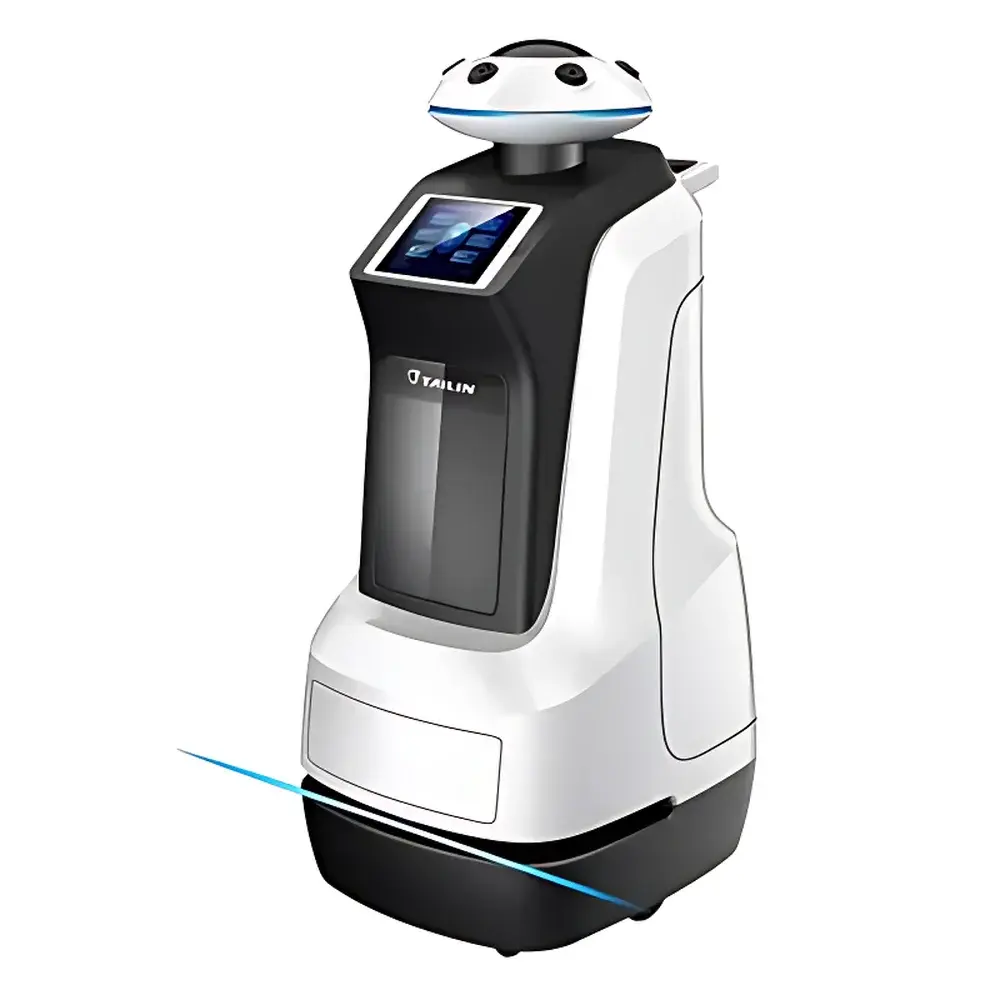
Tailin AGV-SD6 Autonomous Vaporized Hydrogen Peroxide (VHP) Sterilization Robot
| Brand | Tailin |
|---|---|
| Origin | Zhejiang, China |
| Manufacturer Type | OEM Manufacturer |
| Product Origin | Domestic (China) |
| Model | AGV-SD6 |
| Price Range | USD 14,000 – 70,000 |
| Hydrogen Peroxide Capacity | 1500 mL |
| Airflow Rate | 20 m³/h |
| Sterilization Volume | ~500 m³ |
| Vaporization Temperature | >100 °C |
| Relative Humidity Limit for Dehumidification | <85% RH |
| Filtration Efficiency | 99.99% (HEPA H14) |
| Sterilant | Hydrogen Peroxide (H₂O₂) |
| Log Reduction | ≥6-log (for Geobacillus stearothermophilus spores) |
| Dimensions (W×D×H) | 575 × 675 × 1370 mm |
| Weight | 90 kg |
| Power Supply | Rechargeable Lithium-ion Battery Pack |
| Continuous Runtime | ≥3 h |
| Control Interface | PLC + External Touchscreen PAD |
| Navigation System | SLAM-based Laser LiDAR Mapping & Path Planning |
Overview
The Tailin AGV-SD6 Autonomous Vaporized Hydrogen Peroxide (VHP) Sterilization Robot is an engineered solution for terminal sterilization of complex, multi-zone enclosed environments where conventional fixed-position VHP generators fail to ensure uniform agent distribution. Unlike static vaporizers reliant on passive diffusion or external air movers—introducing risks of cross-contamination and shadowed zones—the AGV-SD6 integrates dry-film VHP generation (VHPS®-compatible methodology) with simultaneous autonomous navigation. It operates on a validated vapor-phase hydrogen peroxide sterilization principle: liquid H₂O₂ is thermally vaporized above 100 °C into a true vapor (not aerosol), achieving rapid microbial inactivation through oxidative damage to proteins, lipids, and nucleic acids. Its mobility enables dynamic spatial coverage, ensuring consistent exposure across irregular geometries—including under benches, behind equipment, and within ceiling plenums—critical for ISO Class 5–8 cleanrooms, BSL-2/BSL-3 containment labs, and clinical isolation suites.
Key Features
- Autonomous SLAM-based navigation using 2D laser LiDAR for real-time environmental mapping, obstacle avoidance, and repeatable path execution without pre-installed infrastructure;
- Integrated high-efficiency vaporization module delivering stable, particle-free H₂O₂ vapor at >100 °C, minimizing condensation and surface residue;
- Onboard dual-sensor monitoring: real-time measurement of ambient temperature, relative humidity (<85% RH required for optimal efficacy), and ppm-level H₂O₂ concentration (pre-, during-, and post-cycle);
- Self-contained HEPA H14 filtration system (99.99% @ 0.3 µm) for safe catalytic decomposition of residual H₂O₂ post-cycle, meeting OSHA PEL (1.0 ppm TWA) and NIOSH REL thresholds;
- PLC-controlled cycle logic with customizable parameters (exposure time, dwell duration, dehumidification phase) accessible via ruggedized external touchscreen PAD;
- Lithium-ion battery architecture supporting ≥3 hours of continuous operation per charge, enabling full-cycle deployment in large-volume spaces (~500 m³) without tethering.
Sample Compatibility & Compliance
The AGV-SD6 is validated for use in environments requiring compliance with international sterility assurance standards, including ISO 14644-1 (cleanroom classification), ISO 14698-1 (biocontamination control), and EU GMP Annex 1 (2022 revision) for aseptic processing. It supports sterility validation per ISO/IEC 17025-accredited protocols using biological indicators (BIs) such as *Geobacillus stearothermophilus* ATCC 7953, consistently achieving ≥6-log reduction—meeting the minimum requirement for sterile barrier systems per ISO 11135. The robot’s non-corrosive vapor delivery is compatible with stainless steel, polycarbonate, EPDM gaskets, and most HVAC ducting materials. It is not intended for direct sterilization of heat- or moisture-sensitive devices (e.g., endoscopes, electronics) unless validated per device-specific manufacturer instructions.
Software & Data Management
Cycle execution, sensor logs, and navigation telemetry are recorded with time-stamped, immutable entries compliant with FDA 21 CFR Part 11 requirements for electronic records and signatures. Audit trails include operator ID, start/stop timestamps, environmental parameter deviations, and final BI pass/fail status. Data export is supported via USB or secure Wi-Fi to LIMS or QMS platforms. Firmware updates are digitally signed and version-locked to prevent unauthorized modification. Optional integration with building management systems (BMS) allows coordinated scheduling with HVAC shutdown and room access lockout.
Applications
- Aseptic pharmaceutical facilities: isolators, RABS, filling lines, and Grade A/B cleanroom suites;
- Clinical and diagnostic settings: ICU rooms, negative-pressure airborne infection isolation rooms (AIIR), PIVAS, pathology grossing stations, and molecular diagnostics labs;
- Research infrastructure: BSL-2/BSL-3 laboratories, biosafety cabinets (post-use decontamination), and exhaust air filtration units (e.g., ULPA/HEPA filter housings);
- Mobile sterilization: emergency response in field hospitals, ambulances, and temporary containment modules;
- Facility commissioning and requalification: post-construction, after maintenance, or prior to media fill simulations.
FAQ
What biological indicators are recommended for validation?
*Geobacillus stearothermophilus* spore strips or self-contained BIs (e.g., 1×10⁶ CFU) placed at worst-case locations—such as corners, behind equipment, and near air returns—are standard for cycle development and routine monitoring.
Can the robot operate unattended in occupied spaces?
No. All VHP sterilization cycles must be conducted in unoccupied, sealed environments with interlocked access controls to prevent human exposure. Post-cycle aeration and H₂O₂ residual verification are mandatory before re-entry.
Is third-party validation support available?
Yes. Tailin provides IQ/OQ documentation templates and collaborates with ISO 17025-accredited laboratories for PQ execution, including mapping studies and worst-case challenge testing.
How is humidity controlled during the cycle?
The unit monitors ambient RH in real time and triggers integrated dehumidification only when RH exceeds 85%, ensuring optimal vapor-phase kinetics without introducing liquid water or condensation.
What maintenance intervals are required?
LiDAR lens cleaning every 10 cycles; HEPA filter replacement every 200 operational hours or per pressure-drop threshold; H₂O₂ concentration sensor calibration annually or after 50 cycles—per documented maintenance log.



