
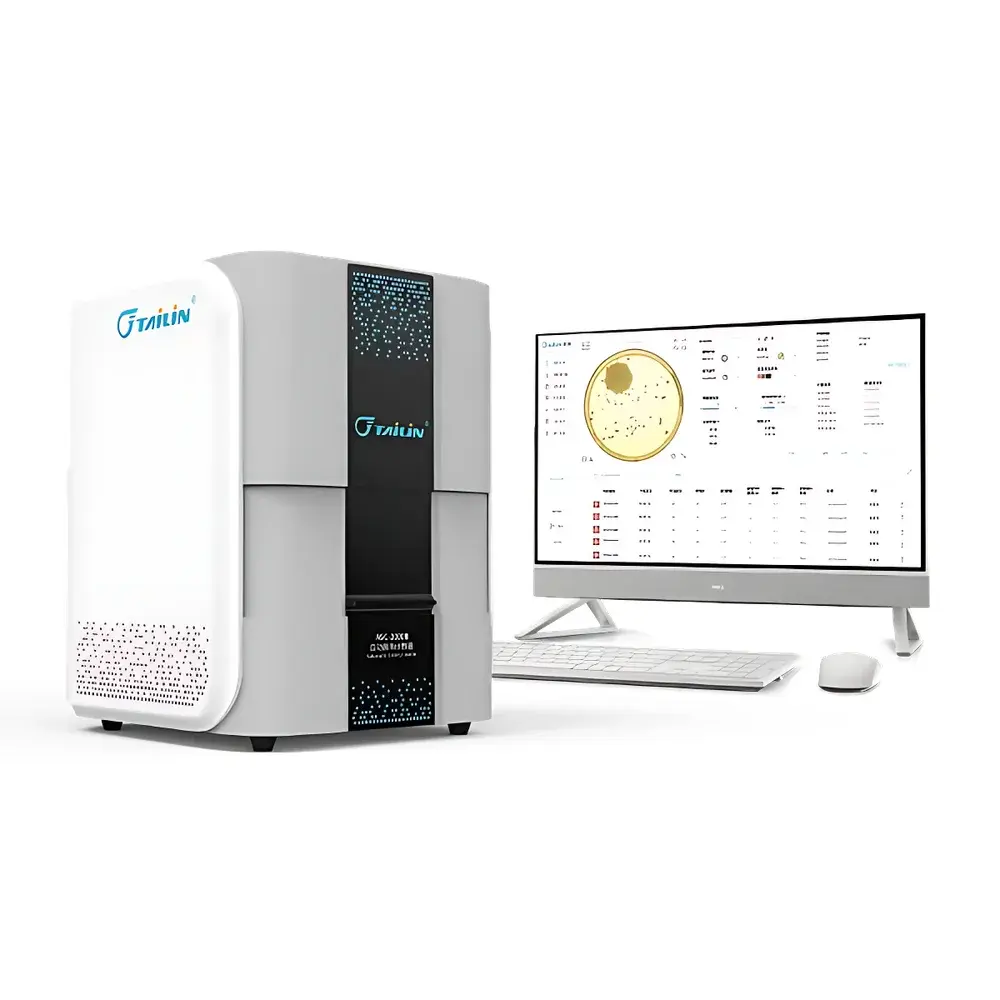
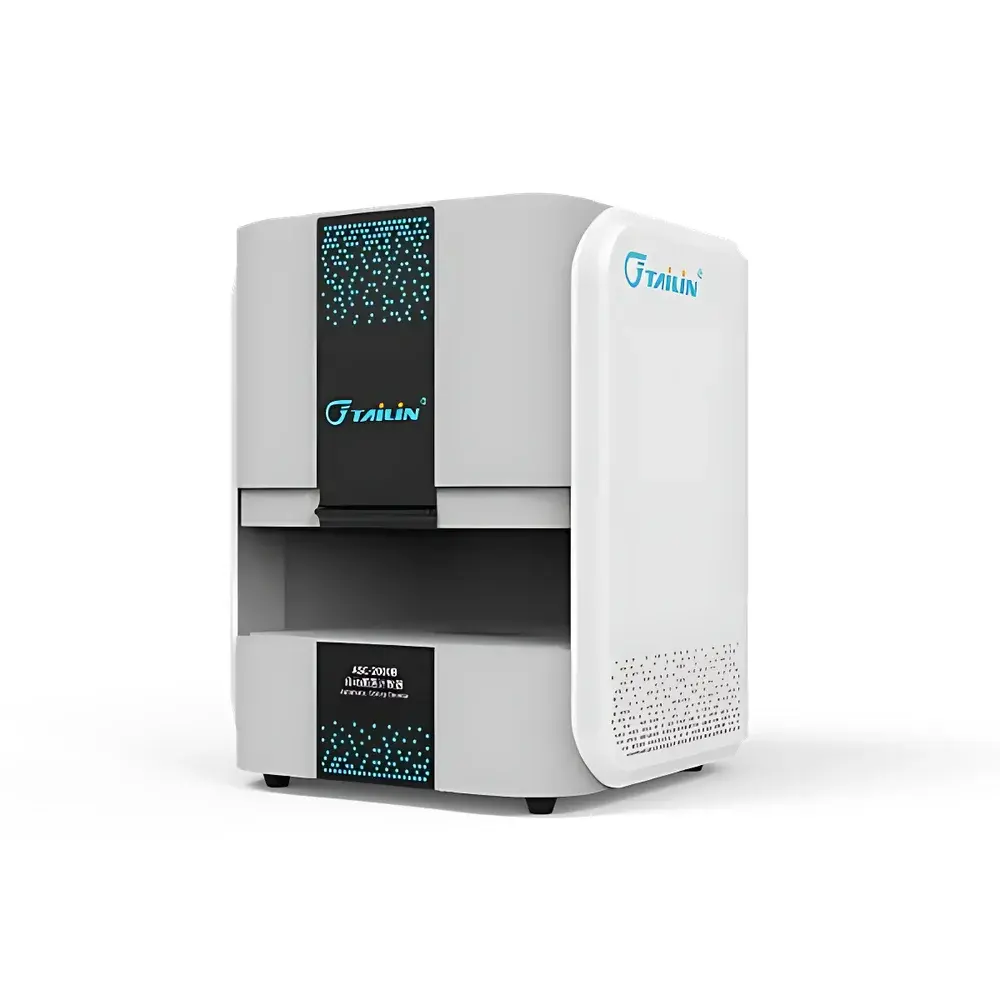
Tailin ASC-2000B Automated Colony Counter
| Brand | Tailin |
|---|---|
| Origin | Zhejiang, China |
| Manufacturer Type | Original Equipment Manufacturer (OEM) |
| Product Category | Domestic |
| Model | ASC-2000B |
| Instrument Type | Fully Automated Colony Counter |
| Camera Resolution | 20 MP High-Speed Industrial Sensor |
| Illumination | Multi-Mode Integrated LED Lighting System |
| Core Algorithm | Onboard Edge AI for Colony Segmentation and Morphometric Analysis |
| Software Functions | Colony Counting, Size Distribution Histogram, Color-Based Classification, Zone of Inhibition (ZOI) Analysis (Two-Point, Three-Point Assay), Disc Diffusion, Well Diffusion, Oxford Cup Method |
| Compliance Support | Designed for GLP/GMP-aligned microbiological QC workflows |
Overview
The Tailin ASC-2000B Automated Colony Counter is an industrial-grade, vision-based microbial enumeration system engineered for precision, reproducibility, and regulatory traceability in pharmaceutical, food safety, clinical microbiology, and contract testing laboratories. It operates on the principle of high-resolution digital image acquisition combined with embedded edge-AI processing to perform objective, operator-independent colony detection and quantification. Unlike manual or semi-automated systems reliant on user-defined thresholds or fixed lighting, the ASC-2000B dynamically optimizes illumination geometry and exposure parameters based on sample substrate characteristics—including opaque membranes, chromogenic agars, thick agar layers, and rapid test films—ensuring consistent contrast enhancement and minimal false-positive/negative classification across heterogeneous plate types.
Key Features
- 20-megapixel high-speed industrial CMOS camera with programmable exposure control and real-time auto-focus calibration for sub-millimeter colony resolution
- Multi-spectral LED illumination module supporting coaxial, oblique, transmitted, and dark-field modes—automatically selected per plate type via intelligent substrate recognition
- On-device edge-AI inference engine executing pixel-level segmentation, morphological filtering, and adaptive clustering to resolve fused colonies, filter membrane artifacts, suppress background noise, and exclude non-biological particulates
- Zero-latency workflow: “Place-and-Shoot” operation with automatic image capture, analysis, and result export within <3 seconds per standard Petri dish (90 mm)
- Integrated analytical suite supporting quantitative metrics: total CFU count, size distribution (µm²–mm² bins), RGB-based color classification (e.g., distinguishing Escherichia coli on CHROMagar™ from Klebsiella pneumoniae), and statistical reporting (mean, SD, CV%)
- Regulatory-ready ZOI module compliant with USP , EP 5.1.5, and CLSI M07-A12 standards—enabling diameter measurement, interpolation-based potency calculation, and parallel assay validation for antibiotic susceptibility testing
Sample Compatibility & Compliance
The ASC-2000B accommodates a broad spectrum of microbiological substrates without mechanical modification: standard agar plates (PCA, TSA, MacConkey), chromogenic media (e.g., Candida ID, UTI ChromoSelect), membrane filters (0.45 µm nitrocellulose, mixed cellulose ester), and commercially available rapid test devices (e.g., 3M Petrifilm™, BioControl R.A.P.I.D.™). Its optical architecture mitigates glare from reflective surfaces and compensates for uneven agar thickness up to 8 mm. The system supports audit-trail generation per FDA 21 CFR Part 11 requirements—including user authentication, timestamped action logs, version-controlled analysis parameters, and immutable PDF/eCSV report archiving—making it suitable for GMP environments undergoing MHRA, ANVISA, or NMPA inspections.
Software & Data Management
The proprietary Tailin ColonyVision™ software (v4.2+) runs natively on the device’s embedded Linux platform and offers optional Windows client integration via secure HTTPS API. All image data are stored locally with SHA-256 checksum verification; raw TIFFs and processed JSON metadata can be exported to LIMS via HL7 v2.5 or ASTM E1384-compliant interfaces. Batch processing supports up to 99 plates with configurable pass/fail criteria, outlier flagging, and automated reanalysis triggers. Software validation documentation (IQ/OQ/PQ protocols, traceability matrices) is provided for laboratory qualification under ISO/IEC 17025 and ISO 13485 frameworks.
Applications
- Pharmaceutical sterility testing and environmental monitoring (ISO 14644-1 Grade A–D zones)
- Food and beverage shelf-life challenge studies and pathogen load quantification (e.g., Listeria monocytogenes, Salmonella spp.)
- Clinical microbiology lab QC for culture-based diagnostics and antimicrobial stewardship programs
- Biotechnology process development requiring colony isolation efficiency assessment
- Academic research involving high-throughput mutant screening or synthetic biology colony phenotyping
FAQ
Does the ASC-2000B require external PC or network connection to operate?
No—it functions as a standalone appliance with integrated touchscreen interface and onboard storage. Network connectivity is optional for LIMS integration or remote diagnostics.
Can it distinguish between viable and non-viable colonies?
No. It performs morphological enumeration only. Viability confirmation requires complementary methods (e.g., resuscitation assays, ATP bioluminescence, or live/dead staining).
Is the ZOI analysis module validated for pharmacopoeial compliance?
Yes. The two- and three-dose assay algorithms follow USP and EP 5.1.5 mathematical models, including linear regression of log-dose vs. zone diameter and parallel-line analysis with slope equivalence testing.
What maintenance is required for long-term accuracy?
Annual optical calibration using NIST-traceable grayscale and resolution test targets is recommended. No consumables or lamp replacements are needed—the LED illumination system has a rated lifetime of >50,000 hours.
How does it handle plates with heavy condensation or surface scratches?
The multi-angle illumination and AI-driven background subtraction algorithm suppress specular reflections and linear artifacts, preserving colony detection integrity even on suboptimal plates.



