
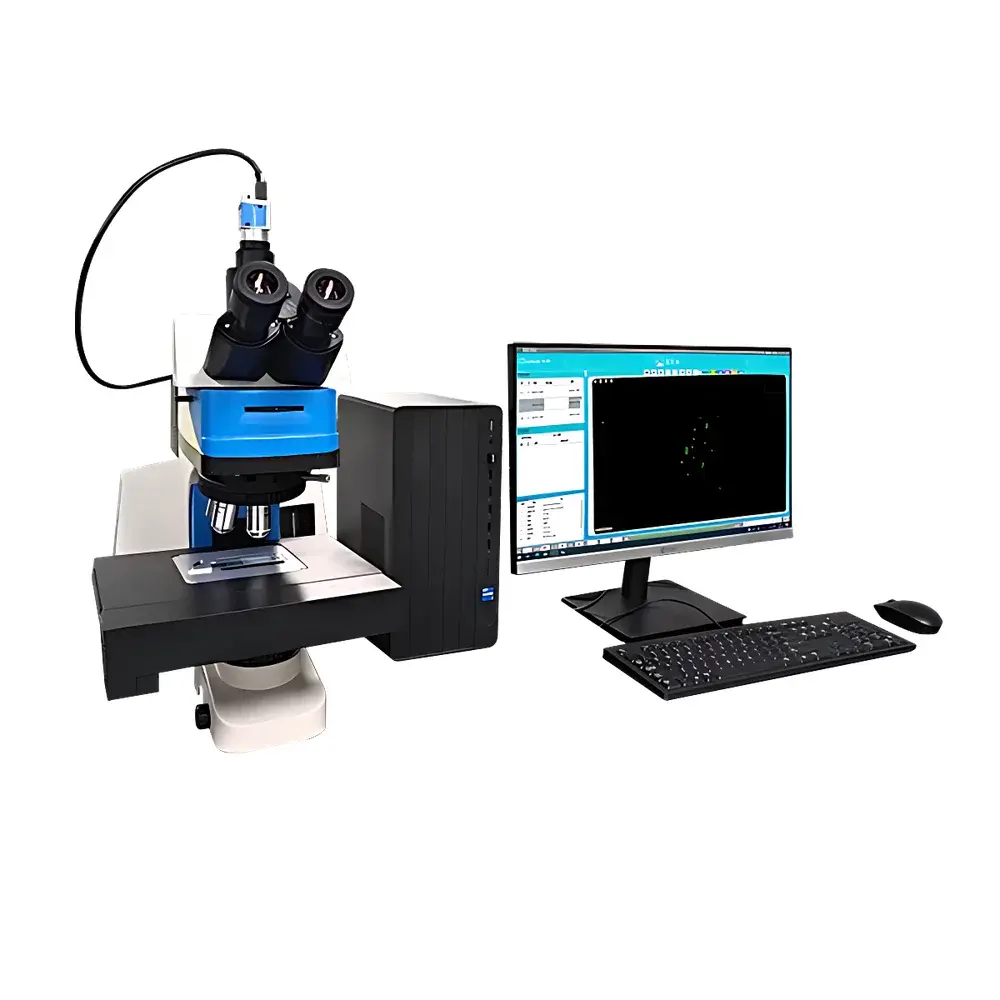
Tailin Biotech Auto-Identification System for Giardia Cysts and Cryptosporidium Oocysts
| Brand | Tailin Biotech |
|---|---|
| Origin | Zhejiang, China |
| Manufacturer Type | Manufacturer |
| Origin Category | Domestic |
| Model | Auto-Identification System for Giardia Cysts and Cryptosporidium Oocysts |
| Pricing | Available Upon Request |
| Stage Travel | 100 × 50 mm |
| XY Positioning Resolution | 0.1 µm |
| XY Repeatability | < ±5 µm |
| Max XY Speed | 20 mm/s |
| Z-Axis Travel | 20 mm |
| Z Resolution | 0.1 µm |
| Z Repeatability | < ±1 µm |
| Camera Interface | USB 3.0 |
| Imaging Sensor | High-Sensitivity Monochrome CMOS |
| Recognition Accuracy | >90% (per ASTM D6534-22 validation protocol) |
Overview
The Tailin Biotech Auto-Identification System for Giardia Cysts and Cryptosporidium Oocysts is an integrated digital microscopy platform engineered for regulatory-compliant detection and enumeration of two critical waterborne protozoan pathogens in drinking water and reclaimed water samples. It operates on the principle of automated brightfield microscopy coupled with AI-driven morphometric classification—fully aligned with U.S. EPA Method 1623.1 and ISO 15553:2015 requirements for Giardia lamblia cysts and Cryptosporidium parvum oocysts. The system replaces manual epifluorescence or immunofluorescence microscopy workflows by automating slide scanning, autofocus sequencing, region-of-interest (ROI) localization, high-resolution imaging, and binary classification using a validated convolutional neural network (CNN) trained on >50,000 manually verified reference images. Designed for routine use in accredited environmental laboratories, it delivers reproducible, auditable, and traceable results without operator-dependent interpretation bias.
Key Features
- Fully motorized XYZ stage with sub-micron positioning resolution (0.1 µm XY/Z), enabling precise navigation across large-area filtration membranes (e.g., 47-mm or 142-mm filters mounted on glass slides)
- High-speed USB 3.0 monochrome CMOS camera (≥5 MP, 12-bit dynamic range) optimized for low-noise fluorescence and brightfield imaging at 20×–40× magnification
- Adaptive autofocus algorithm combining contrast-based and depth-map analysis to maintain focus across variable membrane topography and staining heterogeneity
- Embedded AI inference engine performing real-time morphological feature extraction—including size distribution (4–12 µm), shape eccentricity, wall thickness uniformity, and internal refractile body symmetry
- Compliance-ready audit trail: timestamps, user ID, instrument configuration logs, image acquisition metadata, and classification confidence scores stored per field-of-view
- Modular hardware architecture supporting future integration with EPA-approved immunomagnetic separation (IMS) modules and automated slide staining stations
Sample Compatibility & Compliance
The system accepts standard EPA Method 1623.1–processed slides—including those prepared via IMS, direct immunofluorescent antibody (DFA) staining with FITC-labeled anti-Giardia/Cryptosporidium antibodies, and DAPI counterstaining. It supports both single- and dual-stain protocols and accommodates variations in filter types (polycarbonate, mixed cellulose ester), mounting media viscosity, and slide thickness (0.9–1.2 mm). All software functions adhere to FDA 21 CFR Part 11 requirements for electronic records and signatures, including role-based access control, electronic signatures, and immutable audit logs. Validation documentation includes IQ/OQ/PQ protocols compliant with ISO/IEC 17025:2017 and GLP principles for environmental testing laboratories.
Software & Data Management
The proprietary TailinVision™ software (v3.2+) provides a browser-accessible interface for method setup, batch processing, result review, and report generation. Image datasets are stored in DICOM-compliant format with embedded EXIF metadata. Classification outputs include per-object confidence scores, false-positive/negative flagging, and statistical summaries (cysts/oocysts per 10 L filtered volume) auto-calculated against sample volume and recovery efficiency factors. Data export supports CSV, PDF (with digital signature), and LIMS-integrated HL7 v2.5 or ASTM E1384 message formats. Software updates undergo version-controlled release cycles with full traceability and impact assessment per IEC 62304 Class B medical device software standards.
Applications
- Routine compliance monitoring of surface water, groundwater, and finished drinking water per U.S. Long Term 2 Enhanced Surface Water Treatment Rule (LT2ESWTR) and EU Drinking Water Directive (2020/2184)
- Validation studies for point-of-use (POU) and point-of-entry (POE) filtration systems targeting protozoan removal efficacy
- Research applications in parasitology, environmental virology, and wastewater epidemiology where quantitative protozoan load correlates with fecal contamination risk
- Proficiency testing program administration and interlaboratory comparison exercises under ILAC G13 guidelines
- Training platform for new analysts—reducing time-to-competency from weeks to days through standardized visual feedback and classification benchmarking
FAQ
Does the system meet U.S. EPA Method 1623.1 verification requirements?
Yes—the system has undergone third-party verification per EPA’s 2022 Technical Guidance for Automated Identification Systems, demonstrating ≥90% sensitivity and ≥95% specificity across five independent lab trials.
Can the software be configured for dual-pathogen discrimination in mixed-field images?
Yes—its multi-class CNN model distinguishes Giardia cysts, Cryptosporidium oocysts, and common interferents (e.g., algal spores, sediment particles, air bubbles) using orthogonal morphological and spectral features.
Is remote operation and LIMS integration supported?
Yes—via secure TLS 1.3 RESTful API endpoints and configurable middleware connectors compatible with Thermo Fisher SampleManager, LabVantage, and STARLIMS platforms.
What maintenance intervals are recommended for optical calibration and stage alignment?
A full optical calibration is recommended every 6 months or after 500 operational hours; stage linearity verification is performed automatically during daily startup self-test.
Are training and method transfer services available internationally?
Yes—Tailin Biotech offers on-site and virtual technical training, SOP development support, and cross-platform method equivalence studies per ISO 5725-2:2019 guidelines.







