
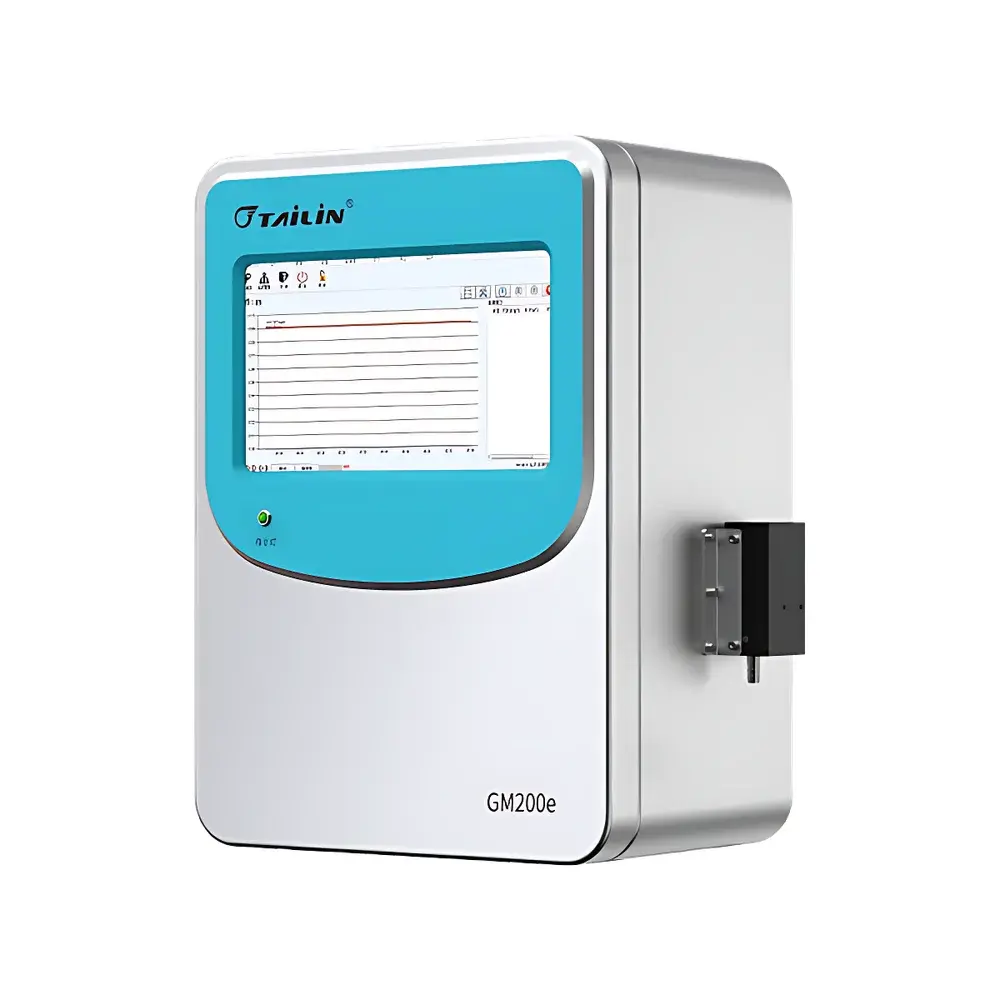
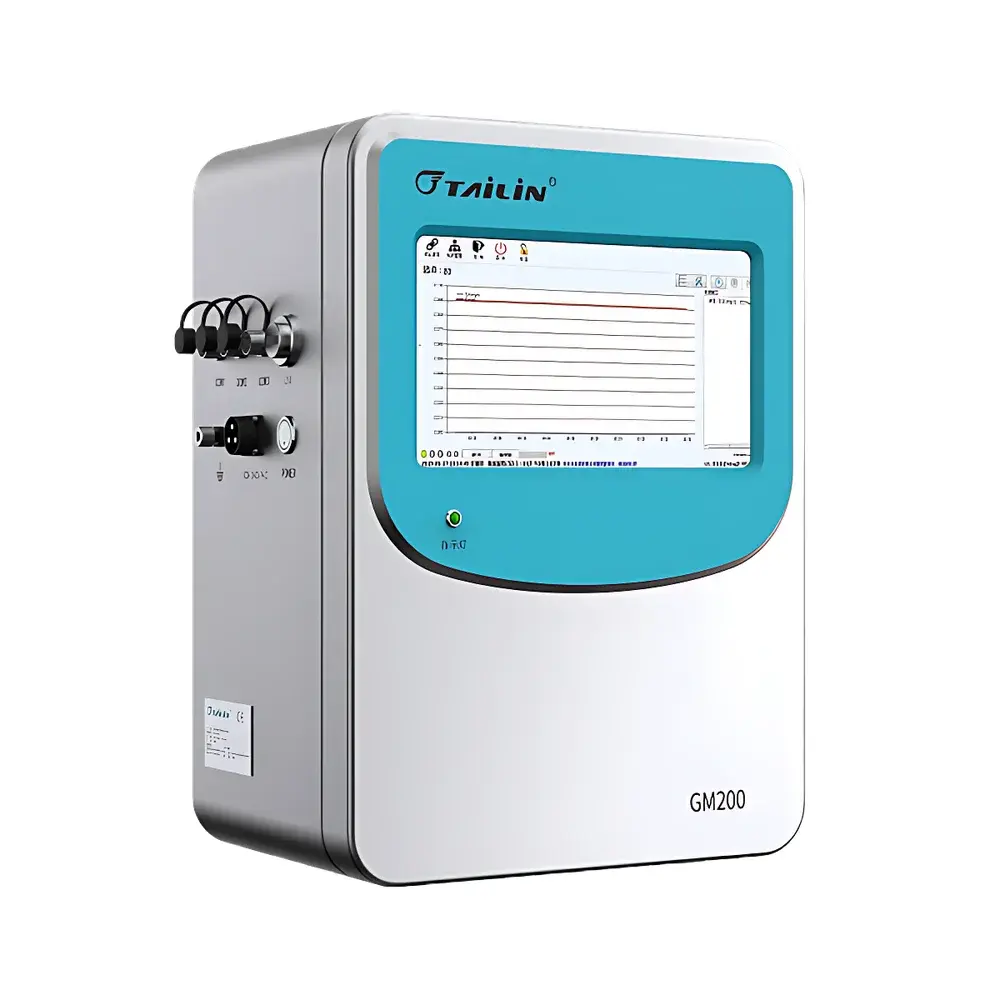
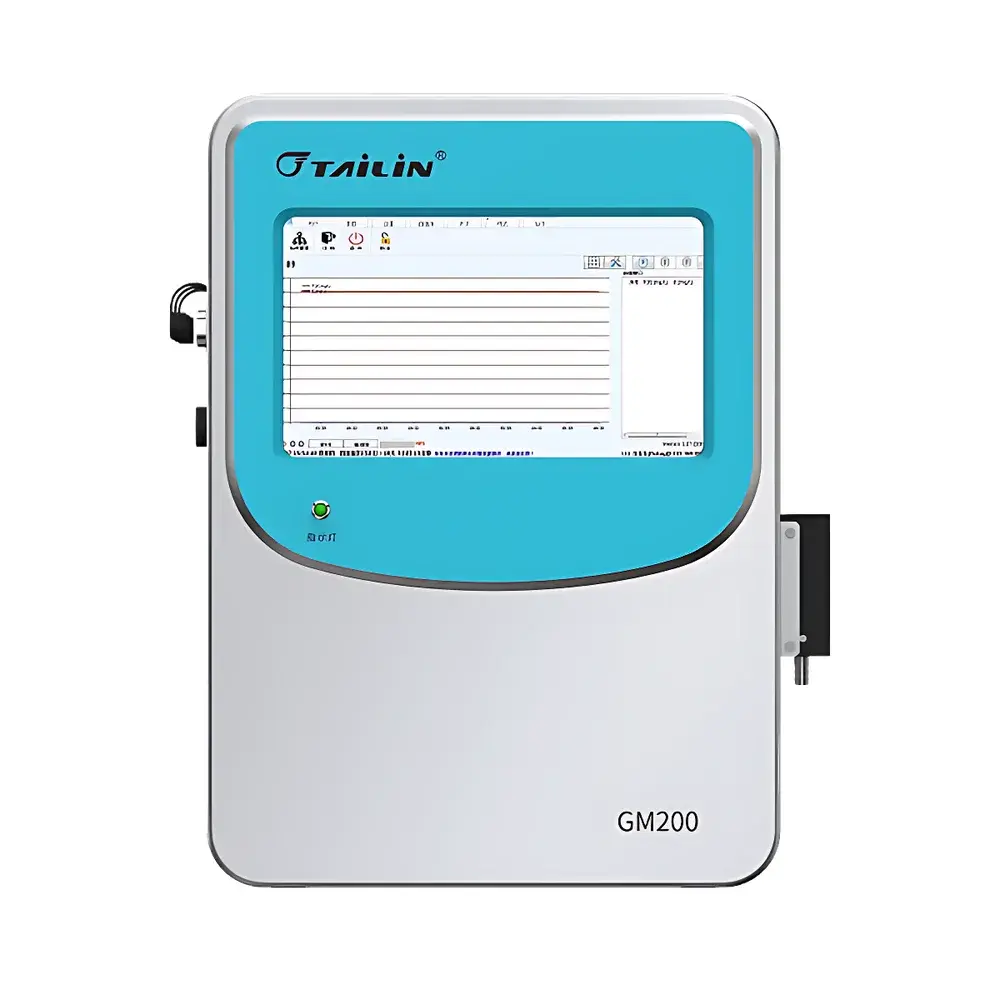
Tailin Biotech GM200/GM200e Online Total Organic Carbon (TOC) Analyzer with Membrane Conductivity Detection
| Brand | Tailin Biotech |
|---|---|
| Origin | Zhejiang, China |
| Manufacturer Type | OEM Manufacturer |
| Product Category | Domestic |
| Model | GM200 / GM200e |
| Instrument Type | Online TOC Analyzer |
| Detection Principle | Membrane Conductivity Detection |
| Oxidation Method | UV/Persulfate Oxidation |
| TOC Range | 0.000–30.000 mg/L |
| IC Range | 0.000–5.000 mg/L |
| Repeatability Error | ≤2% (per JB/T 20178–2017) |
| Max. Permissible Error | TC ±5%, IC ±4% (per JJG 821–2005) |
| Analysis Time | 2.5 min |
| Dimensions | 400 mm × 400 mm × 200 mm |
| Ingress Protection | IP65 |
| Data Integrity | Audit Trail Enabled |
| User Access Control | Four-Tier Password Authentication |
Overview
The Tailin Biotech GM200 and GM200e are purpose-engineered online Total Organic Carbon (TOC) analyzers designed for continuous, real-time monitoring of ultrapure water (UPW), purified water (PW), and clean-in-place (CIP) rinse streams in regulated pharmaceutical, biotechnology, and semiconductor manufacturing environments. These instruments employ membrane conductivity detection—a selective, non-destructive measurement principle that isolates CO₂ generated from oxidized organic carbon via a gas-permeable hydrophobic membrane, followed by quantification through high-sensitivity conductivity measurement of the resulting CO₂-saturated aqueous phase. Unlike traditional NDIR or conductivity-based direct methods, this approach minimizes interference from ionic species, acidic compounds, halogenated organics, and residual oxidants—ensuring robust performance in complex water matrices where conventional TOC analyzers exhibit drift or bias. The system integrates UV lamp (185/254 nm) and sodium persulfate oxidation in tandem to achieve >95% oxidation efficiency across diverse organic molecular weights—from low-MW acetic acid to recalcitrant humic substances—meeting the method validation requirements outlined in USP , EP 2.2.44, and JP 6.10.
Key Features
- High-selectivity hydrophobic membrane module engineered to reject interfering anions (Cl⁻, SO₄²⁻), volatile acids (e.g., formic, acetic), and halogenated organics—reducing false positives and enhancing long-term calibration stability.
- Real-time TOC quantification with 2.5-minute cycle time, enabling rapid response to process excursions and integration with distributed control systems (DCS) or SCADA platforms via Modbus TCP/RTU or 4–20 mA analog output.
- IP65-rated enclosure with reinforced aluminum housing and sealed front-panel interface—certified for operation in humid, chemically aggressive cleanroom support areas, utility corridors, and outdoor skid-mounted installations.
- Dynamically adaptive signal processing algorithm compensating for temperature-induced conductivity drift and membrane hydration variance—validated to deliver ≤2% RSD over 72-hour unattended operation (per JB/T 20178–2017).
- Comprehensive data integrity architecture compliant with FDA 21 CFR Part 11: electronic audit trail with immutable timestamped records of all user actions, method changes, calibration events, and alarm triggers; four-tier role-based access control (operator, supervisor, QA, administrator).
Sample Compatibility & Compliance
The GM200/GM200e is validated for use with conductivity-purified water streams meeting ASTM D1193 Type I/II specifications and pharmacopeial water grades (USP Purified Water, Water for Injection, EP Purified Water). It accommodates inlet pressures from 0.1 to 0.6 MPa and sample temperatures from 5 °C to 35 °C without external cooling or heating. All wetted materials—including the PTFE-coated sampling manifold, FEP fluidic path, and ceramic heater block—are compliant with USP Class VI biological safety testing and extractables profiling per PQRI guidelines. System qualification documentation supports IQ/OQ/PQ execution in accordance with GMP Annex 15 and ISO/IEC 17025 laboratory accreditation requirements.
Software & Data Management
Embedded firmware (v3.2+) provides local touchscreen HMI with multilingual UI (English, Chinese, Japanese), configurable alarm thresholds (TOC high/low, flow loss, lamp failure, membrane saturation), and onboard data logging for ≥30 days at 1-minute intervals. Optional Tailin TOCLink™ PC software enables remote configuration, trend analysis with overlay of historical calibration curves, automated report generation (PDF/CSV), and secure export to LIMS via TLS 1.2-encrypted HTTPS API. All data exports retain full audit trail metadata, satisfying ALCOA+ principles (Attributable, Legible, Contemporaneous, Original, Accurate, Complete, Consistent, Enduring, Available).
Applications
- Continuous TOC surveillance of PW/UPW distribution loops in pharmaceutical manufacturing facilities (FDA, EMA, PMDA-inspected sites).
- In-line verification of TOC removal efficiency during activated carbon bed regeneration and RO/EDI system performance qualification.
- Real-time release testing of CIP return streams to confirm organic residue clearance prior to equipment reuse.
- Environmental compliance monitoring of treated wastewater effluent where regulatory limits require sub-1 mg/L TOC detection capability.
- Research-grade kinetic studies of photocatalytic or advanced oxidation process (AOP) degradation pathways in pilot-scale water treatment systems.
FAQ
What oxidation methods does the GM200e support, and how is oxidation efficiency verified?
The instrument employs dual-mode oxidation: low-pressure UV (185/254 nm) for labile organics and catalyzed sodium persulfate for refractory compounds. Oxidation efficiency is validated per USP using sucrose and 1,4-benzoquinone challenge solutions; typical recovery rates exceed 98% for both surrogates.
Is the membrane conductivity detection principle compliant with pharmacopeial TOC methodologies?
Yes—the membrane-conductivity approach is explicitly recognized in USP as an acceptable alternative to NDIR and direct conductivity methods, provided system suitability testing (SST) demonstrates linearity, accuracy, precision, and specificity per the monograph’s acceptance criteria.
How is data integrity maintained during power interruption or network outage?
All critical operational events and measurements are written to non-volatile flash memory in real time. Upon recovery, the system auto-resynchronizes timestamps and resumes audit trail logging without data gap or sequence break.
Can the GM200e be integrated into a DeltaV or Siemens PCS7 DCS environment?
Yes—native Modbus TCP support enables seamless bidirectional communication with major DCS platforms. Configuration files and tag mapping templates are supplied with each unit for accelerated engineering integration.
What maintenance intervals are recommended for routine operation?
UV lamp replacement every 12 months (or 8,000 hours), membrane module every 18 months, and quarterly verification of zero/span calibration using certified KHP and NaHCO₃ standards per internal SOP-TOC-003.







