
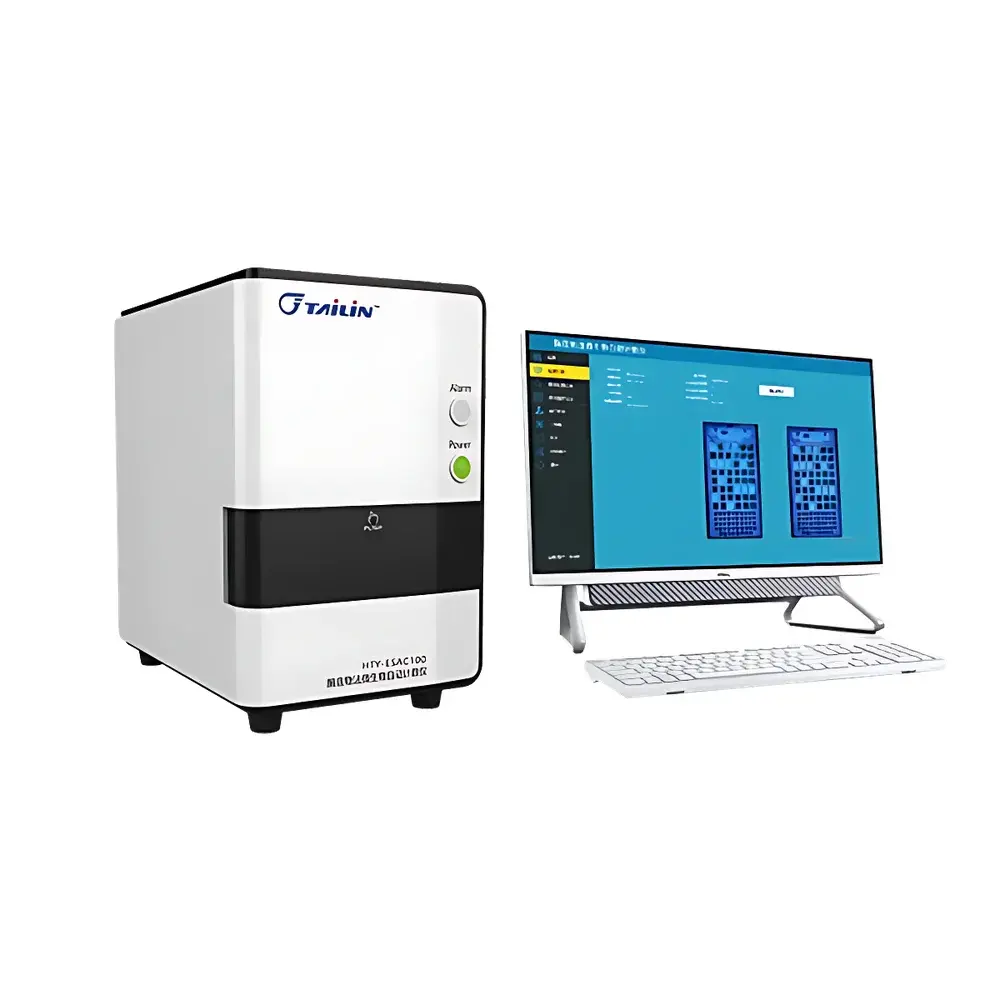
Tailin Biotech HTY-ESAC100 Enzyme-Substrate Based Automated Microbial Colony Counter
| Brand | Tailin Biotech |
|---|---|
| Origin | Zhejiang, China |
| Manufacturer Type | Direct Manufacturer |
| Country of Origin | China |
| Model | HTY-ESAC100 |
| Pricing | Upon Request |
| Illumination Source | Shadow-Free White LED Light Source |
| Detection Method | High-Resolution Digital Camera + AI-Powered Image Recognition Algorithm |
| Interface | USB-A |
| Special Function | Auto-Dilution Mode Support |
| Identification Speed | <10 seconds per quantitative tray |
| Operating Ambient Temperature | 0–45 °C |
| Dimensions (W×D×H) | 380 × 243 × 364 mm |
| Weight | 12 kg |
| Power Supply | AC 220 V ±10% |
Overview
The Tailin Biotech HTY-ESAC100 is a fully automated microbial enumeration system engineered for regulatory-compliant water quality analysis using the standardized enzyme-substrate method. It operates on the principle of detecting enzymatic activity—specifically β-galactosidase (for total coliforms), β-glucuronidase (for Escherichia coli), and other target enzymes expressed by indicator microorganisms—in water samples incubated in multi-well quantitative trays (e.g., IDEXX-type or equivalent 51-well or 97-well trays). Unlike conventional membrane filtration or pour-plate methods, the HTY-ESAC100 eliminates subjective visual interpretation by replacing manual MPN table lookup and human colony counting with algorithm-driven optical detection. The system captures high-fidelity grayscale images of each well under uniform shadow-free white LED illumination, then applies trained convolutional neural networks (CNNs) to classify fluorescence or colorimetric signal intensity above defined thresholds—enabling unambiguous identification of positive wells indicative of viable, metabolically active cells.
Key Features
- AI-powered image recognition engine optimized for enzyme-substrate assay patterns, delivering consistent, operator-independent results across batch runs.
- Integrated dilution mode support: automatically interprets serially diluted sample data from multiple trays and computes final concentration using standard MPN statistical models (e.g., EPA Method 1604, ISO 9308-1).
- Real-time digital imaging with calibrated white-light illumination ensures minimal photometric variability—critical for reproducible threshold-based positivity calls.
- Compact benchtop footprint (380 × 243 × 364 mm) and low power demand (AC 220 V ±10%) enable deployment in field laboratories, municipal water testing facilities, and contract environmental labs with space or infrastructure constraints.
- USB-A interface enables direct connection to Windows-based host computers running Tailin’s validated software suite; no proprietary hardware dongles or network dependencies required.
- Robust mechanical architecture with vibration-dampened optical stage minimizes motion artifacts during image acquisition, supporting high-throughput operation without compromising accuracy.
Sample Compatibility & Compliance
The HTY-ESAC100 is validated for use with standard enzyme-substrate quantitative trays designed for detection of total coliforms, fecal coliforms (thermotolerant), Escherichia coli, Pseudomonas aeruginosa, enterococci, and heterotrophic plate count (HPC) organisms. It supports both single-enzyme and dual-enzyme formulations, including chromogenic/fluorogenic substrates compliant with ASTM D6162, ISO 9308-1:2014, and US EPA Method 1604. While the instrument itself does not perform incubation, it is intended for post-incubation analysis of trays incubated at specified temperatures and durations per applicable standards. Its output format—including raw image archives, well-by-well positivity logs, MPN confidence intervals, and audit-ready PDF reports—aligns with GLP and GMP documentation requirements. Data integrity is preserved through timestamped, user-logged session records and immutable result export (CSV, PDF, XML) without post-hoc editing capability.
Software & Data Management
The HTY-ESAC100 operates via Tailin’s dedicated Windows application, which provides full traceability per FDA 21 CFR Part 11 principles—including electronic signatures, role-based access control, and tamper-evident audit trails for all analysis events. Software features include batch management, customizable report templates (with lab header, analyst ID, instrument ID, and calibration status), and automatic backup to local or network drives. All captured images are stored with EXIF metadata (acquisition time, exposure settings, firmware version) and linked directly to analytical results. Raw image datasets can be exported for third-party reanalysis or method validation studies. The system supports integration with LIMS via delimited text export or ODBC-compatible database schema mapping.
Applications
This instrument serves public health and environmental laboratories conducting routine compliance monitoring of drinking water, recreational waters, wastewater effluents, and source waters per national and international regulatory frameworks. It is routinely deployed in municipal water utilities for daily coliform surveillance, in food and beverage facilities for process water validation, and in pharmaceutical manufacturing environments for purified water and WFI system qualification (aligned with USP and EU Annex 1). Its rapid turnaround (<10 s/tray) and elimination of inter-operator variability make it especially suitable for high-volume testing programs where statistical robustness and documentation rigor are mandated.
FAQ
Does the HTY-ESAC100 require calibration with certified reference standards?
Yes—annual optical calibration using NIST-traceable grayscale targets is recommended, and performance verification must be conducted before each analytical run using positive/negative control trays.
Can the system process trays from vendors other than Tailin?
It supports any 51-well or 97-well quantitative tray conforming to ANSI/AWWA standard dimensions and optical reflectance characteristics; compatibility validation is required prior to routine use.
Is remote diagnostics or firmware update capability available?
Firmware updates are delivered via secure offline installer packages; remote access is disabled by default to maintain cybersecurity compliance in regulated environments.
What is the minimum detectable concentration for E. coli using this system?
Detection limit is determined by the sensitivity of the enzyme-substrate chemistry and tray design—not the instrument—and typically aligns with 1 CFU/100 mL when used with 100-mL sample volumes and appropriate dilution schemes.
Does the software support 21 CFR Part 11 compliance out-of-the-box?
Yes—the application includes built-in electronic signature workflows, audit trail generation, and password-protected user roles, meeting baseline requirements for Part 11 adherence in validated laboratory settings.







