
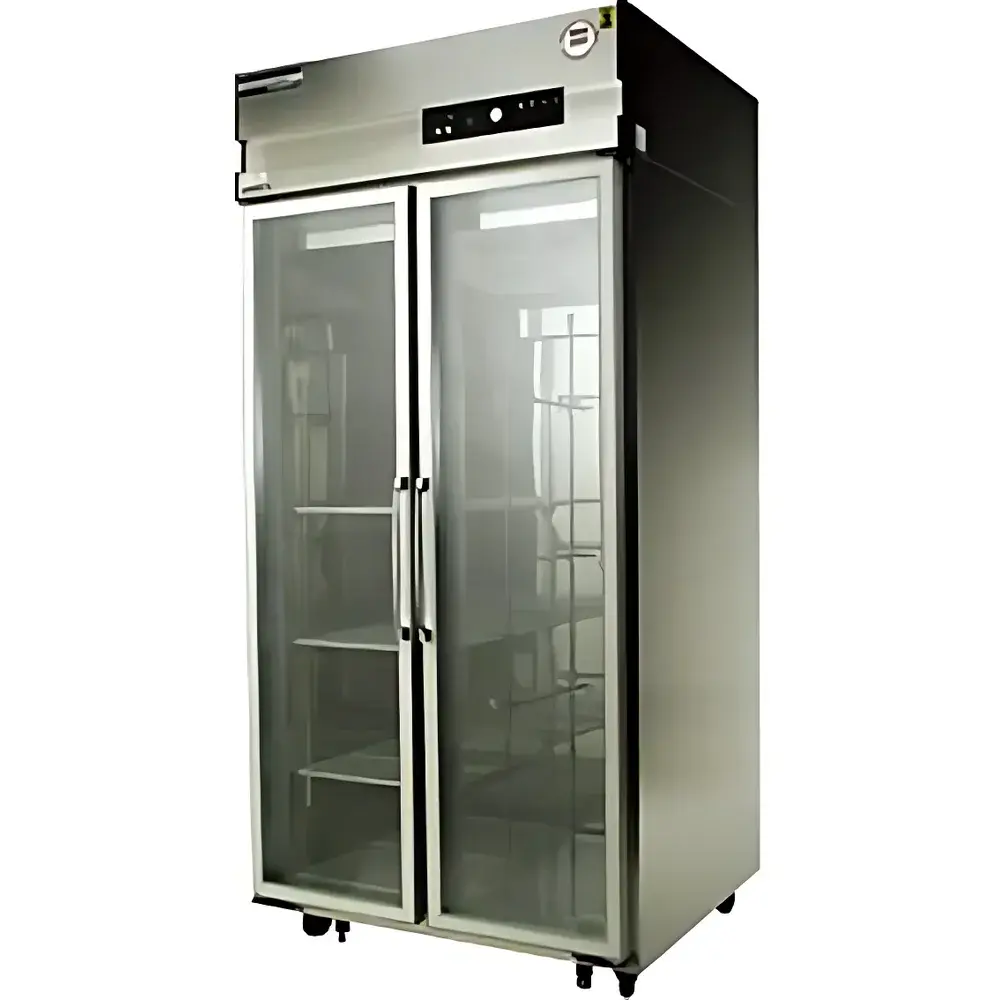
TAITEC M-600FN Large-Scale Refrigerated Incubator Cabinet
| Brand | TAITEC |
|---|---|
| Origin | Japan |
| Model | M-600FN |
| Temperature Range | 0°C to +45°C |
| Temperature Control Accuracy | ±1.0°C to ±2.0°C (*1) |
| Internal Volume | ~642 L |
| Heating Capacity | 200 W |
| Cooling Capacity | 200 W (with user-selectable auto-defrost function) |
| Internal Dimensions | 798 × 650 × 1428 mm (W×D×H) |
| External Dimensions | 900 × 810 × 1905 mm (W×D×H) |
| Net Weight | Approx. 120 kg |
| Power Supply | AC 100 V, 6.5 A |
| Internal Stirring | Forced-air circulation |
| Shelving | 3 stainless steel shelves (50 kg load capacity each, evenly distributed) |
| Interior/Exterior Material | SUS304 stainless steel (except minor components) |
| Internal Outlets | 2 waterproof outlets (max. 5 A each) |
| Defrost Cycle | 15 min every 6 h (configurable ON/OFF) |
| Standard Accessories | Wire mesh shelves ×6, base plates ×2, drip tray ×1, chromatography column mounting kit ×1 |
Overview
The TAITEC M-600FN Large-Scale Refrigerated Incubator Cabinet is an engineered environmental control system designed for multi-purpose laboratory applications requiring precise, stable thermal management across a broad operational range (0°C to +45°C). Unlike standard drying ovens or ambient-temperature storage cabinets, the M-600FN integrates active refrigeration and heating within a robust, corrosion-resistant stainless steel enclosure—enabling both low-temperature preservation and controlled incubation. Its core architecture employs dual 200 W Peltier-based thermal modules (heating and cooling), coupled with forced-air circulation to ensure uniform temperature distribution throughout the 642 L internal chamber (798 × 650 × 1428 mm). The cabinet is explicitly validated for use in chromatography column temperature stabilization, long-term reagent/solution storage, microbial culture support (when integrated with compatible orbital shakers), and immunoassay workflows (e.g., immunoprecipitation with rotating mixers). Its design prioritizes experimental flexibility: removable central door partition, reinforced load-bearing shelves (3 × 50 kg capacity), and IPX4-rated internal power outlets accommodate in-chamber instrumentation without compromising thermal integrity or safety compliance.
Key Features
- Stainless steel construction (SUS304) for interior and exterior surfaces—ensuring chemical resistance, ease of decontamination, and long-term structural stability under routine laboratory use.
- User-configurable auto-defrost cycle (15 minutes every 6 hours), with ON/OFF toggle to prevent thermal perturbation during sensitive low-temperature assays (e.g., enzyme kinetics below +10°C or cold-chain sample conditioning).
- Integrated solar-cell-powered digital temperature display—maintains real-time internal temperature visibility during mains power interruption, supporting continuity of critical storage conditions.
- Dedicated chromatography column mounting kit included as standard equipment, enabling secure vertical or horizontal column placement with adjustable support brackets.
- Two waterproof (IPX4) internal power outlets (5 A max each), positioned to minimize cable strain; rear-mounted conduit ports allow clean routing of external device cables without compromising door seal integrity.
- Forced-air convection system with optimized airflow path ensures ≤±2.0°C uniformity across full volume at steady state (tested per ISO 15270:2021 Annex B protocols at +25°C ambient).
Sample Compatibility & Compliance
The M-600FN supports diverse sample formats—including sealed vials, open petri dishes, chromatography columns (up to 25 mm diameter × 1 m length), and benchtop shakers/mixers up to 30 kg total installed mass. Its internal dimensions and removable center partition facilitate installation of third-party equipment such as orbital shakers (for aerobic microbial culture) or rotating mixers (for antigen–antibody binding kinetics). The cabinet complies with JIS Z 8703:2018 (laboratory environmental control equipment) and meets EMC requirements per IEC 61326-1:2023 Class B. While not certified for medical device storage under FDA 21 CFR Part 11, its temperature logging capability (via optional external data logger interface) supports GLP-aligned recordkeeping when paired with validated validation protocols (IQ/OQ/PQ).
Software & Data Management
The M-600FN operates via a standalone microprocessor controller with non-volatile memory for setpoint retention. It does not include embedded software or network connectivity; however, analog output (0–5 V DC) and RS-485 Modbus RTU interface are available as factory-installed options for integration into centralized building management systems (BMS) or LIMS platforms. Temperature deviation alarms (audible + visual) trigger at ±3.0°C from setpoint. For audit-trail compliance, users may connect calibrated external loggers (e.g., DeltaTRAK FlashLink or Testo 177-T4) to the analog output port—enabling time-stamped, encrypted data capture aligned with ISO/IEC 17025:2017 clause 7.5.2 requirements.
Applications
- Chromatographic method development and validation—stabilizing HPLC/UHPLC columns at constant temperatures (e.g., 4°C for protein separation or 30°C for small-molecule reverse-phase analysis) to improve retention time reproducibility.
- Cold-chain bioreagent storage—maintaining antibody conjugates, restriction enzymes, and lyophilized standards between 2°C and 8°C without frost accumulation or condensation-related degradation.
- Controlled microbial growth studies—housing orbital shakers inside the chamber to maintain culture flasks at defined temperatures (e.g., 37°C for E. coli or 30°C for Pseudomonas) while minimizing ambient lab fluctuations.
- Immunoprecipitation and co-immunoprecipitation workflows—supporting rotating mixers at 4°C to enhance antigen–antibody complex formation while preventing protease activity.
- Material stability testing—exposing polymer films or pharmaceutical excipients to controlled thermal cycling (0°C ↔ +45°C) per ICH Q1A(R2) guidelines.
FAQ
Does the M-600FN meet GMP or FDA 21 CFR Part 11 requirements?
The unit itself is not Part 11–certified, but its analog output and alarm relay contacts enable integration with compliant data acquisition systems that provide electronic signatures, audit trails, and access controls.
Can the internal outlets power high-current devices like centrifuges or vacuum pumps?
No—each outlet is rated for 5 A maximum (500 W @ 100 V). High-power instruments must be externally powered; only low-consumption peripherals (shakers, mixers, pH meters) should be connected internally.
What is the recommended ambient operating environment?
The cabinet is specified for operation in rooms maintained at +25°C ambient, with allowable ambient range of +15°C to +30°C. Operation outside this range may affect cooling efficiency and defrost cycle stability.
Is calibration documentation provided with shipment?
Factory calibration certificates (traceable to JCSS standards) are available upon request at order stage; on-site IQ/OQ qualification support can be arranged through TAITEC’s authorized service partners in EMEA and North America.
How is condensation managed during frequent door openings at low temperatures?
The forced-air system rapidly re-equilibrates chamber conditions, and the auto-defrost function—when enabled—prevents ice buildup on evaporator coils. For high-frequency access, users should minimize door-open duration and consider installing a desiccant-based humidity buffer in the chamber.



