
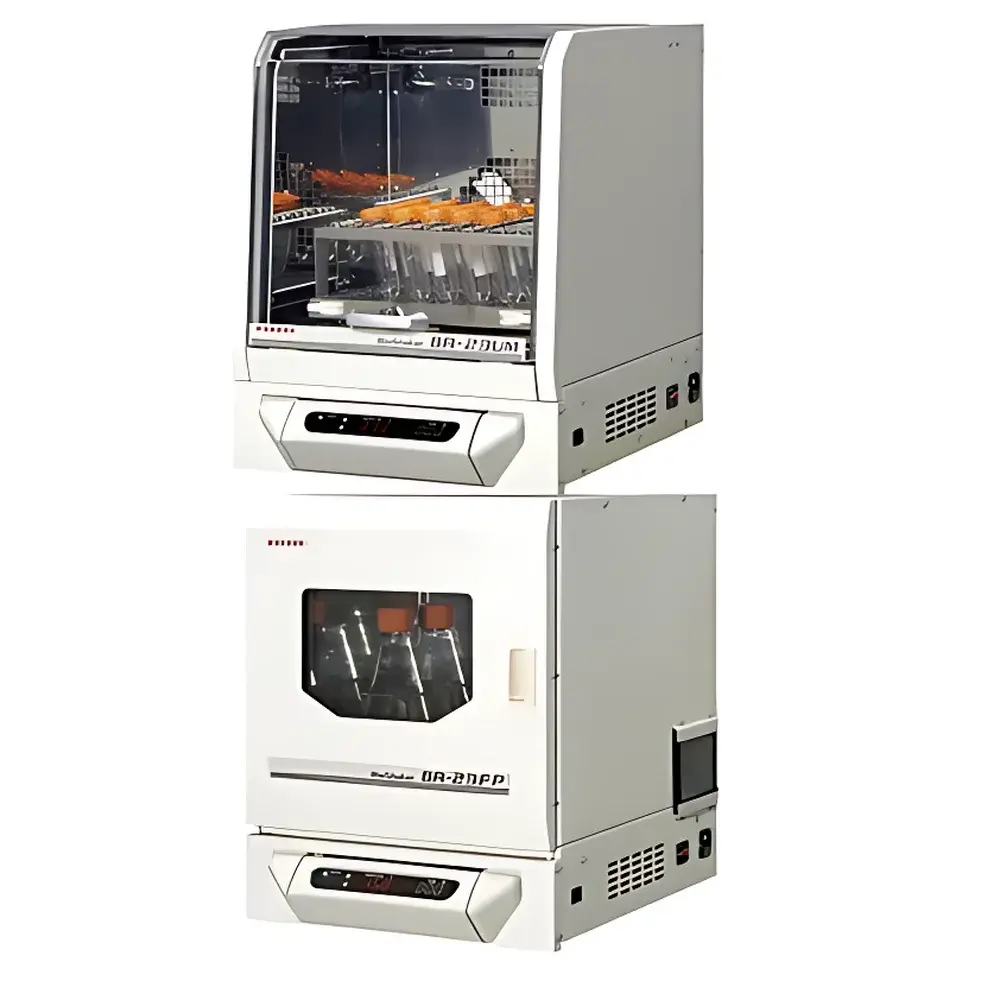
TAITEC BR-21/22/23 Series Peltier-Cooled Benchtop Orbital Shaking Incubator
| Brand | TAITEC |
|---|---|
| Origin | Japan |
| Model Series | BR-21/22/23 (FP/UM/FH variants) |
| Temperature Range | +15 °C to +35 °C (standard operating range) |
| Temperature Uniformity | ±0.2 °C |
| Cooling Method | Peltier (4 × 70 W modules) |
| Heating Method | Resistive (350 W for FH models) |
| Oscillation Mode | Reciprocating or Orbital |
| Speed Range | 20–300 rpm (≤200 rpm when stacked) |
| Amplitude | 25 mm |
| Platform Dimensions | 290 × 250 mm |
| Internal Height | 270–315 mm (model-dependent) |
| Load Capacity | ~3.5 kg (including platform and fixtures) |
| Display & Control | Digital, 9-segment programmable protocol (temperature, speed, time), gradient function |
| Safety Features | Over-temperature/over-current protection, door-open detection, sensor diagnostics, motor current limiting, built-in fuse |
| Power Supply | AC 100 V, 5 A |
| Dimensions (W×D×H) | 422–437 × 550–585 × 540–545 mm |
| Weight | 41.5–49.5 kg |
| Stackable | Yes (up to 2 units with STB-4842 base) |
Overview
The TAITEC BR-21/22/23 Series is a compact, benchtop orbital shaking incubator engineered for precision microbial, yeast, insect cell, and thermophilic culture under tightly controlled thermal and mechanical conditions. Unlike conventional compressor-based systems, this series employs solid-state Peltier cooling technology—enabling rapid temperature stabilization, zero refrigerant use, and silent operation within standard laboratory environments. Its modular architecture supports three thermal configurations: FP (low-to-mid temperature), UM (mid-range ambient-compatible), and FH (mid-to-high temperature), each optimized for specific biological workflows including Escherichia coli expansion, baculovirus-infected Sf9 culture, and Geobacillus-type thermophile propagation. The system operates exclusively within the +15 °C to +35 °C range for standard microbiological applications, delivering ±0.2 °C uniformity across the chamber volume—validated per ISO 13408-1 Annex B for incubator performance verification.
Key Features
- Stackable Dual-Tier Configuration: With the optional STB-4842 stacking base and RSB-3430 internal stabilizer brackets, two units can be vertically integrated to maximize floor space efficiency—total height ≤109 cm when UM models occupy the upper tier.
- Low-Noise, Low-Vibration Operation: Precision-balanced drive mechanism maintains acoustic emissions below 45 dB(A) and vibration displacement <0.02 mm RMS at 300 rpm; upper-tier units are software-limited to 200 rpm to preserve mechanical integrity and sample integrity.
- Modular Platform System: Interchangeable platforms include MR-2925 spring-grid (for tubes, flasks, centrifuge vessels), SR-2925 viscous-plate (for roller-style culture bottles), and MT-2925 claw-type fixtures (for Erlenmeyer flasks); all mount via standardized 290 × 250 mm interface.
- Ergonomic Access Design: UM models feature a transparent resin top-hinged lid for unobstructed overhead loading of large-volume vessels; FP and FH variants employ left-swinging insulated front doors with magnetic latching and real-time door-open status monitoring.
- Pop-Out Touch Interface: The control panel extends 60 mm from the chassis for intuitive access without requiring cabinet repositioning—retaining full functionality including 9-step program sequencing, ramp-and-soak profiles, and user-defined temperature gradients.
Sample Compatibility & Compliance
The BR-series accommodates standard laboratory vessels up to 2 L capacity—including 500 mL Erlenmeyer flasks, 125 mL baffled shake flasks, 50 mL conical tubes, and multi-well plates mounted on custom fixtures. Chamber geometry (270–315 mm internal height) ensures clearance for magnetic stir bars and sensor probes during active culture. All models comply with IEC 61010-1:2010 for electrical safety in laboratory equipment and meet JIS Z 8101-1:2017 statistical requirements for temperature uniformity testing. While humidity control is not implemented (per design intent for non-condensing aerobic cultures), the sealed chamber and Peltier condensate management system prevent moisture accumulation on optics or electronics. Units are supplied with CE marking and conform to RoHS Directive 2011/65/EU.
Software & Data Management
Embedded firmware supports fully independent parameter scheduling: temperature, oscillation speed, and duration are programmable in nine discrete segments, with time resolution down to 1 minute (00h00m–99h59m). Gradient functions allow linear ramping between setpoints—for example, simulating diurnal thermal shifts in environmental microbiology studies. Real-time logging records temperature and speed every 30 seconds to internal flash memory (10,000-point buffer), exportable via USB to CSV for post-acquisition analysis in MATLAB or Python. Audit trails capture operator ID (via optional RFID badge integration), parameter changes, alarm events, and door-open intervals—supporting GLP-compliant documentation per FDA 21 CFR Part 11 when paired with validated electronic signature protocols.
Applications
- High-yield recombinant protein expression in E. coli BL21(DE3) using autoinduction media at 30 °C and 220 rpm.
- Insect cell line maintenance (Sf9, High Five) in serum-free suspension culture under low-shear orbital agitation (110–130 rpm) and 27 °C.
- Thermophilic enzyme screening with Thermus thermophilus HB27 grown at 65 °C (FH-series only) with 150 rpm reciprocating motion.
- Antibiotic susceptibility testing (AST) via broth microdilution in 96-well plates mounted on SR-2925 plates, agitated at 50 rpm to prevent sedimentation.
- Pre-culture preparation for bioreactor inoculation, ensuring consistent OD600 and metabolic synchrony prior to scale-up.
FAQ
Is humidity control available on the BR-series?
No—these units are designed as dry-air shaking incubators optimized for aerobic microbial growth where condensation may compromise sterility or sensor accuracy.
Can I operate the unit at 37 °C?
The BR-21/22/23 FP/UM models are rated for maximum +35 °C; for sustained 37 °C operation, the FH-series variant (with resistive heating) must be selected.
What is the maximum flask size supported on the MR-2925 platform?
Standard configuration accommodates up to 1 L Erlenmeyer flasks; 2 L flasks require SR-2925 viscous-plate mounting with AF-2070 support brackets.
Does the system support remote monitoring via Ethernet or Wi-Fi?
No native network interface is included; data export is limited to USB mass storage mode. Third-party integration requires external PLC or RS-232 gateway hardware.
Are calibration certificates provided with shipment?
Factory calibration is performed per ISO/IEC 17025-accredited procedures; NIST-traceable temperature and speed validation reports are available upon request at additional cost.




