
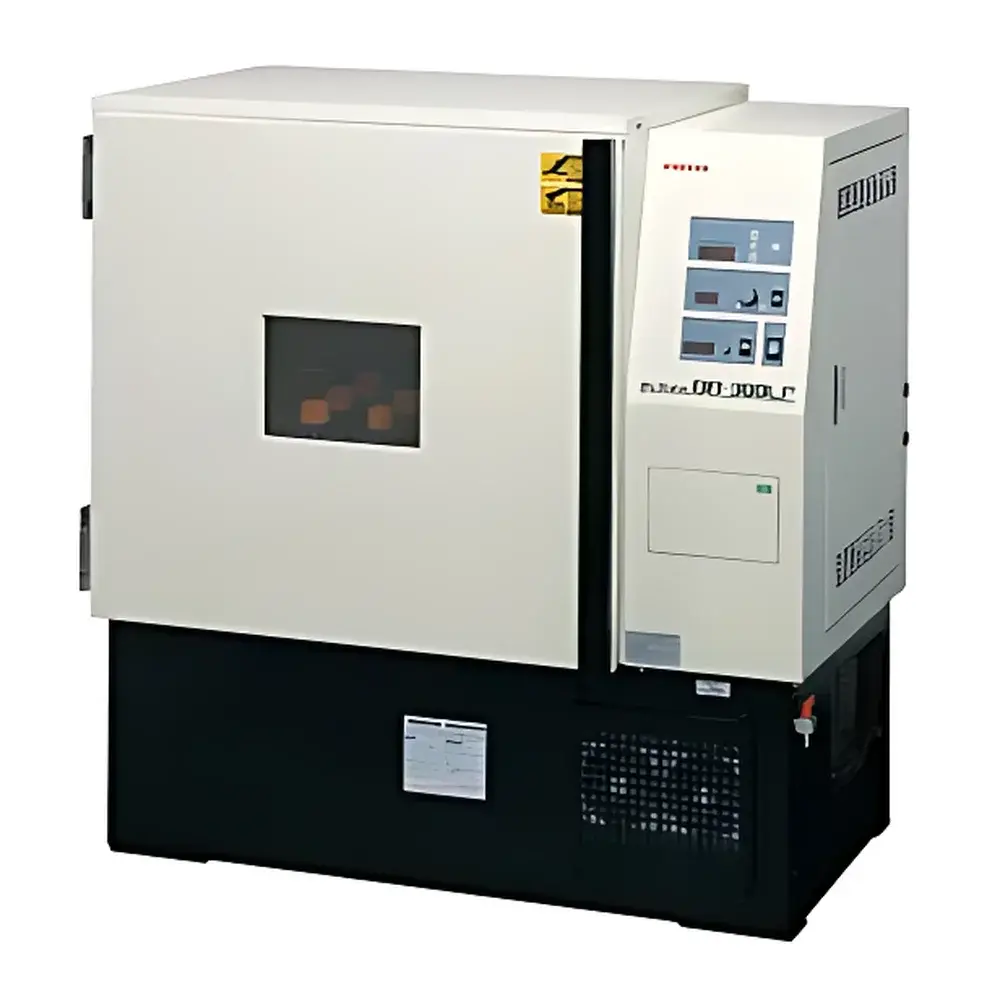
TAITEC BR-300 Series Large-Scale Refrigerated Orbital/Reciprocating Incubator Shaker
| Brand | TAITEC |
|---|---|
| Origin | Japan |
| Model | BR-300 / BR-300LF / LED-Illuminated BR-300LF |
| Temperature Range | +4°C to +70°C |
| Oscillation Mode | Switchable Orbital/Reciprocating |
| Speed | 25–250 rpm |
| Amplitude | 10–50 mm (continuously adjustable) |
| Timer Range | 00h00m to 99h59m |
| Illumination | Up to 8000 lx (LED, dimmable, 24-h timer with 15-min ON/OFF steps) |
| Platform Dimensions | 600 × 400 mm |
| Max Load Capacity | 10 kg (platform excluded) |
| Heating Power | 700 W |
| Cooling | Compressor (125 W, BR-300LF & LED models) or Water-Cooled (BR-300) |
| Temp. Control Accuracy | ±0.3°C to ±1.0°C |
| Safety Features | Leakage/overcurrent protection, compressor overheat cutoff, temperature deviation alarm, sensor self-diagnosis, auto-reset cumulative oscillation timer (0.1–999.9 h) |
| Power Supply | AC 100 V, 8–12 A |
| Net Weight | 200–230 kg |
| Compliance | Designed for GLP-compliant laboratories |
Overview
The TAITEC BR-300 Series is a high-capacity, refrigerated incubator shaker engineered for precision-controlled microbial, yeast, insect cell, and photosynthetic culture under rigorously defined thermal, mechanical, and photic conditions. Unlike standard air-bath shakers, the BR-300 integrates dual-mode oscillation mechanics—switchable between orbital and reciprocating motion—within a single, robust stainless-steel chamber. Its operational principle relies on a brushless DC motor coupled with a precision cam-and-linkage transmission system, enabling stable, low-vibration motion across the full speed range (25–250 rpm) without sacrificing amplitude fidelity (10–50 mm, continuously variable). The unit maintains temperature uniformity through forced-air convection combined with PID-regulated heating (700 W) and active cooling—either via integrated compressor (BR-300LF and LED variants) or external chilled-water circulation (BR-300). This architecture supports sustained operation from +4°C (with defrost management) to +70°C, making it suitable for both psychrophilic cultivation and high-temperature fermentation protocols.
Key Features
- Switchable oscillation mode: Select orbital or reciprocating motion via front-panel toggle—optimized for oxygen transfer efficiency in viscous or shear-sensitive cultures.
- Continuously adjustable amplitude (10–50 mm): Enables fine-tuned control of mixing intensity without mechanical recalibration.
- Programmable illumination system (LED model only): Seven linear high-output LEDs deliver up to 8000 lx at 230 mm above platform; intensity is infinitely variable and synchronized with a 24-hour timer supporting circadian rhythm simulation (e.g., 16h light / 8h dark cycles).
- Extractable platform design: Vertical lever-actuated drawer mechanism allows rapid, tool-free access for loading/unloading flasks, tubes, or custom fixtures—minimizing workflow interruption and operator fatigue.
- Modular accessory ecosystem: Supports interchangeable platforms—including MT-6040E claw-type fixture plate (for Erlenmeyer flasks up to 5 L), MR-4030L spring-grid insert (for tubes and irregular vessels), and application-specific racks (AT-series for centrifuge tubes, AF-series for angled flask positioning).
- Integrated safety and diagnostics: Real-time sensor self-check, upper/lower temperature deviation alerts, automatic oscillation time logging (0.1–999.9 h, auto-reset), and redundant thermal cutoffs (compressor overheat, heater fault, ambient overtemp).
Sample Compatibility & Compliance
The BR-300 accommodates diverse vessel geometries and volumes—from 12-mm microcentrifuge tubes (96 per MR-4030L grid) to 5-L baffled flasks (3 per MT-6040E plate), with maximum payload of 10 kg per platform. Its wide temperature span (+4°C to +70°C) and dual-mode agitation support standardized protocols including ASTM D5259 (microbial growth kinetics), ISO 8601–compliant incubation scheduling, and USP / microbial enumeration methods. When operated with optional PU-5 or PU-6 programmable controllers, the system supports audit-trail generation, user-access-level management, and electronic signature capability—fully aligning with FDA 21 CFR Part 11 requirements for regulated bioprocess development and QC testing. All models are designed for continuous operation within ambient lab conditions of +5°C to +35°C and meet IEC 61010-1 safety standards for laboratory equipment.
Software & Data Management
While the BR-300 operates as a standalone instrument with intuitive digital display (dual-view: setpoint vs. actual chamber temperature), its remote interface port enables integration into centralized lab automation frameworks. The optional PU-5 controller provides two independent 8-segment temperature programs with time-stamped event logging; PU-6 extends functionality to include oscillation ON/OFF scheduling and real-time parameter override via analog voltage input (0–5 V DC). When paired with validated LIMS or ELN software, temperature and oscillation logs—including cumulative runtime, deviation flags, and sensor health status—are exportable in CSV or XML format. All firmware updates are performed via secure USB interface, and configuration backups preserve calibration offsets and user-defined presets—ensuring traceability across instrument lifecycles and GLP/GMP audits.
Applications
- High-yield recombinant protein expression in E. coli and Saccharomyces cerevisiae, where precise O2 transfer and thermal stability directly impact plasmid retention and metabolic flux.
- Cultivation of cold-adapted microbes and psychrophilic enzymes requiring sub-ambient incubation (e.g., marine isolates at +8°C) with minimal condensation risk due to intelligent defrost-cycle awareness.
- Insect cell line maintenance (Sf9, High Five™) under low-shear orbital agitation to preserve membrane integrity during baculovirus amplification.
- Photobioreactor-grade algal and plant cell suspension culture, leveraging the LED model’s spectrally stable white-light output and programmable diurnal cycles for chlorophyll synthesis optimization.
- AGP (Antibiotic Growth Promotion) assay validation per OECD TG 201, where reproducible aeration and temperature gradients are critical for dose-response curve fidelity.
- Long-term stability studies of biologics under accelerated stress conditions (e.g., 40°C/75% RH simulated via controlled chamber humidity via external humidifier coupling).
FAQ
What is the difference between BR-300 and BR-300LF models?
The BR-300 uses water-cooled condensation for sub-ambient operation and requires an external chiller (e.g., ZL-100 or EL-8F); the BR-300LF integrates a sealed compressor, enabling autonomous cooling down to +4°C without auxiliary equipment.
Can the LED illumination be used for photomorphogenesis studies?
Yes—the 8000 lx output at 230 mm, combined with continuous dimming and programmable ON/OFF intervals, satisfies ISO 8583-based light-intensity specifications for phytochrome activation assays and seedling de-etiolation protocols.
Is the oscillation platform compatible with third-party fixtures?
The MT-6040E mounting surface follows ISO 2768-mK dimensional tolerances; M6 threaded holes (4×) spaced at 560 × 360 mm allow secure attachment of custom jigs, provided load distribution remains within 10 kg and center-of-gravity offset does not exceed ±25 mm.
Does the system support 21 CFR Part 11 compliance out of the box?
No—Part 11 functionality requires integration with PU-5/PU-6 controllers and validation of the complete hardware-software chain (including audit trail storage, electronic signatures, and role-based access control) per organizational SOPs.
What maintenance is required for long-term reliability?
Biannual inspection of compressor oil level (BR-300LF/LED), quarterly cleaning of air intake filters, annual verification of temperature sensor calibration against NIST-traceable reference, and routine lubrication of platform drawer rails using food-grade silicone grease.




