
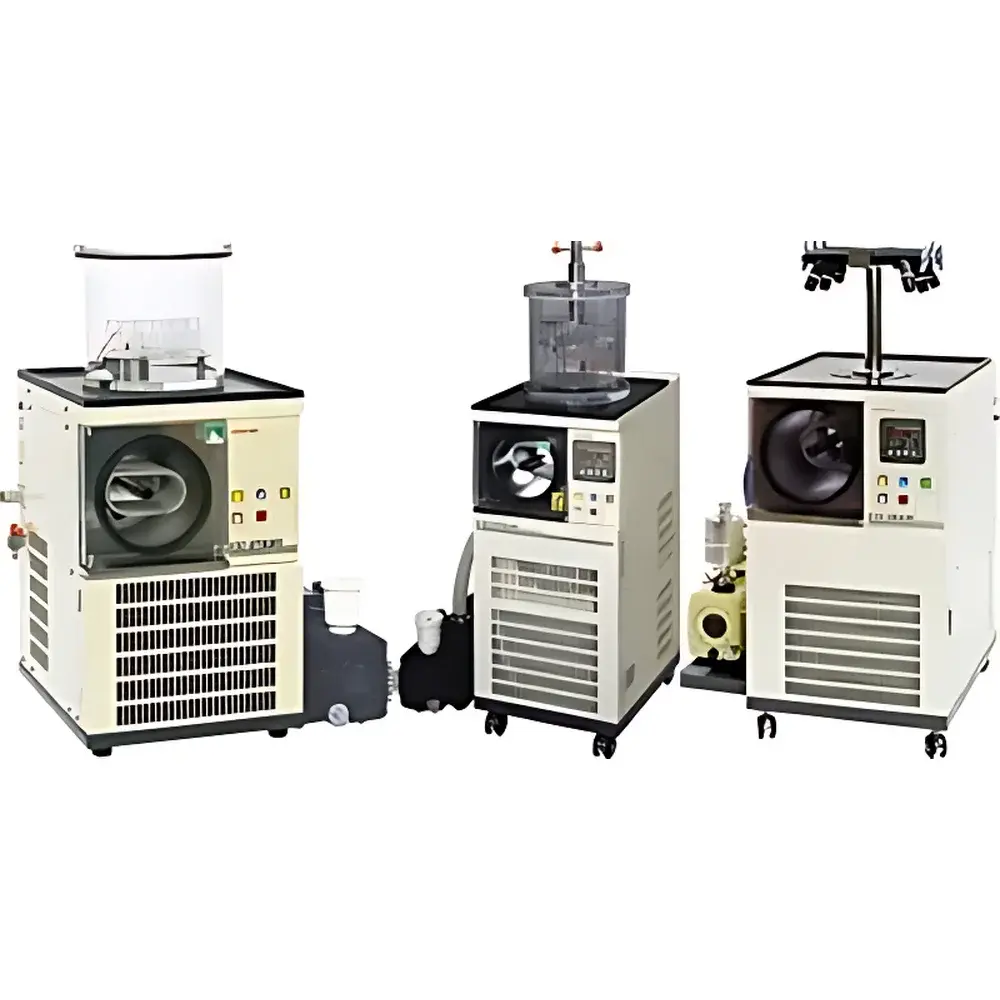
TAITEC VD-250R Benchtop Freeze Dryer
| Brand | TAITEC |
|---|---|
| Origin | Japan |
| Model | VD-250R |
| Instrument Type | Manifold Freeze Dryer |
| Application | Laboratory-Scale Lyophilization |
| Shelf Area | 11.7 L (chamber volume) |
| Ultimate Vacuum | <50 Pa |
| Condensate Capacity | 2000 mL per 24 h |
| Cold Trap Temperature | ≤ −75 °C |
| Dimensions (W×D×H) | 490 × 600 × 805 mm |
Overview
The TAITEC VD-250R is a compact, high-performance benchtop freeze dryer engineered for precise, reproducible lyophilization of heat-sensitive biological and analytical samples in research and quality control laboratories. It operates on the fundamental principle of sublimation—removing water from frozen samples under deep vacuum while maintaining low thermal stress. The system employs a dual-stage refrigeration cycle to achieve and sustain cold trap temperatures ≤ −75 °C, enabling efficient capture of water vapor directly onto the internal condenser coils via direct-contact cryocondensation. This architecture minimizes thermal lag and maximizes ice-trapping capacity—critical for preserving structural integrity of proteins, enzymes, vaccines, and food matrices during primary drying. Designed for compliance with GLP workflows, the VD-250R integrates seamlessly into validated laboratory environments where traceability, process consistency, and contamination control are non-negotiable.
Key Features
- Direct-cooling cold trap with dual-stage compressor (250 W × 2), delivering stable ≤ −75 °C operation under load
- Digital Pirani vacuum gauge with tri-color LED status indicator (atmospheric / vacuum drying / freeze-drying zones) and setpoint visual confirmation
- Nitrogen backfill port (Pisco φ6 mm, filtered) on rear panel for inert atmosphere reconstitution; compatible with regulated N₂ supply (≤ 0.1 MPa, 1 L/min)
- RS-232C interface for real-time vacuum data logging (0–5 V analog output); external recorder or SCADA integration supported
- Stainless-steel chamber, manifold, and vacuum path; all internal seals fitted with 0.22 µm hydrophobic filters to prevent oil vapor or particulate ingress
- Hot-gas defrost function: full cold trap regeneration in ≈30 minutes without manual disassembly
- Integrated pump interlock socket (3P, max 9 A) with dedicated ON/OFF switch; chamber accessory socket (2P, max 3 A) for optional heated shelves or sensors
- Auto-vacuum release with filter-protected N₂ purge—eliminates oxidation risk during sample retrieval
Sample Compatibility & Compliance
The VD-250R supports diverse sample formats via modular accessories: standard manifold configurations (MP-020/060/080) accommodate up to eight Erlenmeyer flasks, test tubes (with AD-0401 adapters), or lyophilization vials (FB-40xx/FB-60xx series). Optional chamber modules—including DC-260 (3-layer heated shelf), DC-280 (box-type with adjustable venting), and SC-305 (vacuum-sealing chamber)—extend applicability to Petri dishes, microplates, and ampoules requiring post-dry hermetic sealing. All wetted surfaces comply with ISO 8573-1 Class 3 compressed air purity requirements when used with N₂ purge. The unit meets IEC 61010-1 safety standards for laboratory equipment and supports audit-ready documentation when paired with compliant data loggers (e.g., FDA 21 CFR Part 11–enabled systems via third-party software).
Software & Data Management
While the VD-250R operates via embedded hardware controls (no onboard OS), its RS-232C port enables bidirectional communication with external PCs running validated data acquisition platforms. Vacuum pressure, runtime, and defrost cycles can be timestamped and archived in CSV or database formats. When integrated into GxP-regulated labs, users commonly pair the system with ELN-compatible tools (e.g., LabArchives, Benchling) or LIMS interfaces to associate lyophilization logs with batch records. The analog 0–5 V output permits connection to PLCs or chart recorders for continuous monitoring—supporting IQ/OQ/PQ validation protocols required by ISO/IEC 17025 and USP .
Applications
- Stabilization of monoclonal antibodies, recombinant proteins, and diagnostic enzyme conjugates
- Preparation of reference standards for HPLC, LC-MS, and immunoassay calibration
- Routine dehydration of food microbiology samples (e.g., ready-to-eat meals, infant formula) prior to pathogen testing
- Lyophilization of bacterial/fungal cultures for long-term strain banking (ATCC-compliant protocols)
- Processing of forensic tissue specimens and environmental swabs under chain-of-custody conditions
- Small-batch formulation development for nasal sprays, inhalable powders, and rapid-dissolve tablets
FAQ
What vacuum pumps are recommended for optimal performance?
Oil-lubricated rotary vane pumps with ≥ 10 L/min displacement and ultimate vacuum ≤ 5 × 10⁻² Pa are advised. Common models include Edwards RV8, Agilent DS-202, or KNF NP series—each requiring periodic oil changes per manufacturer guidelines.
Can the VD-250R operate unattended overnight?
Yes—provided the cold trap capacity (2000 mL/24 h) aligns with total sample moisture load and ambient lab temperature remains within +5 °C to +35 °C. An external timer or PLC-based shutdown is recommended for extended runs.
Is the system compatible with sterile processing requirements?
The stainless-steel construction and 0.22 µm inlet/outlet filters support aseptic transfer when coupled with ISO Class 5 laminar flow hoods; however, full sterilization (e.g., SIP) is not supported—autoclavable accessories (e.g., FB-series bottles) must be pre-sterilized separately.
How is vacuum leak detection performed?
The digital Pirani gauge’s LED threshold indicators allow rapid diagnosis: if the “freeze-drying zone” light fails to illuminate after 60 minutes at rest, check O-rings, valve seals, and pump oil level—no proprietary diagnostics software is required.
What maintenance intervals apply to the dual-stage compressor?
Compressor oil should be inspected every 1,000 operating hours; replacement is recommended every 5,000 hours or per TAITEC Technical Bulletin TB-VD-250R-Rev.4. Cold trap coil cleaning is advised after every 10 defrost cycles using lint-free ethanol wipes.



