
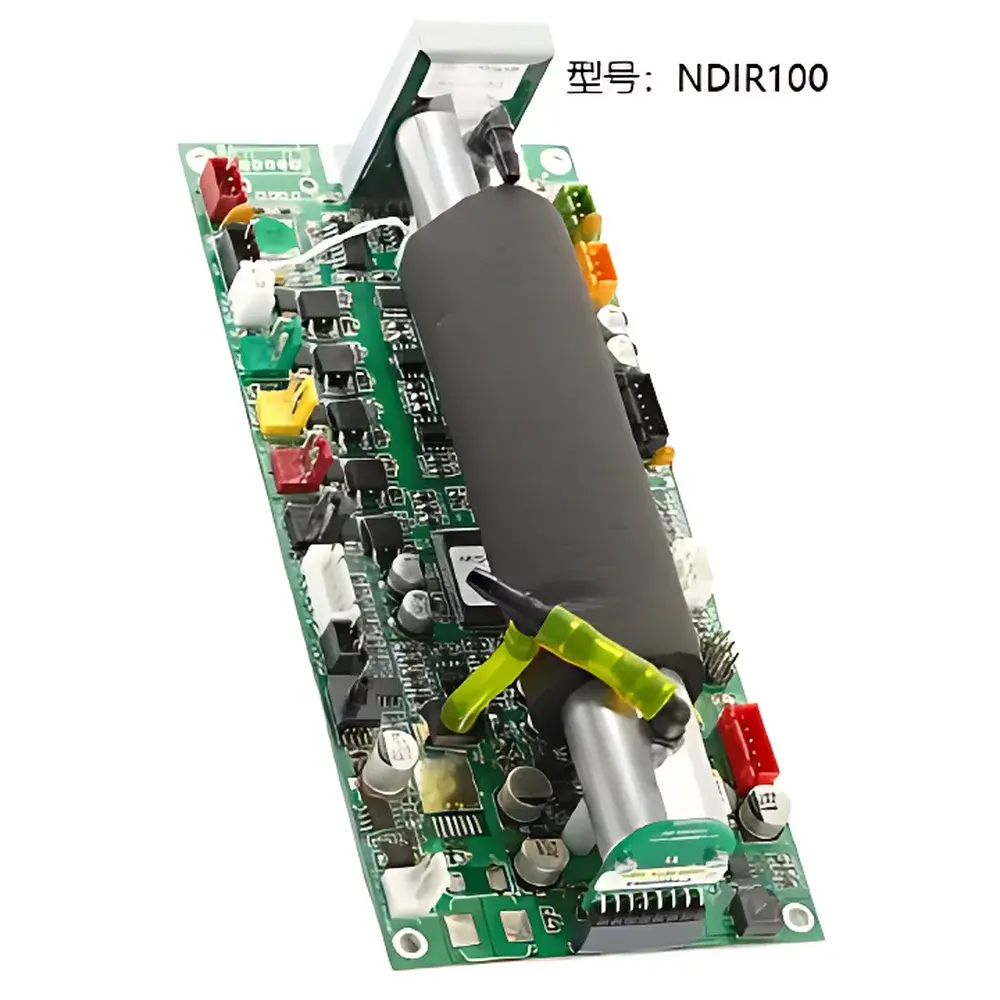
TCT NDIR100 Non-Dispersive Infrared Exhaust Gas Sensor Platform
| Brand | TCT (Xiamen Tongchuang) |
|---|---|
| Origin | Germany |
| Manufacturer Type | Authorized Distributor |
| Origin Category | Imported |
| Model | NDIR100 |
| Compliance | ISO 3930, OIML R99 Class 00, MID Directive 2004/22/EC, BAR-97, JJG 668–2007 |
| Preheat Time | <9 min at 0 °C (full performance), ≥1 min minimum |
| Response Time | <5 s (CO/CO₂/HC), <28 s (O₂) |
| Power Supply | 12 V ±0.2 V / 2 A or 13.5–30 V / 2 A with regulated output |
| Operating Temperature | −10 °C to +55 °C |
| Storage Temperature | −20 °C to +70 °C |
| Humidity | 0–95% RH |
| Ambient Pressure Range | 750–1150 mbar |
| Communication Interface | Dual RS232 (primary + auxiliary) |
| Dimensions | 177 mm × 80 mm |
| Weight | 190 g |
Overview
The TCT NDIR100 Non-Dispersive Infrared Exhaust Gas Sensor Platform is an engineered optical measurement system designed for continuous, real-time quantification of key combustion byproducts—carbon monoxide (CO), carbon dioxide (CO₂), and hydrocarbons (HC)—in engine exhaust streams. Built upon the physical principle of non-dispersive infrared (NDIR) absorption spectroscopy, the platform leverages wavelength-specific IR transmission through a precisely conditioned sample chamber to determine gas concentrations via Beer–Lambert law-based signal processing. Unlike dispersive spectrometers, the NDIR100 employs fixed optical filters and broadband IR sources, eliminating moving parts and enhancing long-term stability. Its architecture integrates seamlessly with electrochemical sensors for complementary detection of oxygen (O₂) and nitrogen oxides (NOx), enabling full-stack exhaust composition analysis in compact OEM emission test systems. The platform is not a standalone analyzer but a certified, modular sensor core—intended for integration into regulatory-grade emissions inspection equipment used in vehicle inspection & maintenance (I/M) programs, laboratory-based engine development rigs, and portable roadside enforcement tools.
Key Features
- Optically stabilized measurement chamber with active temperature control, minimizing thermal drift and ensuring repeatability across ambient fluctuations.
- Dual RS232 interfaces—one dedicated to host system communication, the other reserved for diagnostics, firmware updates, or auxiliary sensor telemetry.
- Four independent 1 A power outputs for direct driving of sampling pumps, solenoid valves, and pressure regulators—reducing external power management complexity.
- Integrated vacuum switch with TTL-level output and optional external vacuum switch support, enabling precise flow path sequencing and leak verification during automated test cycles.
- TTL-compatible inputs for engine RPM and oil temperature synchronization—critical for load-correlated emission reporting per ISO 8178 and EPA 40 CFR Part 1065.
- Robust polarity-reversal protection circuitry prevents damage during field installation or service interventions.
- Onboard EEPROM stores calibrated coefficients, zero/span history, and operational logs; supports factory parameter restoration and secure data export in plain-text format.
- User-accessible optical chamber design allows periodic cleaning without disassembly of electronics or recalibration—significantly lowering lifecycle maintenance overhead.
Sample Compatibility & Compliance
The NDIR100 is validated for use with dry and humid exhaust streams from gasoline, diesel, LPG, and natural gas engines under transient and steady-state conditions. It meets the metrological requirements of ISO 3930:2000 (performance criteria for exhaust gas analyzers), OIML R99 Class 00 (highest accuracy class for automotive exhaust testing), and the European Measuring Instruments Directive (MID 2004/22/EC) for legal-for-trade applications. It is also fully aligned with U.S. BAR-97 specifications and Chinese national verification regulation JJG 668–2007. All calibration traceability is maintained to NIST-traceable gas standards, and the platform supports audit-ready operation under GLP and ISO/IEC 17025 environments. Pressure and temperature compensation algorithms are embedded in firmware to correct for variations in ambient barometric pressure (750–1150 mbar) and sample gas temperature—ensuring compliance across elevation zones and climatic regions.
Software & Data Management
The NDIR100 communicates via ASCII protocol over RS232, supporting command-driven configuration, real-time concentration streaming, and diagnostic query responses. Host software integration requires no proprietary drivers—standard serial libraries suffice. Firmware supports configurable data output formats (e.g., CSV-aligned strings or fixed-field binary frames) and includes timestamped event logging for critical state transitions (e.g., preheat completion, vacuum actuation, alarm triggers). All stored parameters—including span values, zero offsets, and compensation coefficients—are retained in EEPROM with CRC-protected integrity checks. Remote firmware updates are supported via XMODEM protocol over the auxiliary RS232 port, enabling field-deployed units to receive calibration patches or regulatory compliance updates without hardware replacement. Audit trails meet FDA 21 CFR Part 11 requirements when deployed in GMP-aligned test facilities, provided host software implements electronic signatures and change control.
Applications
- OEM integration into on-vehicle OBD-II enhanced diagnostic modules for real-world driving emissions (RDE) monitoring.
- Core sensing unit in stationary I/M station analyzers compliant with EU type-approval Annex XXI and California Smog Check Program requirements.
- Modular building block for research-grade engine dynamometer exhaust trains requiring synchronized multi-gas feedback.
- Portable roadside enforcement devices used by environmental agencies for in-use compliance screening.
- Calibration reference platform for secondary sensor validation in metrology labs accredited to ISO/IEC 17025.
FAQ
What gases does the NDIR100 measure natively?
The NDIR100 optically measures CO, CO₂, and HC using NDIR absorption bands. O₂ and NOx require external electrochemical sensors connected via its analog or digital interface ports.
Is the NDIR100 suitable for wet exhaust sampling?
Yes—its optical chamber and internal temperature control enable stable operation across 0–95% relative humidity; however, condensate must be removed upstream via heated sample lines or permeation dryers per ISO 3930 Annex B.
Can the platform operate outside the specified temperature range?
Operation below −10 °C or above +55 °C is not certified and may compromise measurement linearity, zero stability, and mechanical integrity of the IR source/detector assembly.
Does the NDIR100 support automatic zero calibration?
No—zero calibration requires manual introduction of certified zero gas (N₂ or synthetic air); however, the platform retains zero offset history in EEPROM and supports scheduled zero-check routines via host command.
How is traceability maintained for regulatory audits?
All calibration events, coefficient updates, and operational logs are time-stamped and stored in non-volatile memory. When integrated with a compliant host system, full electronic records—including user identity, action timestamp, and pre/post-calibration values—can be exported for audit submission.





