
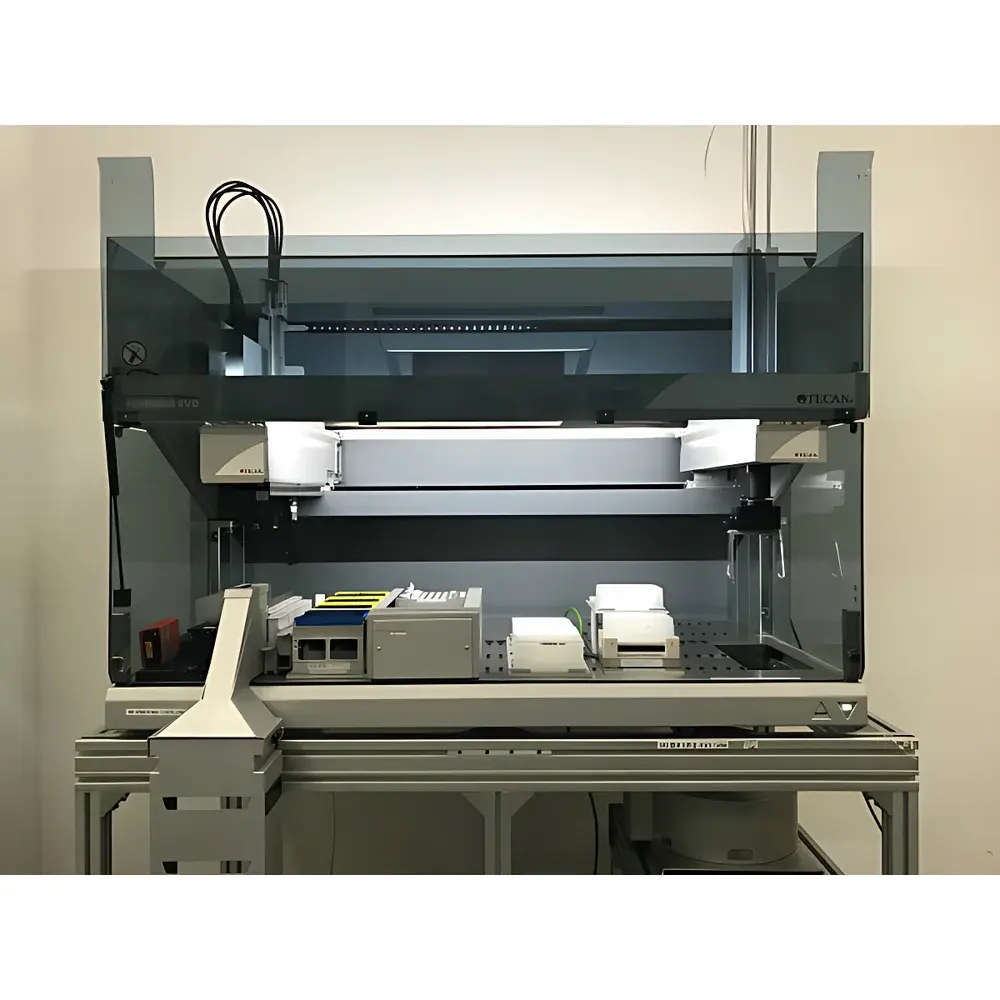
TECAN EVO Automated Forensic Micro-DNA Extraction Workstation
| Brand | TECAN |
|---|---|
| Origin | Switzerland |
| Model | EVO |
| Deck Positions | 20 |
| Liquid Handling Range | 0.5–5000 µL |
| Dimensions | 1075 × 875 × 870 mm |
| Application Scope | Forensic micro-volume DNA extraction and PCR setup |
| Core Technology | Magnetic bead-based nucleic acid isolation |
| Throughput | Up to 48 samples per run |
| Cycle Time | ~100 minutes |
| Integrated Modules | Te-Mags magnetic separation, incubation block, high-speed centrifuge |
| Sample Types | Whole blood, buccal swabs, saliva, semen, vaginal swabs, and other forensic biological fluids |
| Actuation | Pneumatic or liquid-driven pipetting |
Overview
The TECAN EVO Automated Forensic Micro-DNA Extraction Workstation is an OEM-integrated liquid handling platform engineered for reproducible, contamination-controlled nucleic acid isolation from trace forensic specimens. Built on TECAN’s proven EVO robotic architecture, it implements a fully automated magnetic bead-based purification workflow—compliant with ISO/IEC 17025 and FBI DNA Advisory Board (DAB) guidelines for forensic casework. Unlike generic benchtop extractors, this system executes end-to-end processing on a single deck: from lysis and binding through wash, elution, and direct PCR master mix dispensing—eliminating manual tube transfers and minimizing carryover risk. Its design prioritizes low-volume precision (down to 0.5 µL), critical for degraded or volume-limited evidence such as dried blood spots, touch DNA samples, or single-hair roots. The workstation operates under validated SOPs aligned with SWGDAM recommendations and supports audit-ready data capture for GLP/GMP and ISO 15189-accredited laboratories.
Key Features
- Integrated Te-Mags module with programmable magnetic field gradient control for consistent bead capture across variable sample viscosities and volumes.
- Temperature-controlled incubation block (30–95 °C, ±0.5 °C uniformity) enabling optimized proteinase K digestion and hybridization steps without external thermal cyclers.
- Dual-mode pipetting: selectable pneumatic (for volatile reagents) or liquid-driven (for higher accuracy with viscous lysates) actuation, calibrated per tip type and liquid class.
- 20-position universal deck accommodating standard SBS-format plates (96-well, deep-well, PCR strips), tubes (0.2–50 mL), and custom forensic collection devices.
- Onboard high-speed centrifuge (up to 4,000 × g) with rotor recognition and lid-lock safety interlock—enabling spin-down steps without deck reconfiguration.
- Modular expandability: compatible with optional UV decontamination hood, barcode readers, and biometric access logging for chain-of-custody integrity.
Sample Compatibility & Compliance
The EVO Forensic Workstation processes a defined spectrum of challenging forensic matrices—including whole blood (EDTA/K2EDTA), buccal swabs (dry or in transport medium), saliva stains, seminal fluid, vaginal swabs, and environmental touch samples—with demonstrated recovery efficiency ≥85% for ≥100 pg input DNA (per NIST SRM 2372 validation protocols). All liquid handling operations adhere to ISO 20387:2018 (biobanking) and ASTM E2915-22 (forensic DNA analysis) requirements. The system supports FDA 21 CFR Part 11-compliant electronic signatures and full audit trails—including user actions, timestamped protocol versions, and raw sensor logs—for laboratory accreditation under ASCLD/LAB or ENFSI standards.
Software & Data Management
Controlled via Freedom EVOware v3.x software with forensic-specific method templates preloaded (e.g., Promega Maxwell® RSC-compatible, Qiagen QIAamp® DNA Investigator, and custom STR-optimized workflows). Method development includes drag-and-drop step sequencing, real-time liquid level sensing calibration, and dynamic volume tracking per well. Data export conforms to MIAME and MIAPE metadata standards; raw logs are stored in encrypted SQLite databases with SHA-256 hashing. Integration with LIMS (e.g., Thermo Fisher SampleManager, LabVantage) is achieved via HL7 v2.5 or RESTful API, supporting automatic sample ID propagation and QC flagging.
Applications
- High-fidelity DNA extraction from low-template forensic evidence for STR and SNP profiling.
- Parallel preparation of up to 48 samples for downstream qPCR quantification and library prep (e.g., Illumina ForenSeq™).
- Automated PCR setup including master mix dispensing, primer addition, and template transfer—reducing human error in multiplex reaction assembly.
- Validation studies for new extraction chemistries under ISO 18385 (anti-contamination standard for forensic DNA testing).
- Training and proficiency testing in accredited forensic labs, with built-in failure mode simulation and troubleshooting wizards.
FAQ
Does the system support dual-column or silica-membrane-based extraction kits?
No—this configuration is optimized exclusively for magnetic bead-based chemistries to ensure compatibility with forensic-grade automation requirements and minimize clogging risks.
Can the incubation block accommodate 96-well PCR plates during thermal cycling?
Yes—the block accepts standard skirted 96-well plates and maintains ±0.3 °C stability at 60 °C for extended periods, though it is not a thermocycler; ramp rates are limited to 1.5 °C/sec.
Is remote monitoring and intervention possible during a run?
Yes—via TECAN’s WebConnect interface, users can view real-time deck status, pause/resume protocols, and adjust parameters within predefined safety limits.
What validation documentation is provided with the OEM system?
Each unit ships with IQ/OQ documentation templates, a factory-verified performance report (including pipetting accuracy per ISO 8655-6), and a forensic application note compliant with SWGDAM Appendix A.
How is cross-contamination prevented between runs?
The system employs disposable tips per sample, HEPA-filtered laminar airflow, UV-C irradiation (254 nm, 30 mJ/cm²) between protocols, and software-enforced tip-wash cycles using 10% bleach followed by ethanol rinse.



