
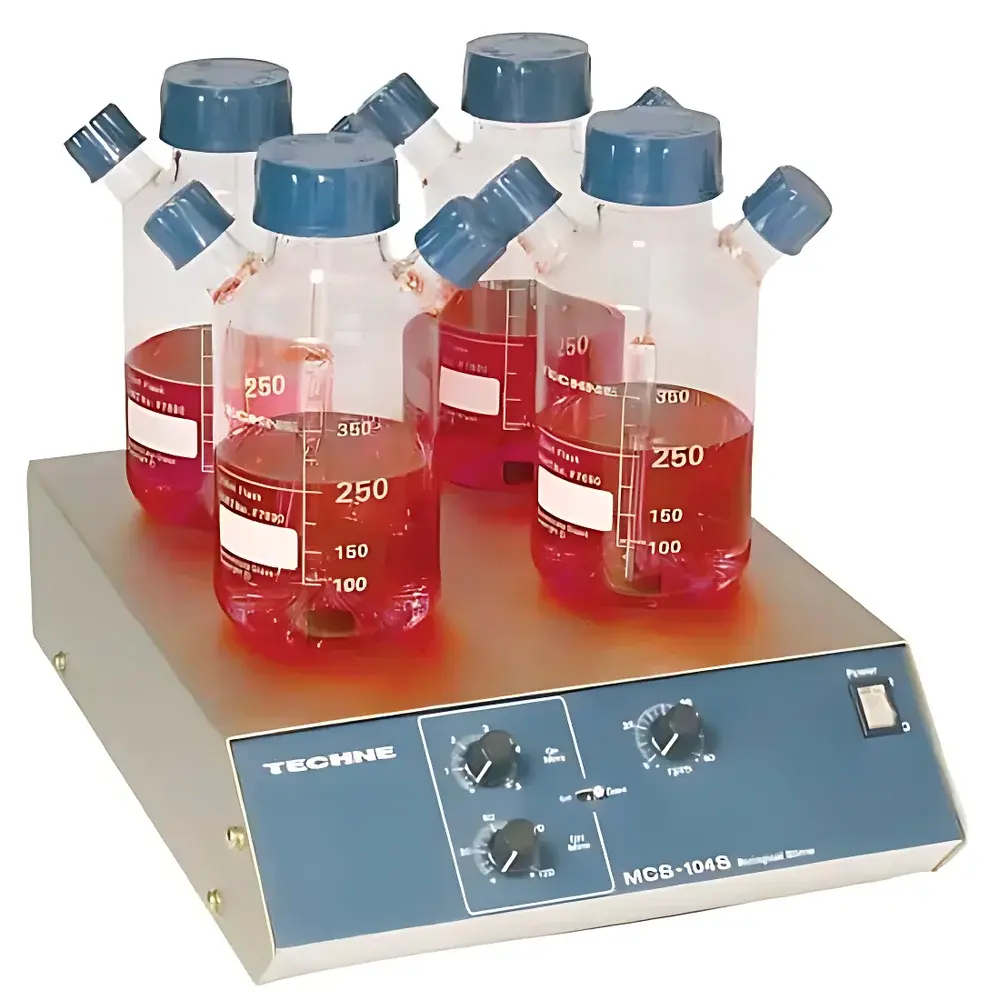
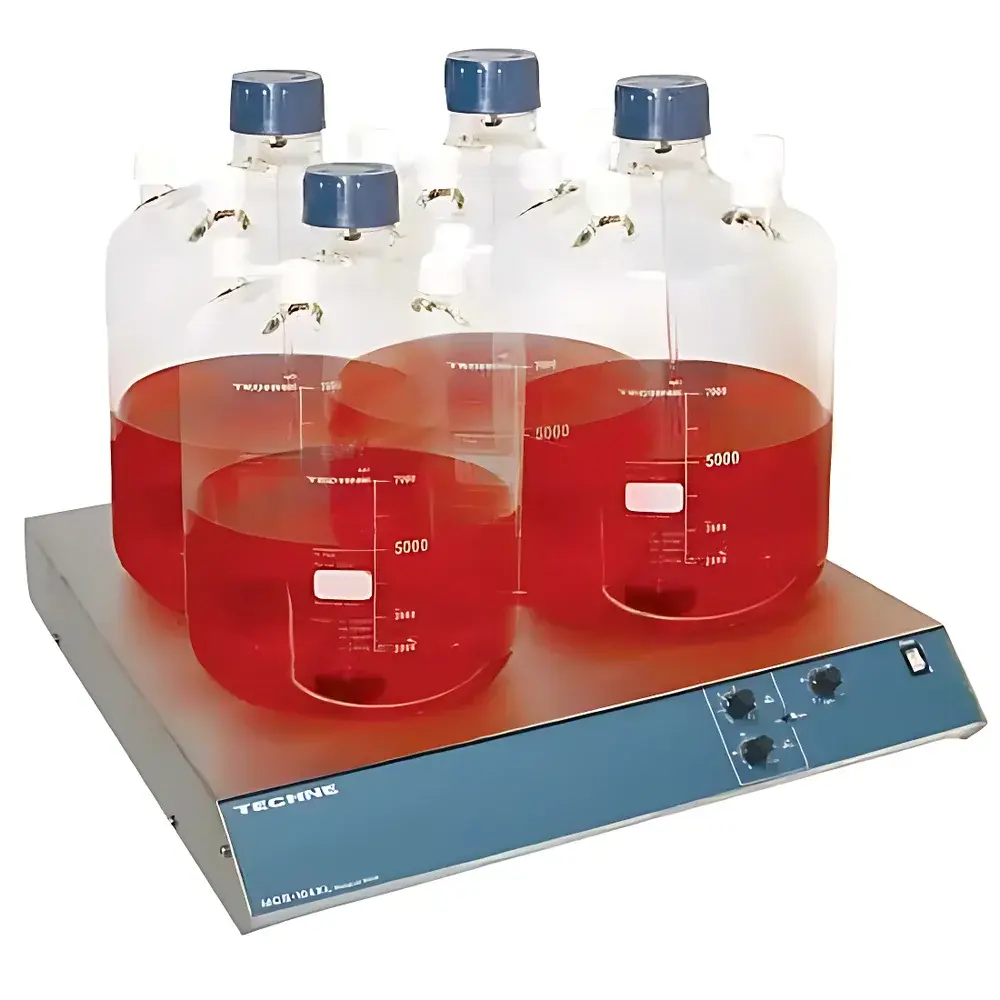
Techne MCS-104L Four-Position Biological Magnetic Stirrer
| Brand | Techne |
|---|---|
| Origin | United Kingdom |
| Model | MCS-104S / MCS-104L / MCS-104XL |
| Maximum Stirring Capacity | 4 × 5 L |
| Speed Range | 0–80 rpm |
| Temperature Operating Range | Up to 40 °C |
| Humidity Tolerance | Up to 95% RH (non-condensing) |
| Speed Accuracy | < ±3 rpm |
| Soft Start/Stop Time | 20 s acceleration/deceleration |
| Interval Stirring | On-time 6 s–5 min, Off-time 2 min–2 h |
| Power Supply | Dual-voltage 110/230 V, 50/60 Hz |
| Nominal Power Consumption | 2 W |
| Dimensions (W×D×H) | 395 × 495 × 90 mm |
| Net Weight | 6.1 kg |
Overview
The Techne MCS-104L Four-Position Biological Magnetic Stirrer is an engineered platform for gentle, reproducible suspension of anchorage-dependent mammalian cells in microcarrier-based bioprocesses. Unlike conventional magnetic stirrers designed for chemical homogenization, the MCS-104L employs a precisely calibrated low-shear rotational principle—based on controlled magnetic coupling between a toroidal drive magnet and spherical-ended stir bars—to generate laminar orbital motion within cylindrical glass culture vessels. This motion lifts cells uniformly from the vessel base without inducing turbulent eddies or hydrodynamic stress, thereby minimizing shear-induced apoptosis and preserving cell viability during prolonged cultivation. The system is validated for continuous operation inside CO2 incubators and refrigerated environments (4–40 °C), owing to its ultra-low thermal output (<0.5 W heat transfer to vessel base) and sealed stainless-steel chassis rated for 95% relative humidity (non-condensing). Its modular architecture supports parallel processing of up to four independent culture units, each with fully decoupled speed and interval control.
Key Features
- Four independent stirring positions with individual speed and timing controls—enabling simultaneous optimization of multiple culture conditions
- Gentle orbital agitation via spherical-end stir bars and optimized magnetic field geometry, delivering uniform suspension at speeds as low as 5 rpm
- Precision speed regulation (0–80 rpm, accuracy < ±3 rpm) with programmable soft-start and soft-stop profiles (20 s ramp-up/ramp-down)
- Configurable interval stirring mode: adjustable on-duration (6 s–5 min) and off-duration (2 min–2 h) to support microcarrier attachment, differentiation phases, or fragile primary cell lines
- Stainless-steel platform with precision-machined vessel locators for 1000 mL borosilicate glass culture bottles—ensuring consistent alignment and minimal vibration transmission
- Dual-voltage compatibility (110/230 V, 50/60 Hz) and ultra-low power draw (2 W nominal) for stable performance in regulated incubator environments
- IP20-rated enclosure compliant with IEC 61010-1 for laboratory use under non-hazardous conditions
Sample Compatibility & Compliance
The MCS-104L is validated for use with standard cylindrical glass culture vessels (e.g., Techne-certified 1000 mL bottles, Cat. No. FMCS104L), though compatible with any non-magnetic, diamagnetic container ≤1000 mL volume and ≤120 mm base diameter. It accommodates common microcarriers—including Cytodex 1, Plastic PCL, and SoloHill DEAE Dextran—without compromising bead dispersion or cell adhesion kinetics. The system meets essential safety and electromagnetic compatibility requirements per EN 61326-1 (measurement/control lab equipment) and EN 61000-6-3 (emission limits). While not FDA-cleared as a medical device, its design aligns with Good Manufacturing Practice (GMP) Annex 1 principles for cell therapy process equipment, particularly regarding material traceability (316L stainless steel platform), absence of lubricants or outgassing polymers, and audit-ready operational consistency.
Software & Data Management
The MCS-104L operates via front-panel membrane keypad with LED status indicators—no external software or driver installation required. All parameters (speed setpoint, interval timing, ramp duration) are retained in non-volatile memory after power cycling. Though standalone by design, it supports integration into broader process monitoring systems via optional analog 0–10 V output (available on custom-configured units) for speed feedback logging. For GLP-compliant workflows, users may pair the unit with timestamped manual logs or third-party environmental data loggers (e.g., EL-USB series) to document temperature, humidity, and runtime against batch records. No embedded firmware update capability exists; calibration verification is performed annually using NIST-traceable tachometry.
Applications
- Suspension expansion of adherent cell lines (e.g., CHO, HEK293, Vero) on dextran- or gelatin-based microcarriers
- Microcarrier seeding and attachment phase optimization under reduced agitation to minimize detachment
- Long-term maintenance cultures requiring low-oxygen or hypothermic conditions (e.g., neural progenitor cells, chondrocytes)
- Process development studies comparing shear sensitivity across cell types or microcarrier chemistries
- Bioreactor seed train preparation where scalable, low-cost parallelization replaces single-vessel shakers
- In vitro toxicology assays requiring synchronized exposure across replicate cultures
FAQ
Can the MCS-104L be used inside a CO2 incubator?
Yes—the unit is rated for continuous operation at 37 °C and 95% RH (non-condensing), with negligible self-heating and no volatile emissions. Mounting brackets (optional) facilitate secure placement on incubator shelves.
Is speed calibration traceable to national standards?
Speed accuracy (< ±3 rpm) is verified at time of manufacture using optical tachometry traceable to UKAS-accredited standards. Certificate of Conformance is supplied with each unit.
What stir bar geometry is recommended?
Spherical-end stir bars (e.g., Techne SB-1000, 25 mm length) are mandatory to achieve the specified laminar lift profile. Cylindrical or cross-shaped bars induce turbulence and invalidate shear-reduction claims.
Does the MCS-104L support serial communication or remote control?
No—it is a manually operated instrument with no digital interface. Remote operation requires external relay-based automation integrated at the facility level.
How often does maintenance require?
No scheduled maintenance is required. Wipe-down with 70% ethanol is sufficient. Annual verification of speed accuracy and interval timing is recommended for GMP-aligned workflows.



