
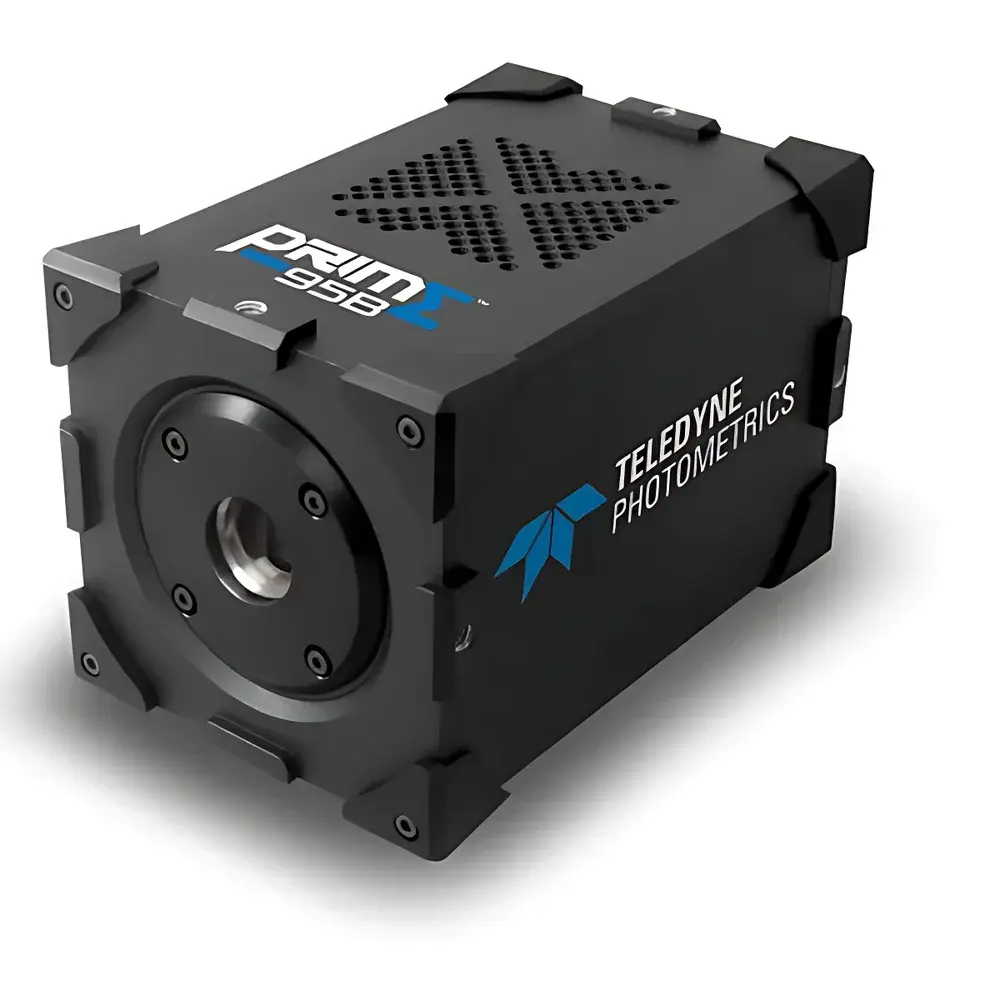
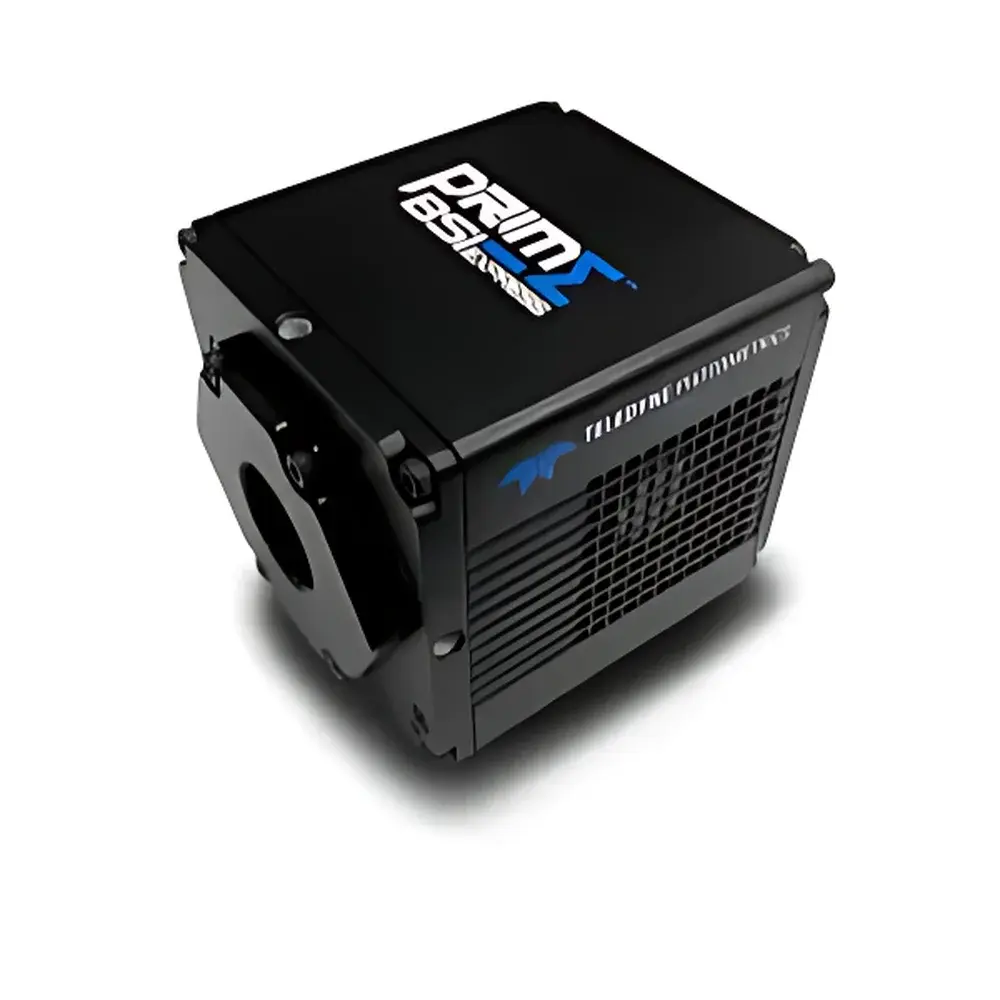
Teledyne Photometrics Prime Series Back-Illuminated Scientific sCMOS Cameras
| Brand | Teledyne Photometrics |
|---|---|
| Sensor Architecture | Back-Illuminated (BSI) sCMOS |
| Resolution Options | 1200 × 1200 |
| Pixel Size Options | 11 µm × 11 µm |
| Quantum Efficiency | 95% (200–1000 nm) |
| Read Noise | 1.0 e⁻ to 1.6 e⁻ |
| Interface | PCIe Gen3 x4 / USB 3.2 Gen 2 |
| Spectral Response | UV-VIS-NIR (200–1000 nm) |
| Cooling | Thermoelectric (TE) regulated to −15 °C below ambient |
| Frame Rate | Up to 43 fps (2048 × 2048, full resolution, USB 3.2) |
| Global Shutter Capability | Yes (effective via synchronized exposure control) |
| Compliance | CE, FCC, RoHS, ISO 9001-certified manufacturing |
Overview
The Teledyne Photometrics Prime Series comprises a family of back-illuminated scientific complementary metal-oxide-semiconductor (sCMOS) cameras engineered for quantitative low-light imaging in demanding life science and physical science applications. Leveraging true back-illumination architecture, these cameras achieve a peak quantum efficiency (QE) of 95% across ultraviolet (200–400 nm), visible (400–700 nm), and near-infrared (700–1000 nm) spectral bands — enabling maximal photon collection without the optical losses inherent in front-illuminated sensors. Unlike electron-multiplying CCDs (EMCCDs), the Prime platform delivers equivalent single-photon sensitivity with superior temporal stability, no gain aging, and significantly higher frame rates — making it suitable for time-resolved fluorescence, single-molecule localization microscopy (SMLM), light-sheet imaging, and high-speed calcium dynamics studies. Each model integrates deep-cooled thermoelectric (TE) regulation (to −15 °C below ambient), ultra-low read noise (as low as 1.0 e⁻ RMS in CMS mode), and hardware-synchronized global shutter functionality — ensuring high-fidelity, reproducible quantitative data acquisition under GLP/GMP-aligned laboratory conditions.
Key Features
- 95% peak quantum efficiency across UV-VIS-NIR spectrum, realized through monolithic back-illumination and anti-reflective microlens optimization
- Ultra-low read noise: 1.0 e⁻ (Prime BSI & Prime BSI Express, CMS mode); 1.6 e⁻ (Prime 95B), enabling photon-limited detection with high dynamic range (>30,000:1)
- Multiple sensor formats: 1200 × 1200 (11 µm pixels) for high-sensitivity wide-field applications; 2048 × 2048 (6.5 µm pixels) optimized for diffraction-limited resolution with 40×/60× oil-immersion objectives
- Advanced on-camera processing: PrimeLocate for real-time particle tracking; PrimeEnhance for photon shot-noise suppression; SMART Streaming for sequenced multi-exposure acquisition (16 user-defined exposure times cycled in real time)
- Dual interface support: High-bandwidth PCIe Gen3 x4 for maximum throughput and deterministic latency; USB 3.2 Gen 2 for simplified integration into compact or OEM systems
- Pattern Noise Reduction (PNR) and Correlated Noise Reduction (CNR) algorithms implemented in firmware to eliminate fixed-pattern artifacts and column-wise readout noise — critical for quantitative intensity calibration and long-duration time-lapse experiments
Sample Compatibility & Compliance
The Prime Series is compatible with standard C-mount and F-mount optical interfaces, and supports seamless integration with major microscope platforms (Nikon Ti2, Olympus IXplore, Zeiss Axio Observer) via TTL trigger, analog/digital I/O, and programmable GPIO. All models meet CE, FCC Part 15 Class A, and RoHS directives. Firmware and driver architecture comply with FDA 21 CFR Part 11 requirements for electronic records and signatures when deployed with validated acquisition software (e.g., MetaMorph, Micro-Manager, or custom LabVIEW applications). TE cooling stability (±0.1 °C) and factory-calibrated gain/offset maps ensure traceable linearity per ISO 15739:2013 (photographic electronic still picture imaging — noise measurements) and ASTM E1558 (standard guide for evaluation of digital imaging systems).
Software & Data Management
Cameras ship with the industry-standard PVCAM SDK (v3.10+), supporting Windows 10/11 (64-bit), Linux (x86_64), and macOS (Intel only). Acquisition software includes full support for time-stamped metadata embedding (EXIF + custom tags), lossless TIFF/ND2/HDF5 export, and histogram-based exposure auto-adjustment. Audit trail logging is enabled by default — recording all parameter changes, acquisition timestamps, environmental sensor readings (sensor temperature, fan speed), and user authentication events. Integration with Python (via PyVCAM) and MATLAB (Image Acquisition Toolbox) allows for reproducible pipeline development aligned with FAIR (Findable, Accessible, Interoperable, Reusable) data principles. Raw pixel data retains 16-bit linear response with <0.1% nonlinearity up to 95% full well capacity.
Applications
- Single-molecule fluorescence imaging (TIRF, HILO, PALM/STORM) requiring sub-electron read noise and high QE in the 640–750 nm range
- Live-cell calcium imaging using GCaMP variants, where >40 fps at 2048 × 2048 enables accurate spike timing resolution
- Light-sheet fluorescence microscopy (LSFM) with dual-side illumination and volumetric reconstruction — benefiting from large FOV options (25 mm diagonal) and uniform quantum efficiency
- Quantitative phase imaging (QPI) and digital holographic microscopy (DHM), where low fixed-pattern noise ensures artifact-free phase unwrapping
- Time-resolved spectroscopy and pump-probe experiments requiring precise inter-frame synchronization and jitter <100 ns
- OEM integration in automated pathology scanners and microfluidic cytometers leveraging USB 3.2 Gen 2 plug-and-play compatibility and compact form factor (Prime BSI Express: 78 × 78 × 90 mm)
FAQ
What distinguishes back-illuminated sCMOS from front-illuminated designs?
Back-illumination removes wiring layers from the photon path, eliminating absorption and reflection losses — directly enabling >90% QE across UV-VIS-NIR. Front-illuminated sCMOS typically achieves ≤60% QE in the blue/UV region due to gate stack attenuation.
Is the Prime series compatible with existing microscope control software?
Yes — fully supported via PVCAM drivers in MetaMorph, NIS-Elements, ZEN, μManager, and LabVIEW. SDK includes source-level examples for custom GUI development.
How is cooling performance validated and maintained over time?
Each unit undergoes 72-hour thermal soak testing at −15 °C setpoint. TE cooler lifetime exceeds 50,000 hours; sensor temperature drift is monitored continuously and logged in acquisition metadata.
Can SMART Streaming be used for ratiometric ion imaging (e.g., Fura-2)?
Yes — the 16-step exposure cycling allows alternating excitation wavelengths with synchronized exposure control, eliminating mechanical filter wheel latency and enabling sub-10 ms dual-wavelength acquisition.
Does the camera support hardware triggering for synchronization with pulsed lasers?
Yes — configurable TTL input/output with <50 ns jitter, programmable exposure delay (0–10 s), and edge-selectable rising/falling trigger modes — compliant with IEEE 1588 PTP for distributed timing networks.



