
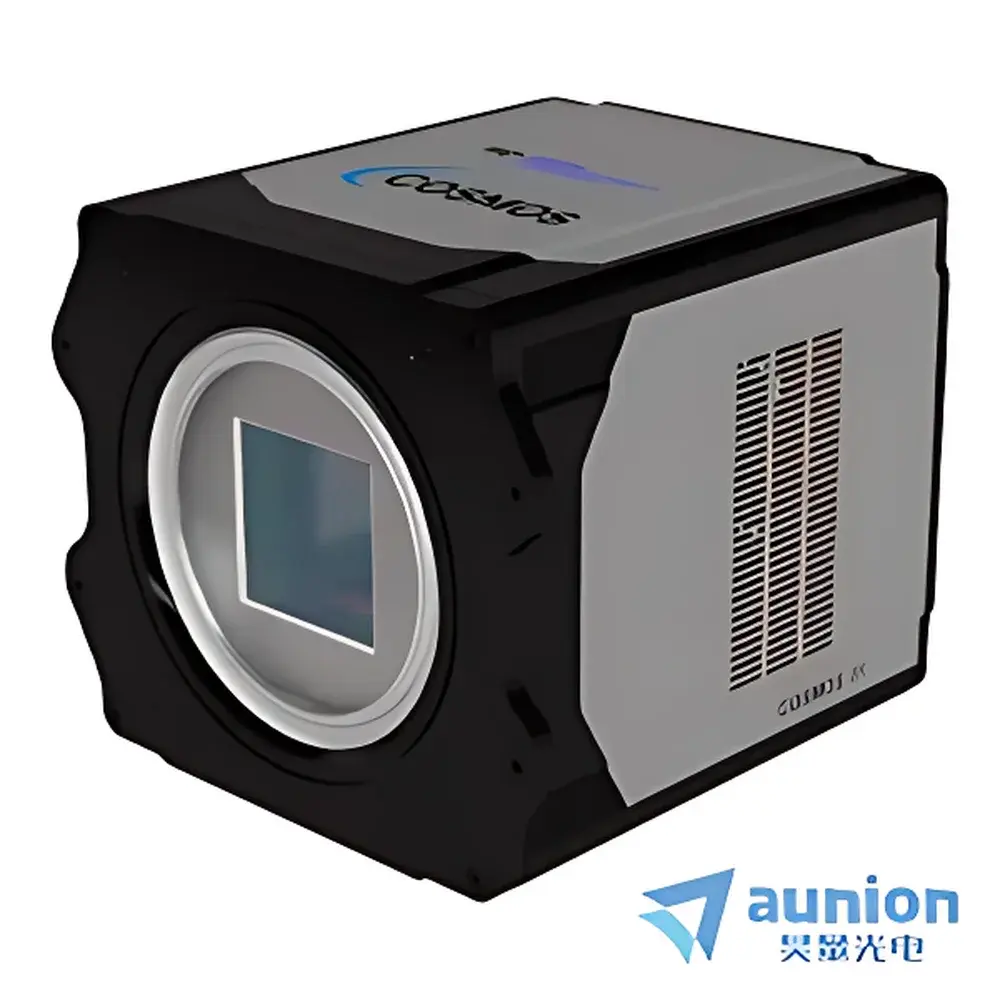
Teledyne Princeton Instruments COSMOS Series Back-Illuminated Large-Format Scientific CMOS Camera
| Brand | Teledyne Princeton Instruments |
|---|---|
| Origin | Shanghai, China |
| Manufacturer Type | Authorized Distributor |
| Regional Classification | Domestic (China) |
| Model Series | COSMOS |
| Pricing | Upon Request |
Overview
The Teledyne Princeton Instruments COSMOS Series is a family of back-illuminated, large-format scientific CMOS cameras engineered specifically for demanding astronomical observation and time-domain astrophysics. Leveraging proprietary LACera™ pixel architecture and monolithic vacuum-sealed cryogenic packaging, the COSMOS platform delivers true global shutter operation without compromising quantum efficiency or introducing stray-light artifacts—overcoming fundamental limitations historically associated with back-illuminated CMOS sensors. Unlike conventional rolling-shutter CMOS devices, COSMOS implements a re-engineered pixel structure that integrates storage nodes directly beneath the photodiode layer, enabling simultaneous exposure control across the entire focal plane while preserving >90% peak quantum efficiency (QE) and sub-electron read noise performance. Designed for integration into professional observatory-grade systems—including adaptive optics wavefront sensors, solar telescopes, exoplanet transit imagers, and wide-field survey instruments—the COSMOS series operates under deep-cooled conditions (down to –30 °C sensor temperature), ensuring thermal dark current remains below 0.05 e⁻/pix/s even during multi-minute integrations. Its architecture conforms to rigorous scientific imaging standards, supporting traceable calibration workflows compliant with ISO 15739 (image sensor noise measurement) and ASTM E1548 (test methods for evaluating digital imaging systems in astronomy).
Key Features
- Back-illuminated CMOS sensor with >91% peak quantum efficiency across 400–1000 nm spectral range
- True hardware global shutter with zero motion-induced distortion, enabled by integrated pixel-level storage nodes
- Sub-electron read noise: ≤1.0 e⁻ RMS (typical), achieved via 18-bit digitization and correlated double sampling
- Deep thermoelectric cooling to –30 °C with lifetime vacuum warranty; no outgassing or sensor degradation over operational lifetime
- Large-format options: 3k×3k (43 mm diagonal), 4k×4k, 6k×6k (92 mm), and 8k×8k (115 mm) active imaging areas
- Uniform 10 µm pixel pitch across all models; full-well capacity >100 ke⁻ per pixel
- Ultra-low dark current: ≤0.05 e⁻/pix/s at –25 °C, validated per IEC 62245-2 calibration protocols
- Simultaneous support for rolling and global shutter modes via firmware-selectable configuration
Sample Compatibility & Compliance
The COSMOS series is compatible with standard astronomical mounting interfaces (e.g., CF-100 flange, M68×0.75 thread) and supports both air- and vacuum-compatible optical train integration. All models comply with RoHS 2011/65/EU and REACH (EC) No. 1907/2006 directives. The vacuum enclosure meets ISO 10110-7 surface cleanliness specifications for space-qualified optical sensors. For regulated research environments—including federally funded observatories and GLP-compliant astrophysical data archives—the camera supports audit-trail-enabled metadata logging (exposure time, temperature, gain, timestamp) aligned with NIST SP 800-53 Rev. 5 requirements for scientific instrument provenance.
Software & Data Management
COSMOS cameras are fully supported by LightField® 7.2+ software (Windows/Linux), providing real-time image acquisition, non-uniformity correction, bias/dark/flat-field calibration pipelines, and FITS-compliant output with embedded WCS headers. SDKs for C/C++, Python (PyLightField), MATLAB, and LabVIEW enable OEM integration and custom pipeline development. All acquired frames include embedded sensor telemetry (temperature, voltage, clock phase), enabling post-hoc thermal drift correction. Data integrity is ensured through CRC-32 checksum validation on every frame transfer and optional 21 CFR Part 11–compliant electronic signature modules for clinical or regulatory-grade observational records.
Applications
- High-cadence solar physics imaging (e.g., magnetic field mapping, flare dynamics)
- Exoplanet transit photometry and direct imaging with coronagraphic systems
- Wide-field time-domain surveys requiring high duty cycle and minimal dead time
- Adaptive optics wavefront sensing and closed-loop correction at kHz frame rates
- Lucky imaging and speckle interferometry for diffraction-limited ground-based observations
- Atmospheric turbulence monitoring using Shack-Hartmann sensor arrays
- Spacecraft attitude determination and star tracker calibration verification
FAQ
Does the COSMOS series support synchronized multi-camera triggering for stereo or tomographic applications?
Yes—hardware TTL trigger input/output ports support sub-microsecond timing precision across up to 16 synchronized units via daisy-chained master-slave configuration.
Is vacuum maintenance required during the product lifecycle?
No—the monolithic vacuum package is sealed at manufacture and covered by a lifetime warranty against vacuum loss or sensor outgassing.
Can COSMOS cameras operate in vacuum chambers or space-qualified enclosures?
Yes—models are available with optional vacuum-compatible feedthroughs and conformal coating for operation in <10⁻⁶ Torr environments.
What calibration standards are provided with each unit?
Each camera ships with NIST-traceable dark current, gain, and QE characterization reports, plus factory-acquired flat-field and linearity datasets in FITS format.
How is radiation tolerance addressed for orbital deployment?
While standard COSMOS units are not rad-hardened, Teledyne offers customized variants with SEL/SEU mitigation and TID-rated shielding upon request—subject to MIL-STD-883H Class B qualification testing.




