
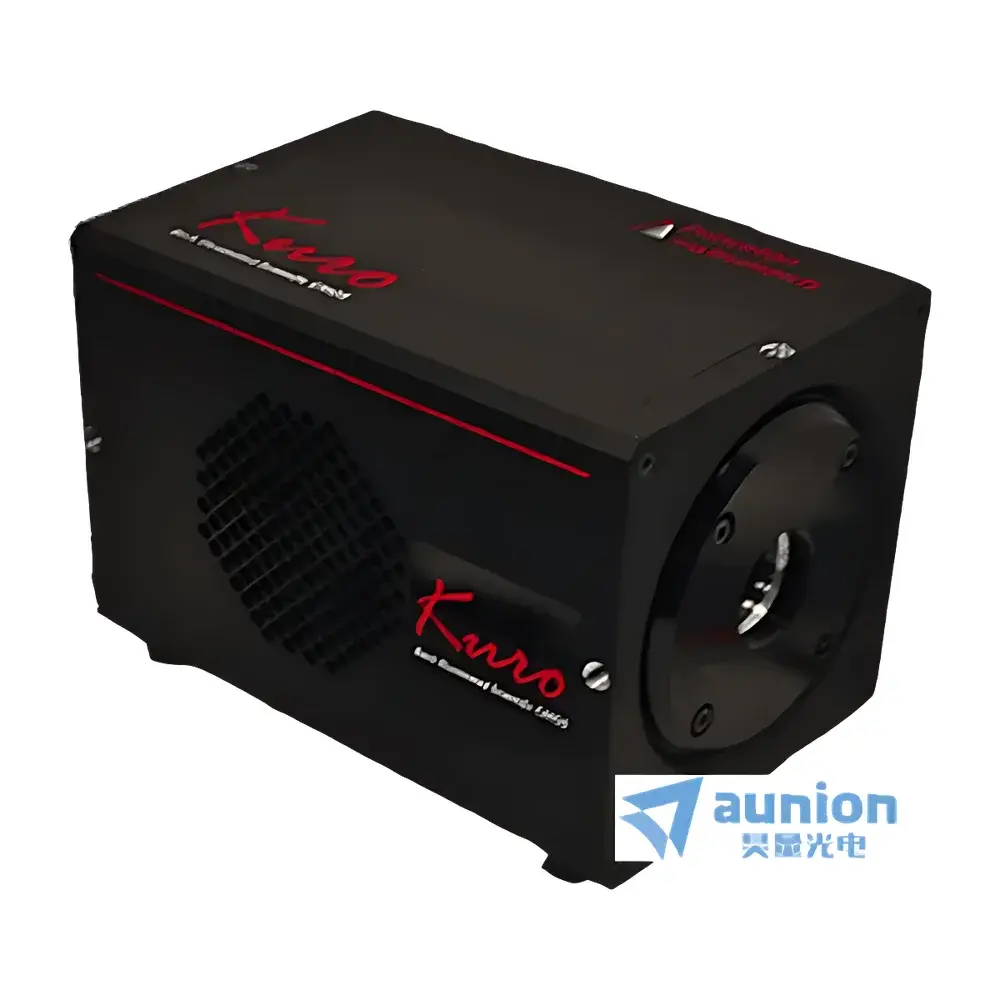
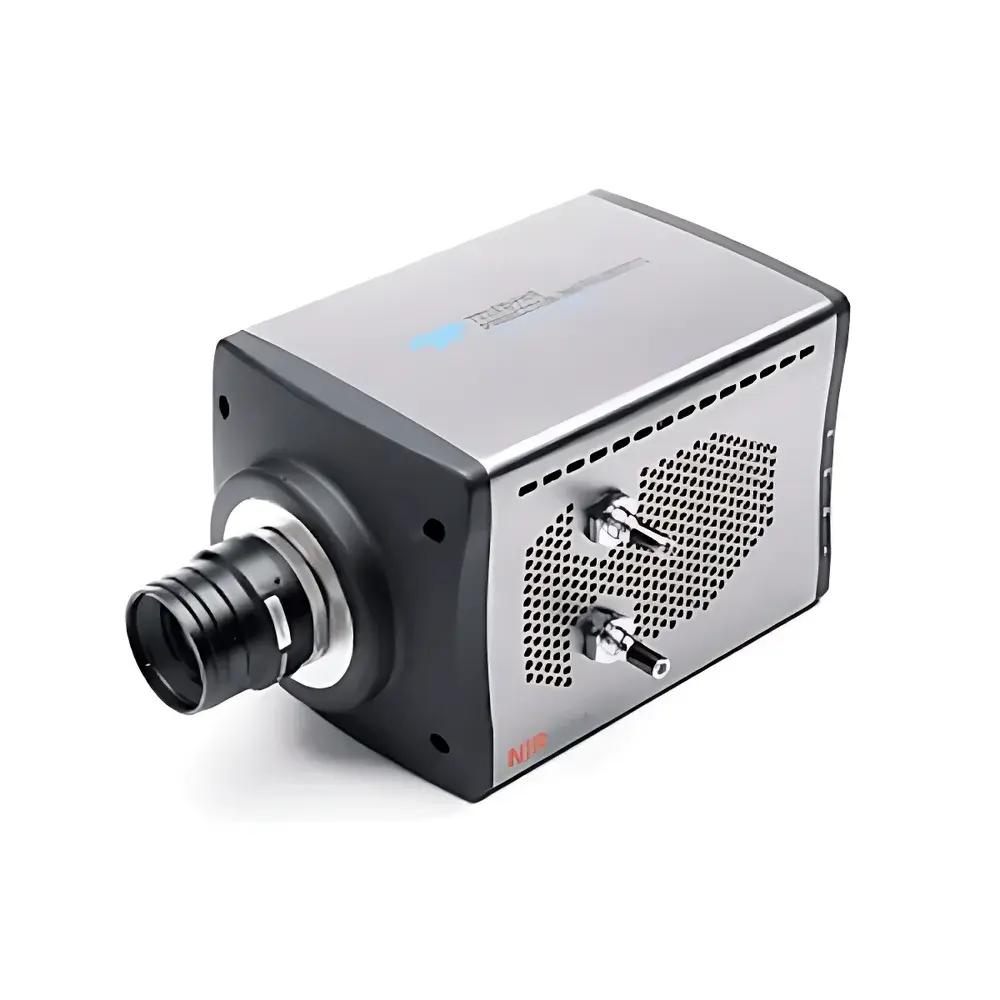
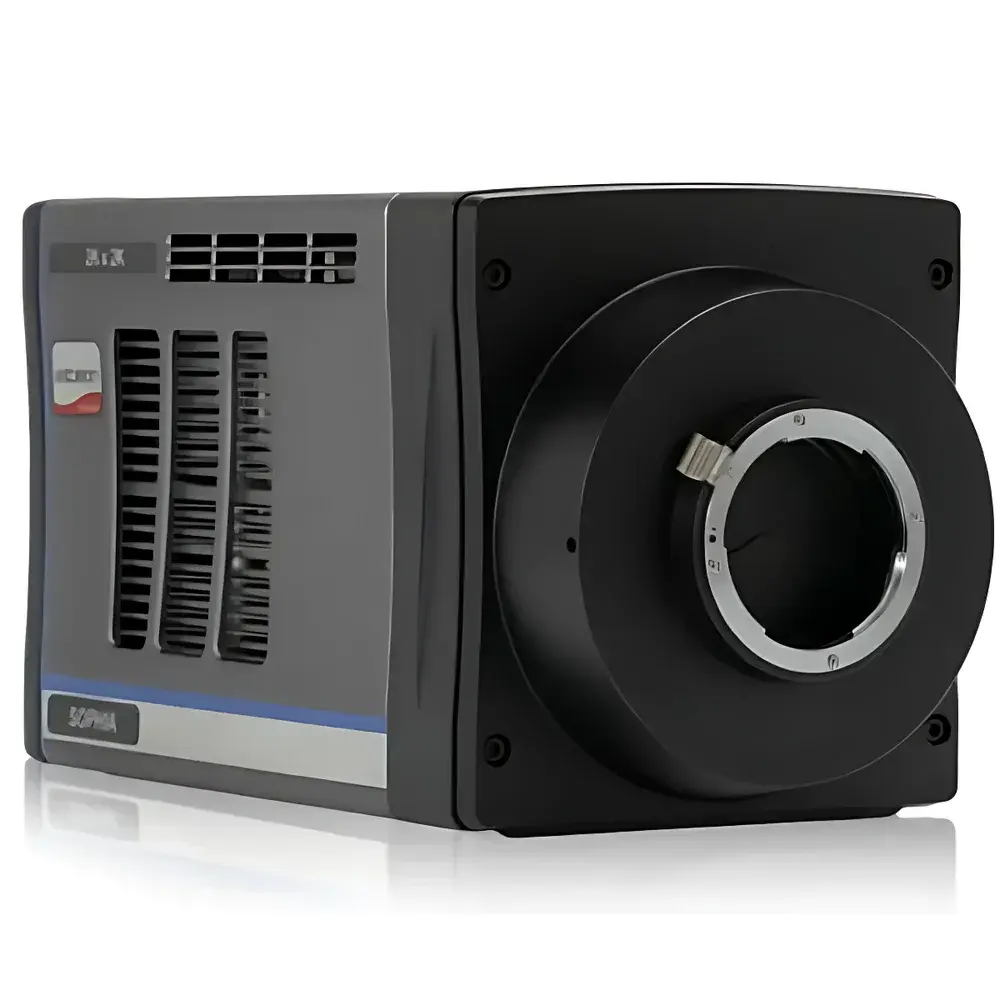
Teledyne Princeton Instruments KURO Series Back-Illuminated Scientific CMOS Camera
| Brand | Teledyne Princeton Instruments |
|---|---|
| Model | KURO 1200B / KURO 2048B |
| Sensor Type | Back-illuminated sCMOS |
| Resolution | 1200 × 1200 (1.44 MP) / 2048 × 2048 (4.2 MP) |
| Pixel Size | 11 µm × 11 µm |
| Quantum Efficiency | >95% (peak) |
| Read Noise | 1.3 e⁻ rms |
| Dark Current | 0.7 e⁻/pixel/s |
| Full Well Capacity | 80,000 e⁻ |
| Frame Rate | 82 fps (12-bit, KURO 1200B) / 47 fps (12-bit, KURO 2048B) |
| Exposure Time | ≤10 s |
| Shutter Mode | Rolling shutter with effective global shutter capability |
| Software | LightField 64-bit with LabVIEW® and MATLAB® integration, PICAM SDK support |
Overview
The Teledyne Princeton Instruments KURO Series represents the world’s first commercially available back-illuminated scientific CMOS (sCMOS) camera platform engineered for ultra-low-light, high-speed quantitative imaging and spectroscopy. Built upon a monolithic, back-thinned sCMOS sensor architecture, the KURO delivers photon-limited performance without compromising temporal resolution—enabling rigorous measurement fidelity in applications where signal scarcity, dynamic range, and timing precision are simultaneously critical. Unlike front-illuminated sCMOS sensors, the KURO’s fully back-illuminated design eliminates gate structures and wiring obstructions above the photosensitive layer, achieving >95% peak quantum efficiency across the visible to near-ultraviolet spectrum (200–1100 nm), a fill factor of 100%, and angular insensitivity to incident light—critical for off-axis illumination in spectrographs and multi-modal optical setups.
Key Features
- Back-illuminated sCMOS architecture: Delivers >95% quantum efficiency and 100% fill factor—matching or exceeding deep-depletion CCD sensitivity while retaining sCMOS speed and dynamic range.
- Ultra-low read noise: 1.3 e⁻ rms at full frame rate—enabling single-photon-level detection in low-signal regimes without binning or excessive averaging.
- High-speed acquisition: Up to 82 fps (1200 × 1200, 12-bit) and 47 fps (2048 × 2048, 12-bit) with hardware-synchronized triggering and sub-microsecond timing jitter.
- Large full-well capacity: 80,000 e⁻ per pixel ensures >88 dB dynamic range—supporting simultaneous capture of weak and intense spectral features within a single exposure.
- Advanced optical coating: Optimized anti-reflective and passivation layers maximize photon transmission and minimize etaloning effects—particularly beneficial for broadband spectroscopic applications.
- Thermal stability: Thermoelectrically cooled to –45°C (typical), reducing dark current to 0.7 e⁻/pixel/s and enabling exposures up to 10 seconds with negligible thermal drift.
Sample Compatibility & Compliance
The KURO Series is designed for integration into vacuum-compatible, vibration-isolated, and cryogenic optical benches—common in synchrotron beamlines, ultra-cold atom traps, and space-qualified instrumentation. Its sealed, evacuated sensor housing complies with ISO 10110-7 surface quality standards and meets RoHS 2011/65/EU requirements. All models support NIST-traceable calibration via IntelliCal™ wavelength and intensity auto-calibration—ensuring metrological traceability for GLP/GMP-compliant laboratories. The camera’s hardware trigger interface conforms to IEEE 1588 Precision Time Protocol (PTP) synchronization standards, enabling time-stamped correlation with external event markers in multi-instrument experiments.
Software & Data Management
KURO cameras are fully controlled by LightField®, a 64-bit, modular acquisition and analysis platform certified for FDA 21 CFR Part 11 compliance (audit trail, electronic signature, role-based access control). LightField integrates real-time mathematical operations—including spectral deconvolution, background subtraction, centroid tracking, and ROI-based binning—with native drivers for LabVIEW® and MATLAB®. Users can define custom regions of interest (ROIs) to achieve >1,000 fps in sub-array modes while preserving full bit-depth fidelity. The PICAM Software Development Kit provides low-overhead C/C++ and Python bindings—eliminating middleware latency for OEM integration and real-time feedback loops. All acquired data is saved in vendor-neutral HDF5 format with embedded metadata (exposure time, temperature, gain, calibration coefficients) for FAIR (Findable, Accessible, Interoperable, Reusable) data management.
Applications
- Astronomy: Low-noise, wide-field imaging of faint stellar objects; adaptive optics wavefront sensing; integral field spectroscopy with high spatial-spectral fidelity.
- Quantum optics: Single-photon counting in entanglement verification, Bell-state measurements, and quantum memory readout under ultra-low-background conditions.
- Fluorescence lifetime imaging (FLIM): High-temporal-resolution acquisition synchronized with pulsed laser excitation sources (e.g., Ti:Sapphire, OPO systems).
- Raman and fluorescence spectroscopy: High-dynamic-range spectral mapping across broad bandwidths with minimal pixel crosstalk or fixed-pattern artifacts.
- Cold atom physics: Absorption imaging of Bose-Einstein condensates and optical lattice experiments requiring shot-noise-limited contrast and precise exposure repeatability.
- High-speed industrial inspection: Real-time defect detection in semiconductor wafer metrology and laser-induced breakdown spectroscopy (LIBS) process monitoring.
FAQ
What distinguishes KURO from conventional front-illuminated sCMOS cameras?
KURO’s monolithic back-illumination eliminates microlens and wiring obstruction losses, delivering >95% QE and true 100% fill factor—unattainable with front-side architectures.
Can KURO be used in vacuum environments?
Yes—the sensor housing is hermetically sealed and rated for operation in vacuum chambers down to 10⁻⁶ Torr without outgassing or performance degradation.
Does LightField support automated calibration workflows?
Yes—IntelliCal™ enables one-click wavelength and radiometric calibration using integrated reference sources, with full audit trail logging per 21 CFR Part 11.
Is the KURO compatible with third-party spectrographs?
Fully compatible via standard C-mount and F-mount interfaces; optical path length and flange distance are specified per ANSI/EIA-741-A to ensure mechanical and optical interoperability.
How is cooling performance validated over extended operation?
Each unit undergoes 72-hour thermal soak testing at –45°C; sensor temperature stability is maintained within ±0.1°C over 10-hour continuous acquisition cycles.





