
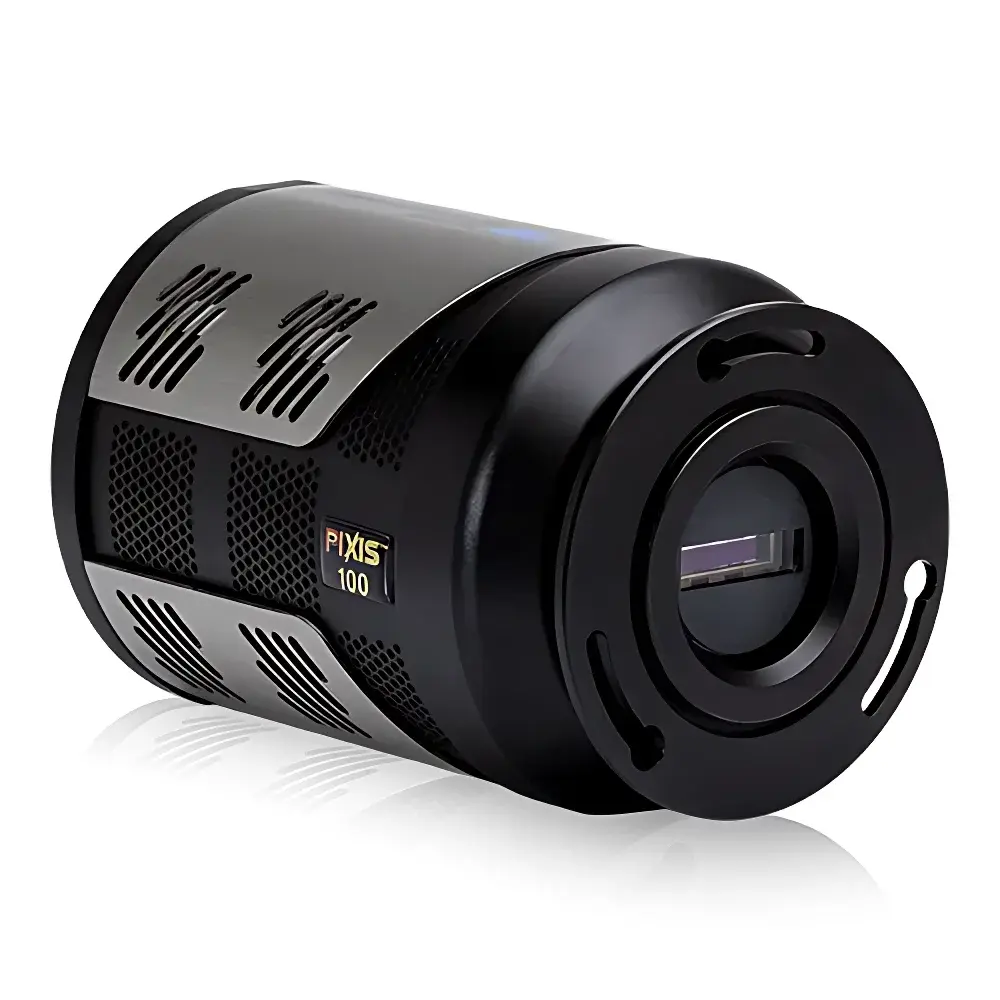
Teledyne Princeton Instruments PIXIS Series High-Performance Low-Noise CCD Camera
| Brand | Teledyne Princeton Instruments |
|---|---|
| Origin | USA |
| Model | PIXIS Series |
| Cooling | Up to −90 °C (vacuum-sealed, air/liquid-cooled) |
| Spectral Range | 120–1100 nm |
| QE | Up to 99% (UV-enhanced with eXcelon™) |
| Read Noise | 3–6 e⁻ |
| Dark Current | As low as 0.0004 e⁻/pix/s @ −70 °C |
| Sensor Type | Teledyne e2v CCD (various formats) |
| Software | LightField® with LabVIEW® & MATLAB® integration, IntelliCal® auto-calibration |
Overview
The Teledyne Princeton Instruments PIXIS Series is a family of scientific-grade, deep-cooled CCD cameras engineered for quantitative optical imaging and spectroscopy in photon-starved environments. Built upon Teledyne’s proprietary vacuum-sealed, thermoelectrically cooled architecture, the PIXIS platform leverages high-fill-factor, back-illuminated CCD sensors from Teledyne e2v — optimized for ultra-low noise, high quantum efficiency (QE), and exceptional linearity across ultraviolet (UV), visible (VIS), and near-infrared (NIR) spectral bands (120–1100 nm). Each camera integrates precision analog signal processing, dual-gain amplifier architecture, and factory-calibrated electronics to ensure reproducible measurements under demanding experimental conditions — including long-exposure Raman mapping, time-resolved fluorescence decay analysis, and low-flux emission spectroscopy. The system operates on the fundamental principle of charge accumulation in silicon photodiodes followed by non-destructive, correlated double sampling (CDS) readout — enabling sub-electron read noise performance and dark current suppression critical for high-dynamic-range, low-background applications.
Key Features
- Deep Cryogenic Cooling: Vacuum-sealed cold finger design supports stable operation at temperatures down to −90 °C using either forced-air or liquid coolant — reducing dark current by up to six orders of magnitude compared to ambient operation.
- UV-Enhanced Quantum Efficiency: eXcelon™-treated, thinned, back-illuminated CCDs deliver >95% peak QE from 200 nm through 900 nm, with UV QE exceeding 50% at 120 nm — mitigating etaloning artifacts common in thick-depletion NIR sensors.
- Dual-Gain Readout Architecture: Independent high-sensitivity (low-noise) and high-capacity (wide-dynamic-range) amplifier paths allow users to select optimal gain settings per experiment — preserving single-photon detectability without saturating bright spectral features.
- Modular Sensor Configurations: Six standard models (PIXIS-100, -256, -400, -1024, -2K, -2048) span pixel counts from 1024 × 256 to 2048 × 2048, with pixel pitches ranging from 13.0 µm to 26.0 µm — supporting both high-resolution spectral dispersion and wide-field luminescence imaging.
- Factory-Calibrated Linearity & Uniformity: Each sensor undergoes full-pixel non-uniformity correction (NUC), gain calibration, and defect map registration — traceable to NIST standards and compliant with ISO 15739:2013 for scientific imaging metrology.
Sample Compatibility & Compliance
The PIXIS series is compatible with standard C-mount, F-mount, and custom optical interfaces — enabling direct coupling to monochromators, spectrographs, microscopes, and vacuum-compatible beamlines. All models meet RoHS 3 and CE electromagnetic compatibility (EMC) directives. For regulated environments, LightField software supports audit-trail logging, user access controls, and electronic signatures aligned with FDA 21 CFR Part 11 requirements when deployed in GLP/GMP-compliant laboratories. Data acquisition workflows are validated against ASTM E1318-21 (Standard Practice for Digital Imaging in Spectroscopy) and ISO/IEC 17025:2017 clause 7.7 (Measurement Uncertainty).
Software & Data Management
LightField software serves as the unified control and analysis environment for PIXIS cameras and associated spectroscopic hardware. It provides real-time image preview, multi-region-of-interest (ROI) extraction, spectral centroid tracking, and embedded mathematical functions (e.g., background subtraction, peak fitting, spectral ratioing). The SDK enables native integration with LabVIEW® (via .NET API), MATLAB® (with instrument control toolbox support), and Python (through PyVISA and NumPy-compatible drivers). IntelliCal® — an automated wavelength and intensity calibration module — uses built-in Hg/Ar lamp references to perform end-to-end spectral response characterization without external calibration sources.
Applications
- Raman spectroscopy (including surface-enhanced and resonance variants)
- Photoluminescence and electroluminescence quantum yield measurement
- Absorption, transmission, and reflectance spectroscopy in material science
- Time-resolved fluorescence lifetime imaging (FLIM) with gated ICCD synchronization
- Semiconductor wafer defect inspection and failure analysis (FA)
- Astronomical spectroscopy and adaptive optics wavefront sensing
- Plasma diagnostics and laser-induced breakdown spectroscopy (LIBS)
FAQ
What cooling method does the PIXIS series use, and what is the minimum operating temperature?
The PIXIS employs a hermetically sealed, vacuum-jacketed cold finger with thermoelectric (Peltier) cooling — capable of reaching −90 °C using liquid coolant or −75 °C with forced air.
Is the PIXIS compatible with third-party spectrographs and OEM integration?
Yes — all models feature industry-standard mechanical interfaces (C-mount, F-mount, or custom flanges) and provide TTL-triggered exposure control, USB 3.0 or Camera Link output, and programmable GPIO for synchronized multi-device operation.
Does LightField software support automated calibration for spectral data?
Yes — IntelliCal® performs fully automated wavelength calibration and flat-field correction using internal reference lamps, eliminating manual interpolation and improving inter-system reproducibility.
Are PIXIS cameras suitable for quantitative low-light imaging under regulatory compliance frameworks?
Yes — when used with LightField’s audit-trail mode and calibrated sensors, PIXIS systems support data integrity requirements for ISO/IEC 17025, GLP, and FDA 21 CFR Part 11 environments.
How is dark current characterized and minimized across different PIXIS models?
Dark current is measured per pixel at specified operating temperatures and stored in factory-generated dark frame libraries; real-time dark subtraction is applied during acquisition using temperature-stabilized reference frames.



