
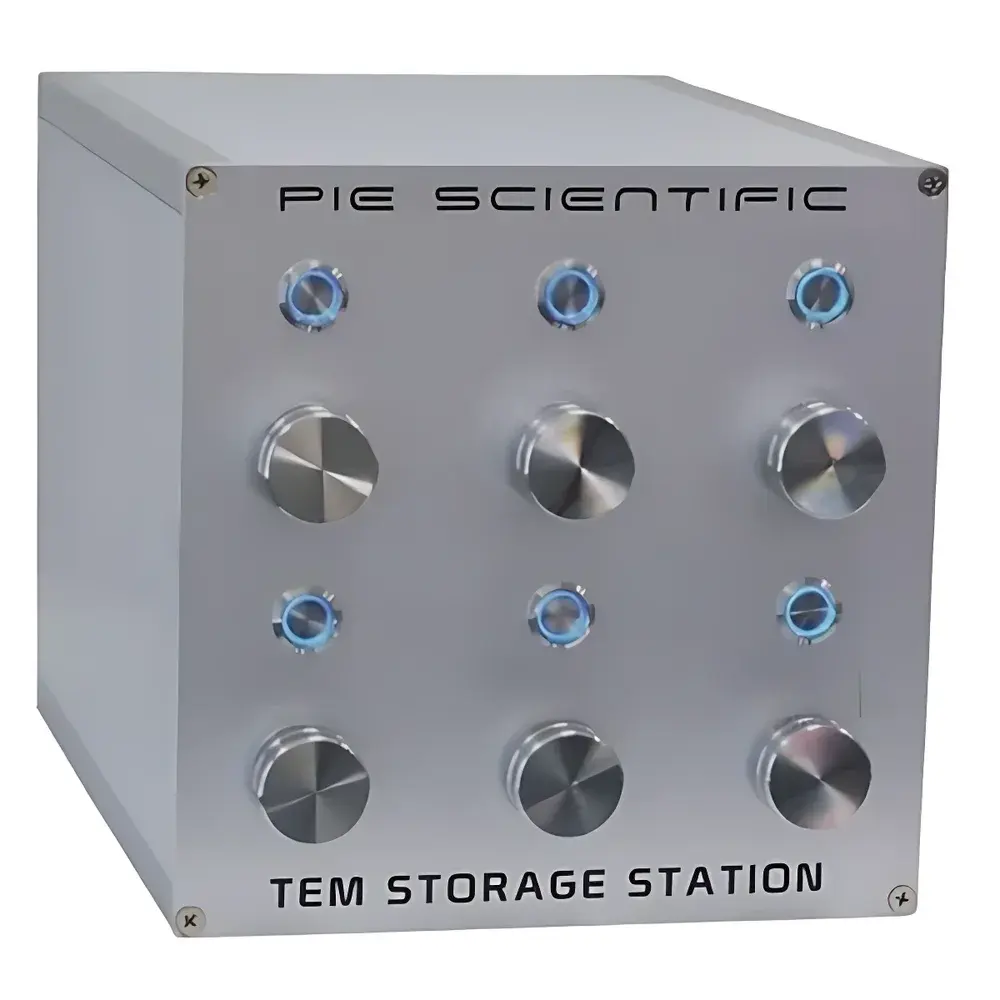
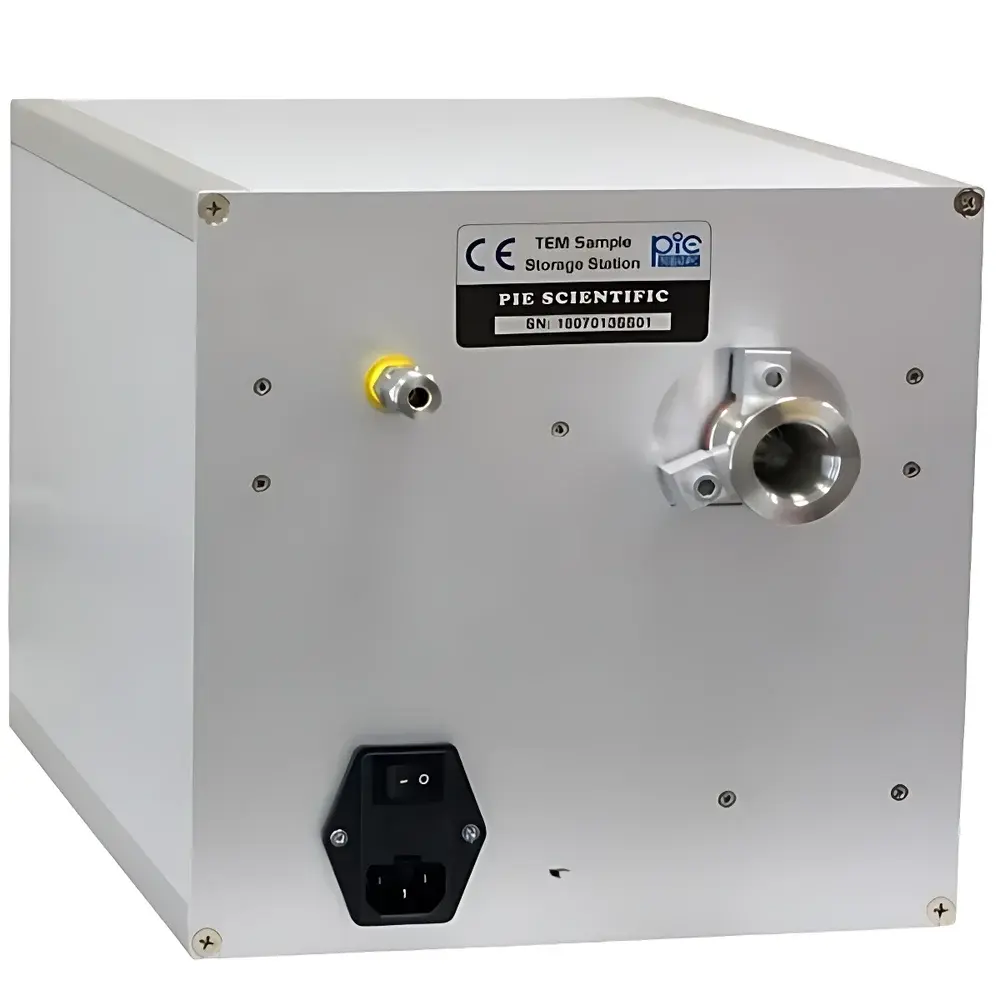
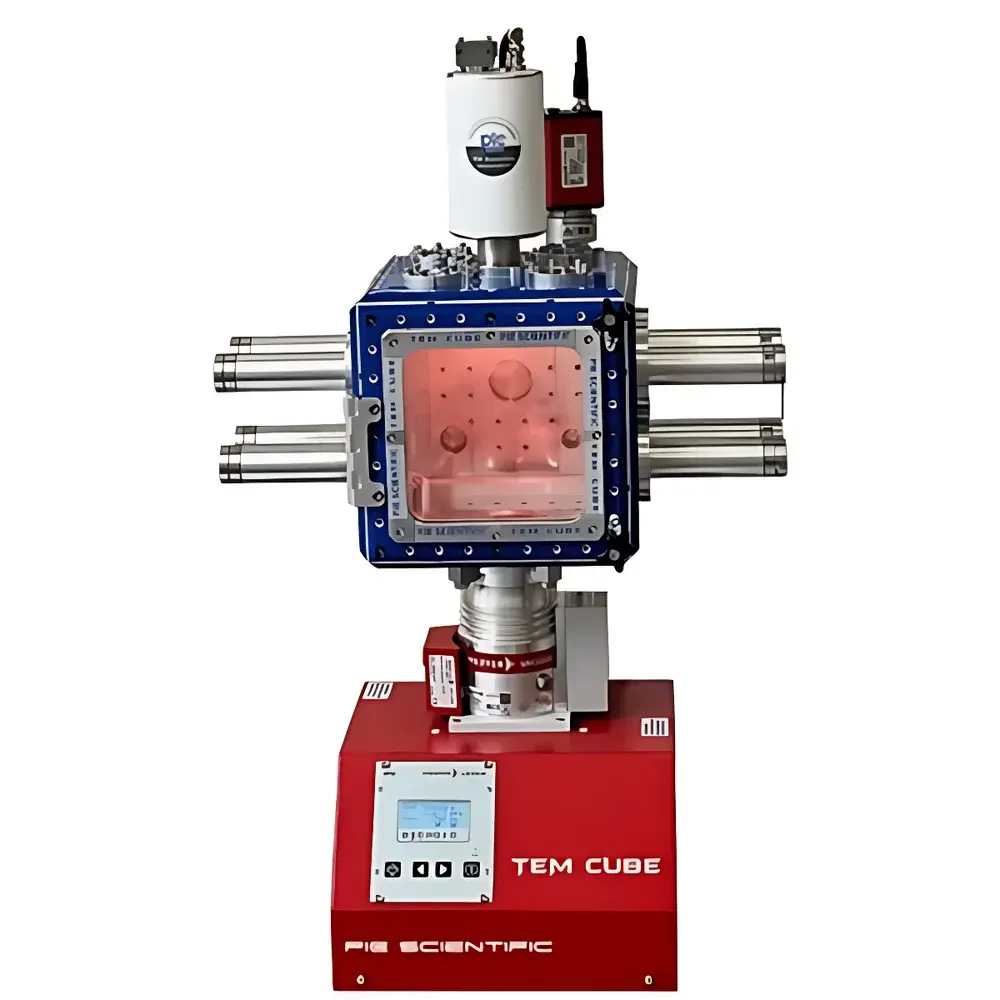
TEM Cube Plasma Cleaning & High-Vacuum Storage Station for TEM/SEM Sample Holders
| Brand | PIE |
|---|---|
| Origin | USA |
| Model | TEM Cube |
| Vacuum Performance | ≤1×10⁻⁷ Torr (with turbomolecular pump) |
| Chamber Dimensions | 9 in × 9 in × 9 in (229 mm × 229 mm × 229 mm) |
| Sample Holder Capacity | Up to 8 TEM holders (4 per side) with universal adapters for JEOL, Hitachi, Thermo Fisher/FEI, and ZEISS systems |
| Plasma Source | EM-KLEEN remote RF plasma source (O₂, H₂, or ambient air compatible) |
| Vacuum Isolation | Electromagnetically actuated valves per holder port |
| Pump Configuration | Separated turbomolecular or oil-free dry scroll vacuum station |
| Chamber Door | Hinged tempered glass door with mechanical locking knob |
| Operating Temperature | Slightly above ambient (±2 °C stability) |
| Compliance | Designed for GLP/GMP-aligned lab environments |
Overview
The TEM Cube Plasma Cleaning & High-Vacuum Storage Station is an engineered solution for the controlled storage, leak verification, and surface decontamination of transmission electron microscope (TEM) and scanning electron microscope (SEM) sample holders—commonly referred to as TEM sample rods or grid holders. Built upon a dual-function architecture, the system integrates a high-vacuum chamber (≤1×10⁻⁷ Torr with turbomolecular pumping) with a remotely coupled RF plasma source (EM-KLEEN), enabling both ultra-low-outgassing storage and non-destructive, residue-free surface cleaning via reactive oxygen or hydrogen radicals. Unlike ambient storage or inert-gas cabinets, the TEM Cube eliminates water vapor condensation, hydrocarbon adsorption, and particulate re-deposition during idle periods—critical for maintaining atomic-scale imaging fidelity, EELS signal integrity, and cryo-EM reproducibility. Its modular design supports integration into centralized vacuum networks and aligns with operational requirements for regulated laboratories performing materials characterization under ISO/IEC 17025 or FDA-aligned quality systems.
Key Features
- Universal holder compatibility: Eight precision-machined adapter ports accommodate standard TEM sample rods from JEOL, Hitachi, Thermo Fisher Scientific (formerly FEI), and ZEISS—four per vertical mounting plane.
- Dual-mode vacuum architecture: Independent electromagnetic valve control per holder port enables selective venting without compromising vacuum integrity across remaining units—supporting concurrent storage, leak testing, and plasma treatment protocols.
- Remote RF plasma source (EM-KLEEN): Generates low-energy O• and H• radicals from O₂, H₂, or filtered ambient air—minimizing ion bombardment damage while removing organic contaminants, hydrocarbons, and adventitious carbon layers.
- Modular vacuum subsystem: Turbomolecular or oil-free dry scroll pump options mounted externally for service accessibility; all vacuum lines constructed from electropolished stainless steel to suppress outgassing and particle generation.
- Thermally stabilized chamber: Maintains a uniform +2 °C offset above ambient temperature to accelerate outgassing kinetics without inducing thermal stress on delicate holder components or MEMS-based chips.
- Interoperable plasma deployment: The EM-KLEEN source is mechanically detachable and can be reinstalled on SEM, FIB-SEM, or XPS chambers for in-situ vacuum system cleaning—extending utility beyond TEM sample management.
Sample Compatibility & Compliance
The TEM Cube is validated for use with solid-state TEM holders—including single-tilt, double-tilt, heating, cooling, and in-situ biasing rods—as well as silicon nitride membrane grids, graphene liquid cells, and microelectromechanical systems (MEMS) chips. It complies with ASTM E2736–21 (“Standard Guide for Handling Specimens for Transmission Electron Microscopy”) regarding contamination control and vacuum conditioning. The system’s vacuum integrity, valve sequencing logic, and plasma exposure parameters support audit-ready documentation for GLP and GMP environments. Full vacuum log export (pressure vs. time, valve state timestamps) is available via RS-232 or Ethernet interface for 21 CFR Part 11–compliant data archiving when paired with validated LIMS or ELN platforms.
Software & Data Management
The TEM Cube operates via a dedicated embedded controller with real-time pressure monitoring (capacitance manometer + cold cathode gauge), programmable plasma duty cycles (0.1–10 min), and automated multi-step protocols (e.g., pump-down → leak check → plasma clean → storage). All operational parameters—including valve actuation events, pressure transients, and plasma ignition logs—are timestamped and exportable as CSV or XML. Optional integration with PIE’s LabLink™ software suite enables centralized fleet monitoring, predictive maintenance alerts (pump runtime, plasma electrode wear estimation), and electronic signature–enabled SOP execution for regulated workflows.
Applications
- Prolonged vacuum storage of TEM holders between experiments to prevent moisture adsorption and oxide formation on tungsten tips or Cu grids.
- In-situ leak testing of gas-tight holders used in environmental TEM or in-situ reaction cells using pressure-rise rate analysis.
- Pre-acquisition cleaning of TEM grids to reduce background carbon contamination and improve signal-to-noise ratio in HAADF-STEM and EDS mapping.
- Reconditioning of reused holders after FIB lift-out or focused ion beam thinning to remove Ga⁺ implantation residues.
- Vacuum preconditioning of MEMS-based in-situ chips prior to cryo-transfer to avoid ice nucleation during plunge freezing.
- Plasma-assisted chamber cleaning of adjacent SEM/FIB systems using the removable EM-KLEEN module—reducing downtime associated with manual solvent wiping or bake-out procedures.
FAQ
Can the TEM Cube accommodate custom or non-standard sample holders?
Yes—adapter plates are available for OEM-specific geometries upon request; dimensional drawings and flange specifications must be provided for mechanical validation.
Is plasma cleaning compatible with sensitive TEM grid coatings (e.g., ultrathin carbon, graphene oxide)?
Yes—low-power, remote plasma operation minimizes energetic ion flux; process optimization (gas type, power, duration) is recommended for each coating class and is supported by PIE application engineering.
How does the TEM Cube interface with existing lab vacuum infrastructure?
It supports standard NW40/KF40 vacuum flanges and can be daisy-chained with Tergeo-EM or other PIE vacuum systems using shared turbomolecular pumping stations.
What maintenance intervals are recommended for the EM-KLEEN plasma source?
Electrode inspection every 500 hours of cumulative plasma operation; quartz window cleaning every 200 hours; full source recalibration annually or after major component replacement.
Does the system meet electromagnetic compatibility (EMC) requirements for installation near sensitive electron optics?
Yes—the RF plasma generator includes integrated EMI shielding and meets CISPR 11 Group 1 Class B emission limits; magnetic field emissions at 1 m distance are <0.1 µT RMS across 10 kHz–1 GHz.




