
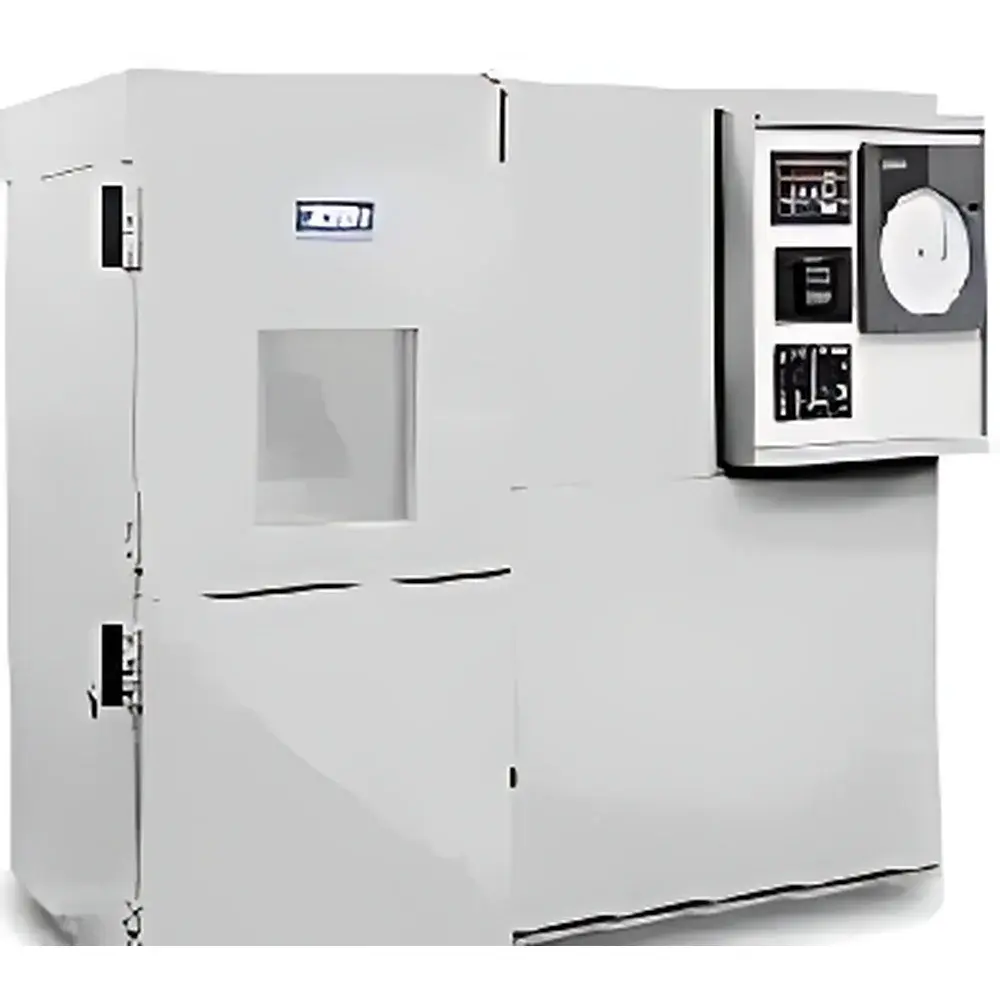
Tenney Thermal Shock Chamber
| Origin | USA |
|---|---|
| Manufacturer Type | Authorized Distributor |
| Origin Category | Imported |
| Model | Tenney |
| Pricing | Available Upon Request |
Overview
The Tenney Thermal Shock Chamber is an engineered environmental test system designed to evaluate material and component reliability under rapid, extreme temperature transitions. Utilizing a multi-zone chamber architecture—available in dual- or triple-zone configurations—the system subjects test specimens to controlled, high-rate thermal cycling between predefined hot and cold extremes. This methodology adheres to standardized thermal shock test protocols defined in MIL-STD-810H Method 503.7, IEC 60068-2-14, and ASTM D5794. The chamber operates on the principle of physical separation of temperature zones with independent thermal control, enabling precise dwell times, transition rates (typically ≤ 15 seconds between zones), and repeatable thermal gradients. Its robust construction and sealed thermal pathways ensure minimal cross-contamination between zones and high test reproducibility—critical for qualifying aerospace electronics, automotive ECUs, medical device housings, and high-reliability PCB assemblies.
Key Features
- Vapor-tight interior liners fabricated from 100% continuously welded 316 stainless steel—eliminating crevices, preventing moisture ingress, and ensuring long-term corrosion resistance in humid or condensing environments.
- Advanced PID-based digital control system with alphanumeric touchscreen interface, supporting programmable profiles, real-time monitoring, alarm logging, and seamless integration into facility-wide environmental test networks.
- Configurable platform: available in both vertical and horizontal orientations to accommodate spatial constraints and ergonomic loading requirements; dual-zone (hot/cold) and triple-zone (hot/ambient/cold) variants support expanded test matrix flexibility.
- Automated carriage transport mechanism with precision positioning—equipped with a large-diameter stainless steel wire mesh basket (standard 304 SS, optional electropolished 316) for uniform airflow distribution and minimal thermal mass interference during transfer.
- Insulated chamber walls with high-density polyurethane foam (≥ 100 mm thickness) and vacuum-jacketed door seals deliver exceptional thermal efficiency and stable zone isolation—even during extended dwell cycles at −70 °C to +200 °C operating ranges (model-dependent).
Sample Compatibility & Compliance
The Tenney Thermal Shock Chamber accommodates a broad range of sample geometries—from small SMT components mounted on test boards to assembled modules up to 610 × 610 × 610 mm (24″ × 24″ × 24″). Standard baskets support fixtures, trays, and custom jigs compliant with IPC-A-610 and JEDEC J-STD-020 handling guidelines. All models are designed and validated per UL 61010-1 (Safety Requirements for Electrical Equipment for Measurement, Control, and Laboratory Use) and meet CE marking requirements for EMC (EN 61326-1) and Low Voltage Directive (2014/35/EU). Optional IQ/OQ documentation packages support GLP, GMP, and ISO/IEC 17025-accredited laboratory validation workflows.
Software & Data Management
The integrated controller supports native data logging at user-defined intervals (down to 1-second resolution) with timestamped CSV export via USB or Ethernet. Optional TenneyLink™ software enables remote monitoring, multi-chamber fleet management, automated report generation (PDF/Excel), and audit-trail-compliant event history—including operator login, profile edits, and alarm acknowledgments. When configured with FDA 21 CFR Part 11–compliant firmware, the system provides electronic signatures, role-based access control, and immutable audit logs suitable for regulated pharmaceutical and biotech applications.
Applications
- Qualification testing of solder joint integrity and intermetallic growth in lead-free electronics per IPC-TM-650 2.6.26.
- Validation of hermetic seal performance in MEMS sensors and implantable devices.
- Accelerated life-cycle assessment of polymer encapsulants, conformal coatings, and adhesive bonds.
- Thermal fatigue evaluation of power semiconductor packages (e.g., SiC MOSFETs, IGBT modules) under repeated ΔT > 100 K transitions.
- Pre-certification screening for automotive AEC-Q200 stress tests and aerospace DO-160 Section 4.11 thermal shock requirements.
FAQ
What temperature ranges are supported across Tenney thermal shock models?
Standard configurations operate from −70 °C to +200 °C; extended-range variants reach −80 °C to +225 °C. Exact limits depend on zone configuration and refrigeration architecture (mechanical cascade vs. LN₂ assist).
Is the carriage transfer time adjustable?
Yes—transfer duration is programmable within 5–30 seconds, with position repeatability ±0.5 mm, verified via laser displacement calibration during factory acceptance testing.
Can the chamber be integrated into an existing MES or LIMS environment?
Via Modbus TCP or optional OPC UA server module, enabling bidirectional communication with LabVantage, STARLIMS, or Siemens Opcenter Execution systems for traceable test execution and data lineage.
Does Tenney provide validation support for ISO 17025 laboratories?
Yes—factory-issued IQ/OQ documentation, NIST-traceable sensor calibration certificates, and on-site SAT (Site Acceptance Testing) services are available upon request.



