
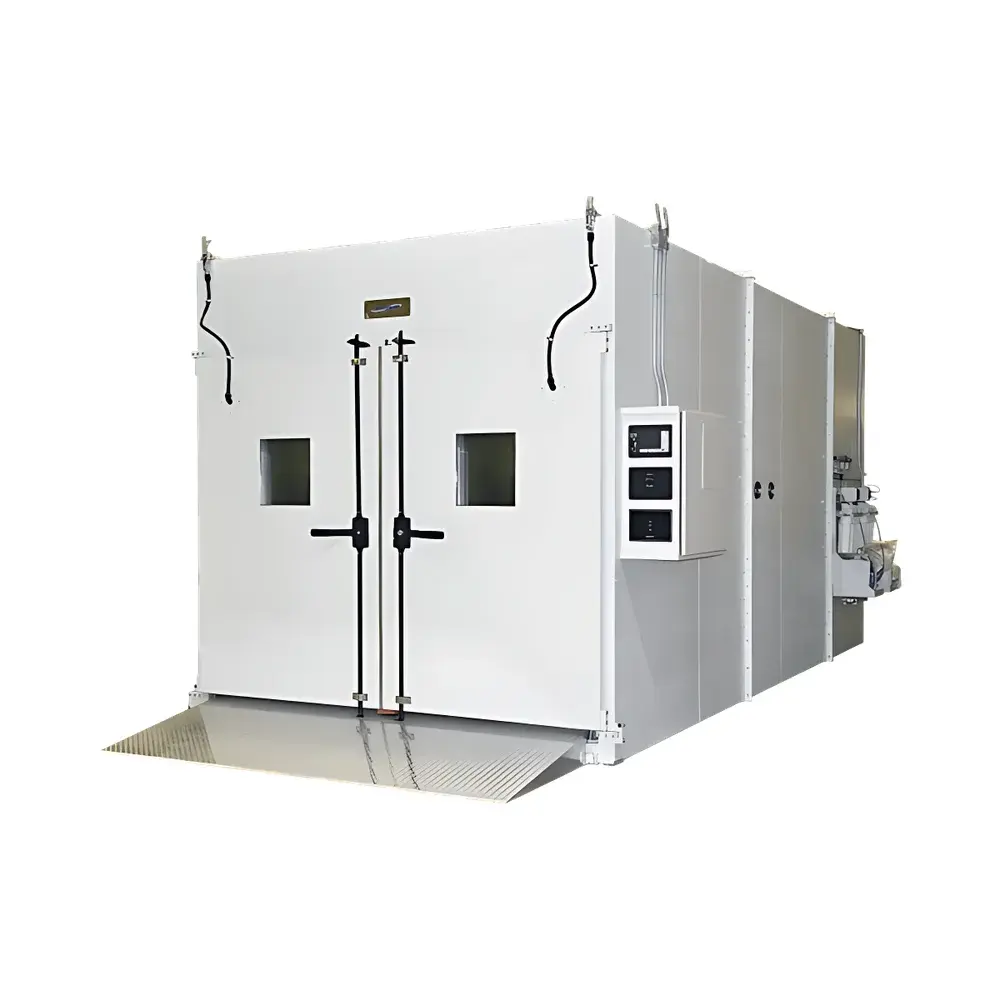
Tenney Walk-In Environmental Test Chamber – Climate Simulation System
| Brand | Blue M |
|---|---|
| Origin | USA |
| Model | Walk-In Environmental Test Chamber |
| Temperature Range | Ambient to +200°C |
| Temperature Uniformity | ±1.0°C |
| Temperature Stability | ±0.5°C |
| Temperature Deviation | ±1.0°C |
| Ramp-Up Time | ≤100 min (to +200°C) |
| Interior Dimensions (W×H×D) | 1016 mm × 2057 mm × 2007 mm to 1626 mm × 2616 mm × 2515 mm |
| Construction | Stainless steel interior, galvanized exterior, 102 mm (4″) polyurethane insulated panels |
| Humidity Range | 20–95% RH (at 20–70°C, dew point ≥5°C) |
| Floor Load Capacity | 340 kg/m² (750 lb/ft², uniformly distributed) |
| Refrigeration | Single-stage (“S”) or cascade (“C”) systems available |
| Heating | Open-coil NiCr heating elements on ceramic insulators |
| Air Circulation | Dual centrifugal blowers, horizontal downward airflow |
| Controller | Synergy Quattro touchscreen PID controller with Ethernet (TCP/IP), RS-232, USB, and flash memory support |
Overview
The Tenney Walk-In Environmental Test Chamber – Climate Simulation System is an industrial-grade, fully enclosed thermal and climatic testing environment engineered for rigorous validation of large-scale components, subsystems, and finished products under reproducible, traceable, and standards-compliant conditions. Designed and manufactured in the USA by Blue M (a division of SPX FLOW), this chamber operates on fundamental principles of convective heat transfer, forced-air circulation, and precision psychrometric control to simulate real-world environmental stressors—including extreme temperature exposure, thermal cycling, and humidity-induced degradation—over extended durations. Its structural integrity, calibrated sensor network, and closed-loop feedback architecture ensure long-term operational stability across thousands of test cycles, making it suitable for mission-critical applications in aerospace, automotive, defense, medical device manufacturing, and electronics reliability engineering. The chamber meets foundational design requirements aligned with ASTM E145, IEC 60068-2, MIL-STD-810G, and ISO 16750-4 for environmental stress screening and accelerated aging protocols.
Key Features
- Synergy Quattro touchscreen controller with 320 × 240 color LCD, English-language interface, and real-time clock—supporting unlimited programmable profiles with multi-step ramp-soak-hold sequences
- Dual-channel PID control with adaptive tuning; automatically adjusts heating, cooling, and humidification output based on chamber loading, thermal mass, and ambient conditions
- Robust mechanical construction: seamless welded stainless steel interior, galvanized structural frame, and 102 mm (4″) high-density polyurethane insulation with vapor barrier
- Horizontal downward airflow system with two centrifugal blowers and aluminum finned copper evaporator coils for uniform thermal distribution and minimized stratification
- Tenney Steam-Flow humidity generation system with stainless steel steam generator, ceramic-insulated heating elements, and integrated condensate management
- Comprehensive safety architecture: high/low pressure switches, oil-level monitors, overtemperature cutouts, door interlock circuits, and optional gas detection or fire suppression interfaces
- Modular panel design enables factory pre-assembly, field installation in constrained spaces, and future scalability via expansion kits or auxiliary ports
Sample Compatibility & Compliance
The chamber accommodates full-size assemblies—including avionics racks, electric vehicle battery modules, HVAC units, military shelters, and industrial control cabinets—up to 1626 mm (W) × 2616 mm (H) × 2515 mm (D). Its floor-rated load capacity of 340 kg/m² supports heavy-duty fixtures and test instrumentation without compromising thermal uniformity. All critical measurement points are equipped with traceable 100 Ω platinum RTD sensors (Class A, IEC 60751), calibrated per NIST-traceable procedures. Data logging complies with FDA 21 CFR Part 11 requirements when configured with audit-trail-enabled firmware and user-access controls. Validation documentation—including IQ/OQ protocols, temperature mapping reports (per ISO 14644-3), and uncertainty budgets—is available upon request to support GLP, GMP, and AS9100-certified quality systems.
Software & Data Management
The Synergy Quattro controller embeds Microsoft Windows CE OS and provides native support for data acquisition, alarm event logging, and remote diagnostics. Test parameters and real-time sensor values (air temperature, chamber RH, steam pressure, compressor status) are stored internally on flash memory or exported via USB, PCMCIA card, or Ethernet to external SCADA or LIMS platforms. Built-in TCP/IP communication enables integration into Industry 4.0 architectures using Modbus TCP or custom RESTful APIs. Optional software packages include Tenney’s ChamberLink™ for centralized fleet monitoring, automated report generation (PDF/CSV), and deviation alerting via email or SNMP traps. All logged data retains time-stamped metadata, operator ID, and version-controlled configuration snapshots for full regulatory traceability.
Applications
This chamber serves as a primary tool for thermal aging per ASTM D573 and ISO 188, high-temperature storage qualification (e.g., JEDEC J-STD-020 for semiconductor packaging), burn-in testing of power electronics, corrosion resistance evaluation under cyclic humidity, and validation of material dimensional stability per ISO 291. It is routinely deployed in R&D labs for climate stress screening prior to HALT/HASS, in production QA for lot-release verification, and in certification labs supporting UL 508A, EN 60068-2-1/2/14/30, and DO-160 Section 4/5 compliance testing. Its wide operating envelope—from ambient to +200°C—and precise humidity control make it uniquely suited for evaluating polymer degradation, sealant adhesion loss, solder joint fatigue, and battery electrolyte volatility.
FAQ
What is the standard calibration interval for RTD sensors in this chamber?
Per manufacturer recommendation and ISO/IEC 17025 guidelines, RTDs should be verified annually using a NIST-traceable dry-block calibrator or liquid bath, with additional verification performed after major maintenance or relocation.
Can the chamber operate continuously at +200°C without humidity control?
Yes—the dry-heat mode disables the steam generator and dehumidification circuit, enabling stable operation at maximum temperature with <±0.5°C stability over 72-hour periods.
Is remote monitoring supported without third-party middleware?
Yes—native Ethernet connectivity allows direct web-browser access to live chamber status, historical trends, and alarm history via embedded HTTP server; no external gateway required.
What electrical and utility connections are required for installation?
Three-phase 208–480 VAC power (capacity depends on model size and refrigeration type), compressed air (for pneumatic door seals, if specified), and deionized water supply (for steam generation); detailed specifications provided in the Installation Manual.
Does Tenney offer validation services for IQ/OQ/PQ execution?
Yes—certified Field Application Engineers provide on-site protocol development, execution, and final documentation compliant with FDA, ISO 13485, and aerospace quality standards.



