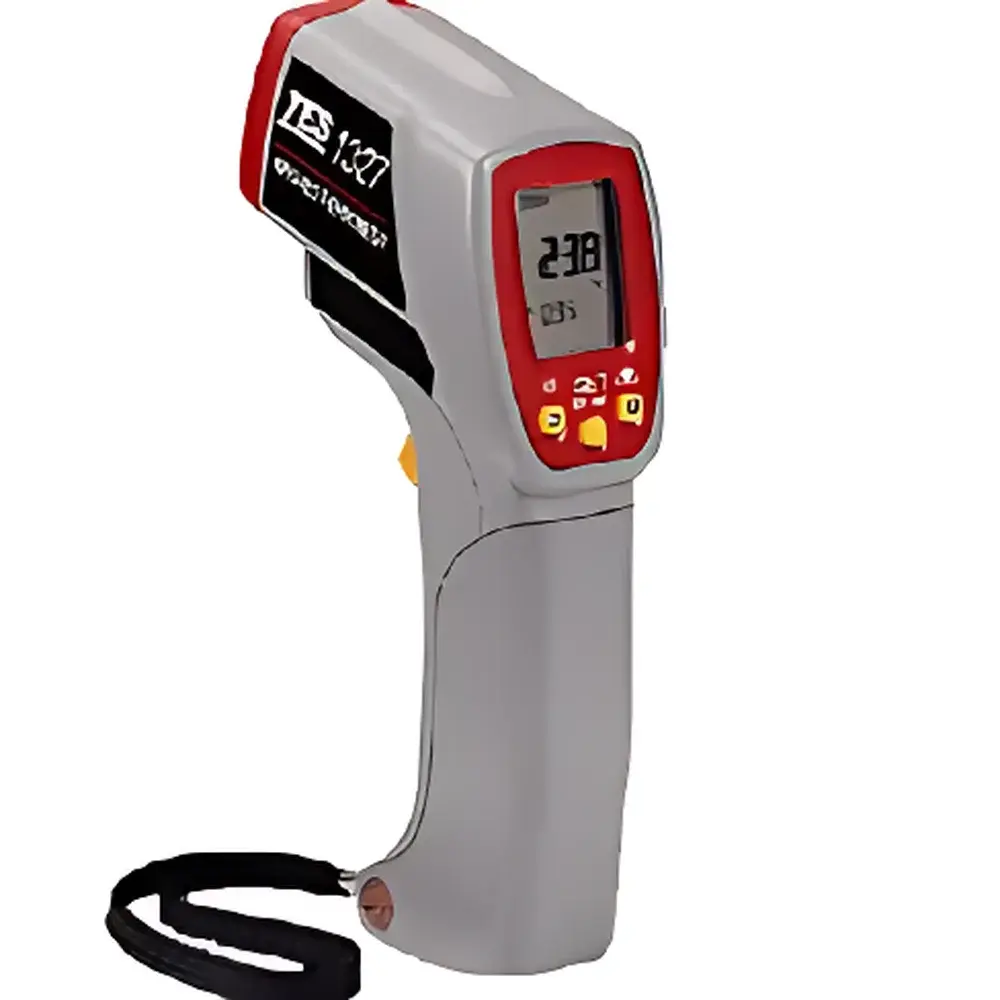
TES-1327 Infrared Thermometer by TES (Taiwan)
| Brand | TES |
|---|---|
| Origin | Taiwan |
| Model | TES-1327 |
| Measurement Range | -35 °C to +500 °C (-31 °F to 932 °F) |
| Resolution | 0.1 °C / 0.2 °F |
| Accuracy | ±2% of reading or ±2 °C (whichever is greater) |
| Spectral Response | 6–14 µm |
| Distance-to-Spot Ratio | 12:1 |
| Emissivity Adjustment | 0.17–1.00 |
| Laser Targeting | Class II, <1 mW |
| Memory Capacity | 50 data points |
| Display | Backlit LCD |
| Auto Power-Off | ~15 seconds |
| Battery | 9V alkaline (006P) |
| Operating Environment | 0–50 °C, ≤80% RH |
| Storage | -10–60 °C, ≤70% RH |
| Dimensions | 172 × 118 × 46 mm |
| Weight | 220 g |
Overview
The TES-1327 Infrared Thermometer is a handheld non-contact temperature measurement instrument engineered for industrial maintenance, HVAC diagnostics, electrical panel inspections, and general-purpose thermal verification tasks. It operates on the principle of passive infrared radiation detection—measuring the intensity of mid-wave infrared energy emitted from a surface within the 6–14 µm spectral band, which corresponds closely to the peak emissive range of most common materials at ambient to elevated temperatures. The device calculates surface temperature based on Planck’s law of blackbody radiation, applying user-configurable emissivity compensation to improve measurement fidelity across diverse material types. With a 12:1 optical distance-to-spot ratio, the TES-1327 enables reliable targeting of objects as small as ~8.3 mm in diameter at a 100 mm working distance, making it suitable for localized thermal assessment without physical contact—critical for safety-critical or inaccessible applications.
Key Features
- High-resolution digital display with adjustable backlight for low-light environments
- Adjustable emissivity (0.17–1.00) to accommodate metals, painted surfaces, plastics, ceramics, and oxidized materials
- Integrated Class II laser targeting system (<1 mW) for precise aiming alignment
- Onboard data logging capability storing up to 50 sequential measurements, accessible directly via LCD interface
- Max/Min value tracking for transient thermal events such as motor startup, transformer load cycling, or refrigerant line temperature gradients
- Programmable high/low alarm thresholds with audible beeper feedback upon threshold violation
- Automatic power-down after ~15 seconds of inactivity to extend battery service life
- Robust ergonomic housing designed for one-handed operation in field conditions
Sample Compatibility & Compliance
The TES-1327 is compatible with solid, non-reflective, and semi-matte surfaces commonly encountered in mechanical, electrical, and building systems. It is not intended for use on highly reflective metals (e.g., bare aluminum or stainless steel) without surface treatment or emissivity correction. While not certified for medical or food-grade process control, its performance aligns with general-purpose industrial measurement requirements referenced in ASTM E1933-19 (Standard Test Methods for Measuring and Compensating for Emissivity Using Infrared Imaging Systems) and ISO 18434-1:2008 (Condition monitoring and diagnostics of machines — Thermography — Part 1: General procedures). No intrinsic safety (ATEX/IECEx) or FDA 21 CFR Part 11 compliance is claimed; users requiring audit-trail functionality must integrate external software solutions.
Software & Data Management
The TES-1327 does not support USB, Bluetooth, or PC connectivity. All data management occurs locally via the built-in 50-point memory buffer. Users may manually record values from the LCD display for inclusion in maintenance logs, CMMS entries, or thermal inspection reports. No proprietary firmware updates or calibration certificate traceability are provided by default; periodic recalibration against NIST-traceable reference sources is recommended per ISO/IEC 17025 guidelines when used in quality-critical workflows. The device lacks timestamping, batch tagging, or export capabilities—functionality typical of entry-level portable IR thermometers intended for routine spot-checking rather than regulated documentation.
Applications
- Electrical infrastructure: Identifying hot spots in circuit breakers, busbars, fuse holders, and connection terminals
- Mechanical systems: Monitoring bearing temperatures, pump casings, compressor discharge lines, and steam trap operation
- HVAC&R: Verifying duct surface temperatures, coil inlet/outlet differentials, refrigerant line superheat/subcooling estimates, and insulation integrity checks
- Building envelope diagnostics: Detecting thermal bridging, moisture-induced thermal anomalies, and window U-value estimation support
- Manufacturing support: Quick verification of mold surface temps, curing oven uniformity, and post-process cooling rates
- Automotive service: Assessing radiator efficiency, exhaust manifold heat distribution, and brake rotor thermal asymmetry
FAQ
What is the spectral response range of the TES-1327, and why does it matter?
The sensor operates in the 6–14 µm band, optimized for measuring near-ambient to moderately high temperatures (–35 °C to 500 °C) with minimal atmospheric absorption interference.
Can the TES-1327 measure through glass or plastic covers?
No—standard silicate glass and most transparent polymers are opaque in this spectral band; measurements must be taken on exposed surfaces.
How is emissivity adjusted, and what reference values should I use?
Emissivity is set manually via the front-panel keypad; typical values include 0.95 for asphalt, 0.85–0.90 for painted metal, 0.60–0.70 for oxidized steel, and 0.30–0.40 for polished aluminum.
Is the laser pointer used for measurement or only for aiming?
The laser serves exclusively as an aiming aid—it contributes no energy to the measurement and does not affect radiometric accuracy.
Does the device meet any international calibration standards?
The unit is factory-calibrated but does not ship with a NIST-traceable certificate; third-party calibration services compliant with ISO/IEC 17025 are recommended for metrologically sensitive applications.