
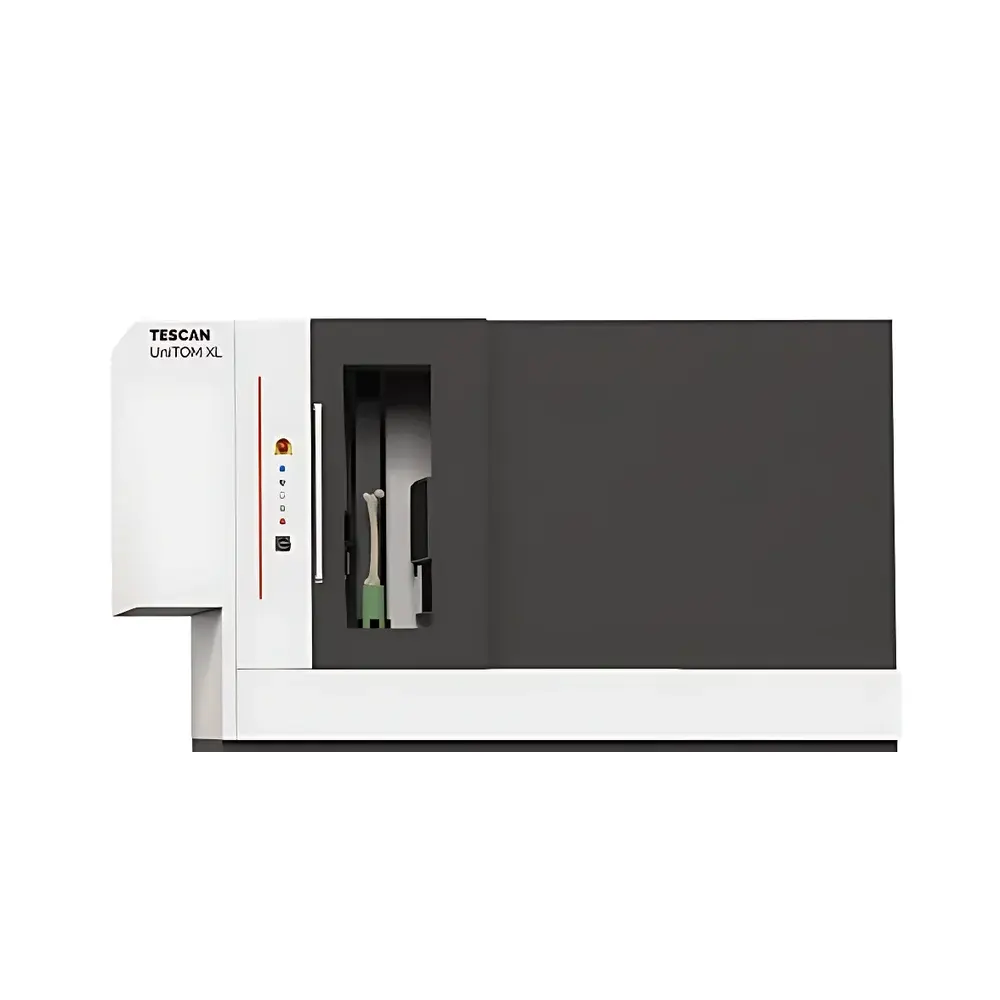
TESCAN UniTOM XL High-Resolution Industrial Micro-CT System
| Brand | TESCAN |
|---|---|
| Origin | Belgium |
| Manufacturer Type | Original Equipment Manufacturer (OEM) |
| Origin Category | Imported |
| Model | UniTOM XL |
| Pricing | Available Upon Request |
Overview
The TESCAN UniTOM XL is a high-throughput, laboratory-based industrial micro-computed tomography (micro-CT) system engineered for non-destructive 3D imaging and quantitative analysis of materials across research and industrial quality assurance environments. Operating on the principle of cone-beam X-ray computed tomography, the system reconstructs volumetric datasets by acquiring hundreds of 2D projection images as the sample rotates through 360°, followed by GPU-accelerated filtered back-projection or iterative reconstruction algorithms. Designed for structural integrity assessment, porosity quantification, phase distribution mapping, and in situ mechanical or thermal testing, the UniTOM XL delivers true spatial resolution down to 3 µm—achievable without compromising field-of-view flexibility or sample handling capacity. Its high-power microfocus X-ray source, coupled with a large-area, low-noise flat-panel detector, ensures high signal-to-noise ratio (SNR) even at accelerated acquisition speeds, enabling sub-10-second temporal resolution for dynamic 4D studies.
Key Features
- True 3 µm spatial resolution achievable across full-field-of-view configurations, validated per ISO 15732 and ASTM E1441 standards for CT performance characterization.
- Maximum sample envelope of Ø500 mm × H1150 mm—compatible with industrial components including turbine blades, battery modules, composite laminates, and geological cores.
- Modular architecture supporting field-upgradable hardware: interchangeable X-ray sources (e.g., tungsten or transmission-target variants), detector options (including high-dynamic-range scintillator configurations), and mechanical stages optimized for in situ loading or environmental chambers.
- Real-time region-of-interest (ROI) navigation: live overview scan enables intuitive selection and zoom into sub-regions for targeted high-resolution scanning—reducing total experiment time while preserving metrological traceability.
- Ruggedized gantry design with active vibration damping and thermal stabilization—ensuring long-term dimensional stability required for repeatable metrology-grade measurements under GLP/GMP-aligned workflows.
Sample Compatibility & Compliance
The UniTOM XL accommodates diverse material classes—including metals, ceramics, polymers, foams, rocks, and biological tissues—without requiring conductive coating or vacuum compatibility. Its open geometry supports integration with third-party in situ rigs (e.g., uniaxial tensile stages, heating/cooling cells, electrochemical cells) for time-resolved 4D tomography. All system operation and data handling comply with ISO/IEC 17025 requirements for testing laboratories; raw projection data and reconstructed volumes are stored in DICOM and HDF5 formats, ensuring interoperability with FAIR data principles. Audit trails, user access controls, and electronic signatures within Acquila software support adherence to FDA 21 CFR Part 11 for regulated industries.
Software & Data Management
Acquila is a purpose-built, modular software platform developed exclusively for TESCAN micro-CT systems. It provides end-to-end workflow control—from experimental planning and automated scan parameter optimization to GPU-accelerated reconstruction (including FDK, SART, and iterative regularization methods) and post-processing via integrated segmentation, mesh generation, and quantitative morphometry tools. Acquila supports scripting (Python API) for batch processing and integrates natively with external hardware controllers via TTL, analog I/O, and TCP/IP protocols—enabling synchronized triggering of mechanical actuators or environmental sensors during acquisition. All metadata—including acquisition parameters, calibration logs, and operator annotations—are embedded directly into reconstructed volume files for full traceability.
Applications
- Materials science: pore network analysis in catalysts and battery electrodes per ISO 23273; fiber orientation mapping in carbon-fiber composites.
- Failure analysis: detection and volumetric quantification of internal cracks, voids, delaminations, and solder joint defects in electronics packaging.
- Geosciences: digital rock physics modeling, permeability prediction, and mineral phase segmentation using machine learning–assisted classification.
- Manufacturing QA: GD&T-compliant dimensional inspection of additively manufactured parts against CAD models; wall thickness analysis per ASME Y14.5.
- In situ studies: real-time monitoring of deformation, crack propagation, fluid infiltration, or phase transformation under controlled load/temperature conditions.
FAQ
What is the minimum detectable feature size under standard operating conditions?
The system achieves a verified true spatial resolution of ≤3 µm under optimal contrast conditions (e.g., high-Z/low-Z interfaces), as measured using line-pair phantoms per ISO 15732 Annex C.
Can the UniTOM XL be integrated with existing in situ mechanical testing equipment?
Yes—its open software architecture and standardized I/O interface allow seamless synchronization with commercial load frames, thermal chambers, and electrochemical workstations via hardware triggers and shared time stamps.
Is Acquila software compliant with 21 CFR Part 11 for pharmaceutical or medical device applications?
Acquila supports role-based user authentication, electronic signatures, and immutable audit trails—meeting core technical requirements for Part 11 compliance when deployed in validated environments.
Does the system support automated batch scanning of multiple samples?
Yes—Acquila’s job scheduler enables unattended multi-sample workflows with programmable stage positioning, adaptive exposure control, and error recovery protocols.
What calibration standards are supplied with the system?
Each UniTOM XL includes NIST-traceable resolution and dimensional calibration phantoms, along with factory-generated geometric distortion maps and beam-hardening correction profiles.



