
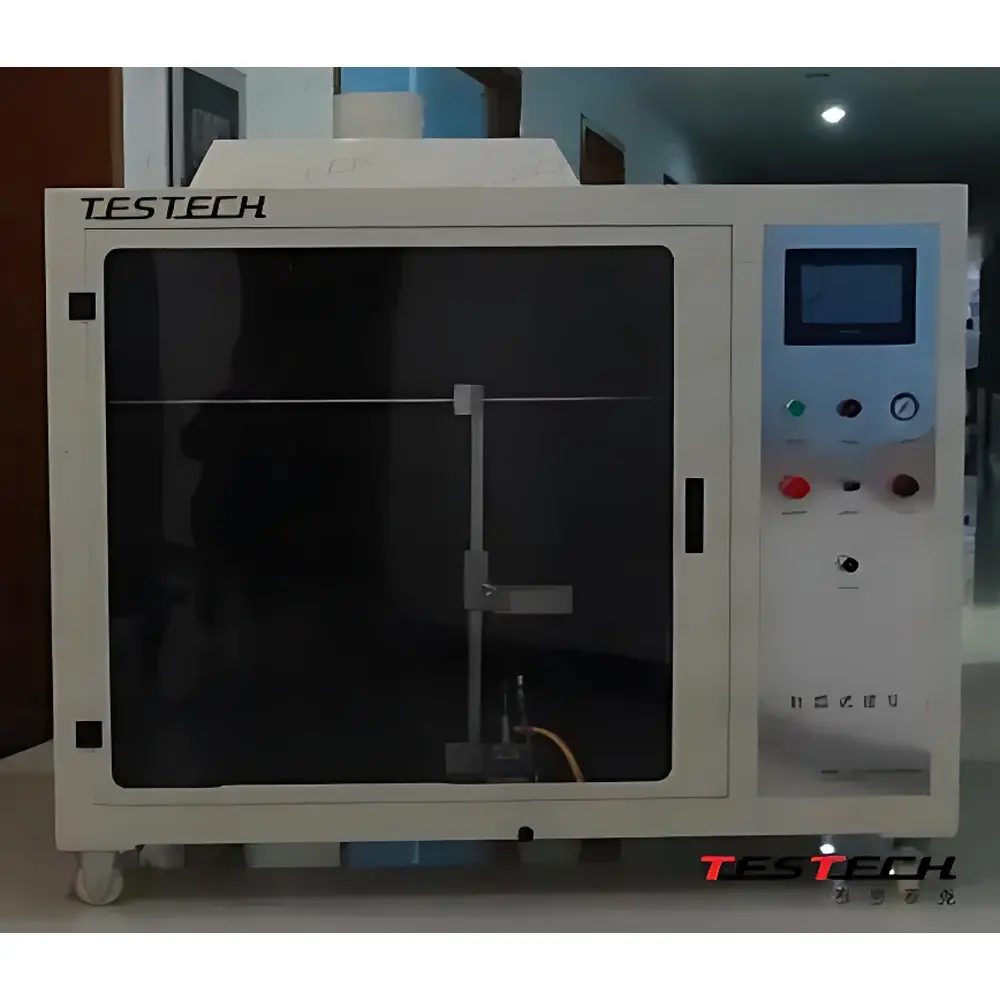
TESTech TTech-JG3050 Intelligent Rigid Conduit Flame Retardancy Tester
| Brand | TESTech |
|---|---|
| Origin | Jiangsu, China |
| Manufacturer Type | Manufacturer |
| Country of Origin | Domestic (China) |
| Model | TTech-JG3050 |
| Quotation | Upon Request |
| Combustion Chamber Dimensions | 650 mm × 400 mm × 1100 mm |
| Burner Nozzle ID | 9 mm Bunsen burner |
| Flame Angle Adjustment | 90° and 45° |
| Horizontal Flame Height | 100 mm |
| Blue Cone Flame Height | 50 mm |
| Timing Resolution | 0.1 s |
| Control System | PLC + 7-inch HMI touchscreen |
| Ignition Method | Pulse high-voltage electronic auto-ignition |
| Gas Pressure Regulation | Precision pressure gauge & needle valve |
| Sample Holder Material | 304 stainless steel |
| Power Supply | 220 V, 50/60 Hz with grounded socket |
Overview
The TESTech TTech-JG3050 Intelligent Rigid Conduit Flame Retardancy Tester is a purpose-built apparatus engineered to evaluate the self-extinguishing behavior of rigid electrical conduits under controlled flame exposure, in strict accordance with the Chinese industry standard JG 3050–1998, Clause 6.10. This instrument implements a single-tube vertical flame test methodology based on the principle of standardized ignition source application followed by observation of post-ignition flame propagation and extinguishment time. The device applies a calibrated Bunsen-type flame—generated from laboratory-grade propane or butane gas—to the specimen at defined angles (90° or 45°), durations, and heights, enabling quantitative assessment of flame resistance, afterflame time, afterglow time, and char length. Designed for use in quality control laboratories, building material certification centers, and R&D facilities, the TTech-JG3050 supports deterministic evaluation of flame retardancy performance for thermoplastic and thermosetting rigid conduit systems used in low-voltage electrical installations.
Key Features
- Robust combustion chamber constructed with powder-coated steel housing (650 × 400 × 1100 mm), offering corrosion resistance and structural integrity during repeated thermal cycling.
- High-precision 9 mm internal diameter imported Bunsen burner with adjustable mounting angle (90° vertical or 45° inclined), ensuring repeatable flame geometry and thermal flux distribution.
- Dual-mode flame height calibration: horizontal flame length settable to 100 mm; blue inner cone height adjustable to 50 mm using integrated needle valve and certified flame height gauge (304 stainless steel).
- PLC-driven control architecture with 7-inch industrial touchscreen HMI interface, supporting programmable test parameters including ignition duration, observation window, and pass/fail thresholds.
- Auto-ignition via pulse high-voltage electronic spark generator—eliminating manual lighting and reducing operator variability.
- Integrated timing subsystem with ±0.1 s resolution, automatically logging start time, flame application duration, afterflame time, and afterglow time; all data stored locally with timestamping.
- Stainless steel sample holders and fixtures (AISI 304) ensure dimensional stability, oxidation resistance, and compliance with specimen positioning requirements in JG 3050–1998.
- Gas delivery system equipped with certified pressure gauge and fine-adjustment needle valve to maintain stable fuel pressure—critical for flame repeatability across test cycles.
- Grounded 220 V, 50/60 Hz power input with dedicated earth terminal, meeting basic electrical safety requirements for laboratory instrumentation.
Sample Compatibility & Compliance
The TTech-JG3050 is validated for testing rigid non-metallic conduits—including PVC, PE, PP, and FRP-based products—as specified in JG 3050–1998 for building wiring applications. Specimens must conform to dimensional tolerances outlined in the standard (e.g., nominal outer diameter ≥16 mm, wall thickness ≥1.6 mm). The tester accommodates variations in material thickness by allowing user-defined flame exposure times (e.g., 30 s, 60 s, or 120 s), enabling correlation between thermal insult severity and self-extinguishing response. While JG 3050–1998 remains its primary reference, the instrument’s modular flame control and precise timing capabilities permit adaptation to related methodologies such as GB/T 1410–2006 (surface resistivity) or supplementary assessments aligned with IEC 60695-11-10 for glow-wire ignition temperature screening. It does not substitute for UL 94 or ISO 5660 cone calorimetry but serves as a standardized pass/fail screening tool within regulated construction product workflows.
Software & Data Management
The embedded HMI firmware provides real-time display of flame status, elapsed time, and system diagnostics. Test sequences are configured via intuitive touchscreen menus—no external PC required. All timing events (ignition onset, flame removal, flame extinction, glow cessation) are captured, timestamped, and archived in non-volatile memory. Up to 100 test records can be retained onboard; data export is supported via USB interface in CSV format for traceability and integration into LIMS or QA documentation systems. Audit trails include operator ID (optional login), date/time stamps, parameter settings, and raw timing values—supporting GLP-aligned recordkeeping. The system does not implement FDA 21 CFR Part 11 electronic signature functionality but meets baseline data integrity requirements for internal QC reporting and third-party inspection audits.
Applications
- Verification of flame-retardant grade compliance for rigid insulating electrical conduits supplied to construction contractors and OEM panel builders.
- Pre-certification screening prior to submission to CNAS-accredited testing laboratories for formal JG 3050–1998 certification.
- Batch release testing in conduit manufacturing facilities to ensure consistency in halogen-free flame-retardant compound formulations.
- R&D support for polymer compounders developing novel flame-inhibited thermoplastics with improved charring behavior and reduced heat release rate.
- Technical training and demonstration in vocational institutions specializing in building electrical safety standards.
FAQ
What standard does the TTech-JG3050 strictly comply with?
It is engineered and verified for JG 3050–1998, Clause 6.10 “Flame Resistance Test for Rigid Conduits.”
Can this instrument be used for flexible conduits or cables?
No—JG 3050–1998 applies exclusively to rigid non-metallic conduits; flexible tubing or insulated wires require alternate test methods (e.g., GB/T 18380.12).
Is gas supply included with the system?
No—users must provide laboratory-grade propane or butane gas with appropriate pressure-regulated cylinder and flashback arrestor.
Does the system support remote monitoring or Ethernet connectivity?
Not natively—the current configuration relies on local HMI interaction and USB data retrieval; optional RS-485 or Modbus RTU expansion may be arranged upon request.
How is calibration verified?
Flame height is verified using the supplied 304 stainless steel ruler; timing accuracy is traceable to internal quartz oscillator (±0.1 s); annual verification against NIST-traceable stopwatch is recommended.



