
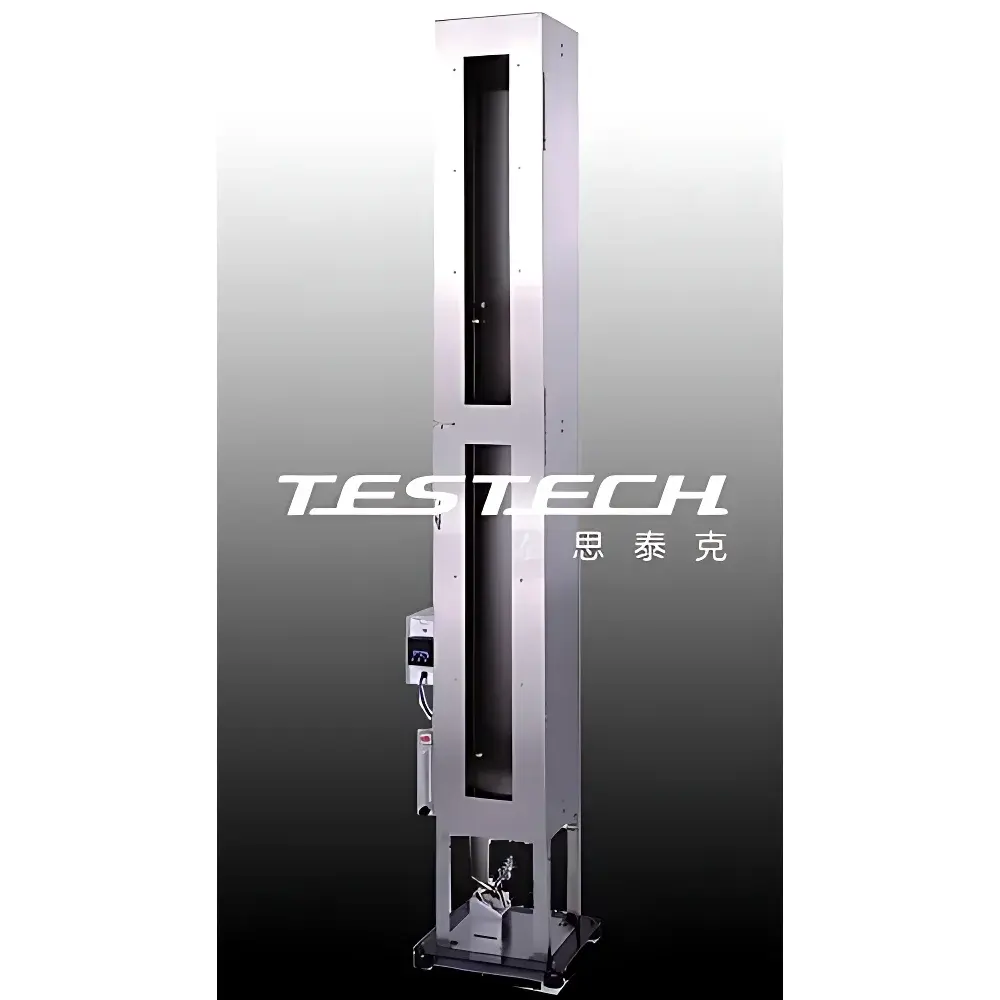
TESTech TTech-NFPA701 Large-Scale Vertical Fabric Combustion Test Chamber for NFPA 701 Method 2
| Brand | TESTech |
|---|---|
| Model | TTech-NFPA701 |
| Origin | Jiangsu, China |
| Manufacturer Type | Direct Manufacturer |
| Compliance | NFPA 701:2004, NFPA 701:2010 (Method 2) |
| Chamber Dimensions (L×W×H) | 500 × 500 × 2420 mm |
| Burner Type | Meker Burner per ASTM D5025 |
| Burner Orifice Diameter | 9.5⁺¹·⁵₋₀ mm |
| Burner Length | 100 ± 10 mm |
| Flame Angle | 25° from vertical |
| Flame Height | 280 ± 12 mm |
| Gas Supply Pressure | 17.5 ± 2.0 kPa |
| Gas Flow Rate | 113 ± 3 L/hr |
| Heat Output | 10,500 BTU/hr |
| Ignition Mode | Automatic spark ignition |
| Burn Time | Programmable up to 99 s (0.1 s resolution) |
| Gas Release Duration | Fixed 20 s |
| Sample Holder | Stainless steel clamp assembly |
| Chamber Lining | Calcium silicate board with 304 stainless steel exterior |
| Power Supply | 220 V, 50 Hz, 110 W |
| Net Weight | ~110 kg |
Overview
The TESTech TTech-NFPA701 is a large-scale vertical combustion test chamber engineered specifically for evaluating the flame propagation resistance of hanging textile materials in accordance with NFPA 701:2004 and NFPA 701:2010 (Test Method 2). This standardized test method quantifies the flammability behavior of vertically oriented fabrics—including curtains, draperies, banners, awnings, and outdoor decorative textiles—under controlled radiant and convective heat exposure from a calibrated Meker burner. Unlike small-scale screening tests, NFPA 701 Method 2 replicates real-world fire initiation conditions for heavy-weight or coated substrates, requiring specimens to be suspended freely without mechanical constraint. The apparatus operates on the principle of time-limited flame impingement followed by post-ignition observation, measuring critical pass/fail criteria including flame spread distance, afterflame duration, and char length. Its design adheres strictly to the dimensional, gas delivery, and burner geometry specifications outlined in ASTM D5025—the standard governing laboratory burners used in textile flammability testing.
Key Features
- Full-compliance Meker burner system conforming to ASTM D5025, featuring precision-machined orifice (9.5⁺¹·⁵₋₀ mm), fixed 25° tilt angle, and stable 280 ± 12 mm blue flame height at 17.5 ± 2.0 kPa supply pressure
- Programmable digital timer with 0.1-second resolution for precise control of 20-second gas release and total exposure duration (0–99 s)
- Automated spark ignition and flame extinction sequence eliminating manual intervention and improving inter-laboratory reproducibility
- Robust open-top chamber architecture with calcium silicate insulation board lining and 304 stainless steel cladding for thermal stability and corrosion resistance
- Dedicated stainless steel sample holder assembly designed to secure single- or multi-layer fabric specimens weighing ≥700 g/m² (21 oz/yd²), including PE-coated and laminated constructions
- Integrated mass flow-controlled propane/air delivery system calibrated to deliver 113 ± 3 L/hr at specified pressure—ensuring consistent heat flux across test cycles
Sample Compatibility & Compliance
The TTech-NFPA701 accommodates specimens up to 914 mm (36 in) in height and 152 mm (6 in) in width, supporting both single-layer and composite textile configurations. It is validated for use with non-water-resistant hanging fabrics commonly installed in commercial interiors, transportation interiors (e.g., bus/train curtains), and temporary outdoor structures. The system meets all physical and procedural requirements of NFPA 701:2010 Method 2, including burner positioning, specimen mounting geometry, ambient conditioning stipulations (23 ± 2 °C, 50 ± 5% RH), and post-test assessment protocols. While not intended for regulatory certification under UL 723 or ASTM E84, its output serves as primary evidence for third-party certification bodies assessing compliance with U.S. building codes (e.g., IBC Chapter 8), NFPA 101 Life Safety Code, and local fire marshal approvals.
Software & Data Management
This standalone mechanical test chamber does not incorporate embedded software or data logging firmware. All operational parameters—including ignition timing, exposure duration, and gas cutoff—are managed via front-panel electro-mechanical controls. Test records must be manually documented per GLP-aligned laboratory practice, with recommended adherence to FDA 21 CFR Part 11 principles when integrated into quality management systems. Users are advised to maintain traceable calibration logs for the Meker burner, pressure regulator, and flowmeter—each requiring annual verification against NIST-traceable standards. Optional external USB-connected high-speed thermal imaging cameras or flame photometers may be deployed for supplementary quantitative analysis, though such add-ons fall outside the scope of base-system validation.
Applications
- Flame resistance qualification of theatrical drapery and stage curtains for venues subject to NFPA 101 enforcement
- Pre-market evaluation of architectural textiles—including tensioned membrane facades and canopy systems—prior to ICC-ES listing
- Quality assurance testing for contract upholstery suppliers serving hospitality, healthcare, and education sectors
- Failure analysis of flame-retardant finish durability after repeated laundering or weathering exposure
- Comparative benchmarking of intumescent coatings applied to polyester-cotton blends and vinyl-laminated substrates
FAQ
Does the TTech-NFPA701 support NFPA 701 Method 1?
No. This model is exclusively configured for Method 2, which applies to heavier, non-washable hanging textiles. Method 1 is intended for lightweight, water-sensitive materials and requires a different burner orientation and specimen support mechanism.
Can the chamber be used with natural gas instead of propane?
No. NFPA 701 Method 2 mandates propane as the fuel source. Substitution with natural gas invalidates test compliance due to differences in stoichiometric air requirement and flame thermodynamics.
Is calibration certification included with shipment?
A factory calibration report verifying burner dimensions, flame height, gas pressure, and flow rate is provided. Full ISO/IEC 17025 accreditation requires on-site verification by an accredited metrology provider.
What maintenance is required between tests?
After each test cycle, the burner tip must be inspected for carbon buildup and cleaned with non-metallic tools; the calcium silicate liner should be checked for cracking or delamination; and the stainless steel sample clamp must be verified for mechanical integrity and oxidation resistance.
Does the system meet CE or UKCA marking requirements?
It is not CE-marked, as NFPA 701 is a U.S.-centric standard with no harmonized EU counterpart. For European markets, EN 13773 or EN 1107 series testing would require alternate instrumentation.
Related Products



