
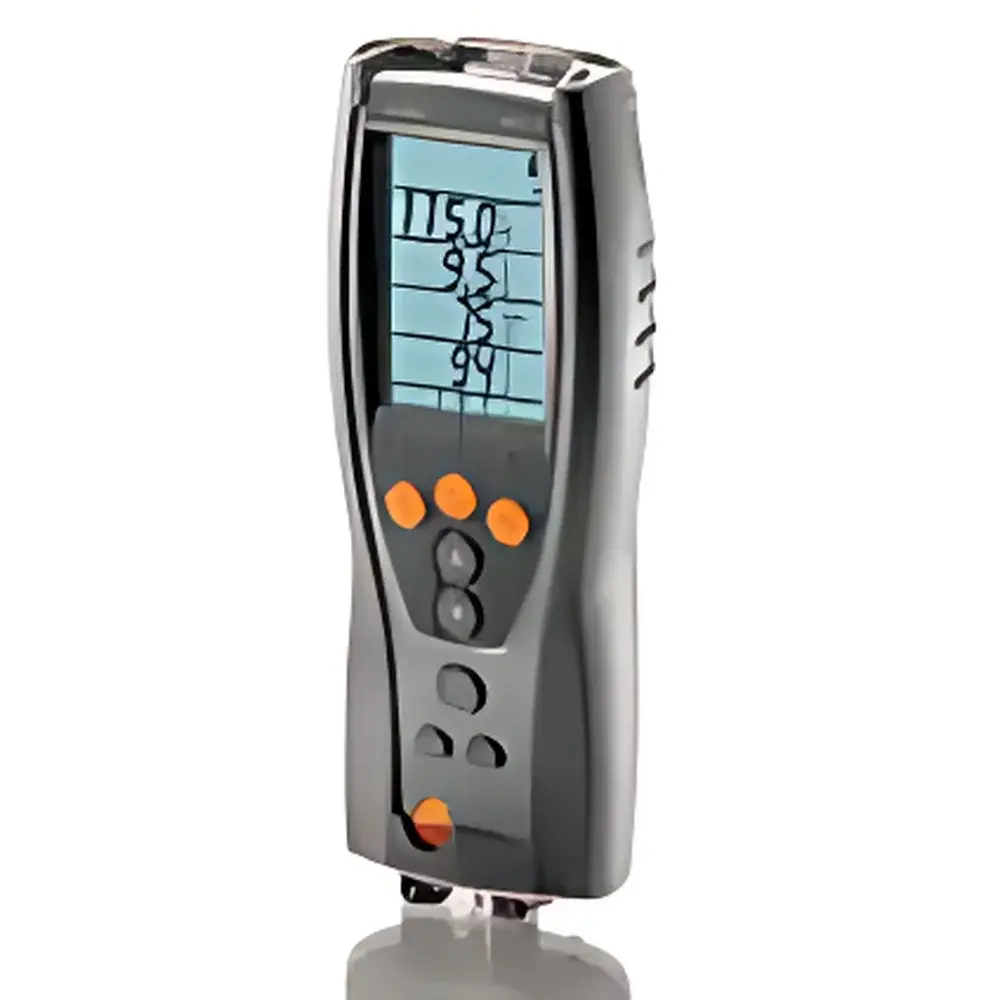
testo 327-1 O₂ Combustion Efficiency Analyzer
| Origin | Germany |
|---|---|
| Manufacturer Type | Authorized Distributor |
| Origin Category | Imported |
| Model | testo 327-1 |
| Pricing | Available Upon Request |
Overview
The testo 327-1 O₂ Combustion Efficiency Analyzer is a compact, field-deployable flue gas analyzer engineered for reliable measurement of fundamental combustion parameters in residential, commercial, and light industrial heating systems. Based on electrochemical oxygen (O₂) sensing and differential pressure transduction, the instrument calculates key efficiency indicators—including combustion efficiency (%), flue gas loss (%), and CO₂ concentration (via KCO₂ algorithm)—in accordance with DIN EN 298, VDI 2046, and EN 50379-1 standards. Its design prioritizes operational robustness under variable ambient conditions: the integrated K-type thermocouple enables direct flue temperature monitoring, while the high-accuracy differential pressure sensor quantifies draft (±40 hPa range) across boiler exhausts and chimney stacks. The analyzer operates on a rechargeable Li-ion battery with >5 hours of continuous runtime—critical for on-site HVAC commissioning, periodic boiler maintenance, and energy audit workflows.
Key Features
- Simultaneous real-time display of four critical parameters (O₂ % vol, flue gas temperature °C, draft hPa, combustion efficiency %) on a high-contrast LED-backlit screen
- Electrochemical O₂ sensor with ±0.2 vol% accuracy (0–21 vol%) and 0.1 vol% resolution, certified per EN 50379-1 for portable emission analyzers
- Differential pressure module with three-tiered accuracy specification: ±0.02 hPa (−0.50 to +0.60 hPa), ±0.03 hPa (+0.61 to +3.00 hPa), and ±1.5% of reading (+3.01 to +40 hPa)
- K-type thermocouple input supporting −40 °C to +600 °C measurement range; ±0.5 °C accuracy from 0.0 to 99.9 °C, ±0.5% of reading above 100 °C
- Integrated KCO₂ calculation algorithm deriving CO₂ concentration from measured O₂ and stoichiometric air/fuel ratios—no separate CO₂ sensor required
- Rugged, ergonomic housing (216 × 68 × 47 mm; ~500 g) rated for operation between −5 °C and +45 °C, with storage capability from −20 °C to +50 °C
- t₉₀ response time ≤40 seconds for all gas and pressure measurements—enabling rapid system stabilization checks during burner tuning
Sample Compatibility & Compliance
The testo 327-1 is validated for use with dry, non-corrosive flue gases generated by natural gas, propane, heating oil (EN 590), and biomass combustion appliances. It complies with EU Directive 2014/30/EU (EMC) and 2014/53/EU (RED), and meets essential requirements of EN 50379-1:2012 for portable flue gas analyzers used in emission-related service applications. While not intended for continuous emissions monitoring (CEMS), its measurement uncertainty profiles align with EN 15548-1 for periodic inspection of small-scale combustion plants (<1 MW thermal input). The device supports GLP-aligned documentation through traceable factory calibration certificates included with each unit.
Software & Data Management
Data logging is performed internally with timestamped storage of up to 250 measurement sets. Export is facilitated via USB interface to PC using testo’s proprietary analysis software (testo EasyHeat or testo IRSoft), enabling generation of compliance-ready reports compliant with DIN EN 12952-15 and VDI 2046 Part 2. All stored datasets include metadata such as ambient temperature, instrument serial number, calibration date, and operator ID fields—supporting audit trails required under ISO/IEC 17025-accredited laboratory practices. Firmware updates maintain alignment with evolving regulatory thresholds, including revised NOₓ and CO limits introduced under the EU Ecodesign Directive (EU) 2015/1188.
Applications
- Commissioning and post-installation verification of condensing and non-condensing boilers, furnaces, and water heaters
- Routine efficiency audits per EN 13384-1 and ASHRAE Guideline 36 for facility energy management programs
- Diagnostic troubleshooting of incomplete combustion, excessive draft, or heat exchanger fouling
- Training and certification assessments for HVAC technicians under national vocational frameworks (e.g., UK Gas Safe Register, German HWK)
- Pre-compliance screening prior to formal EN 15548-2 testing for small-scale biomass installations
FAQ
Does the testo 327-1 require annual recalibration?
Yes—electrochemical O₂ sensors exhibit gradual drift; testo recommends full functional verification and adjustment every 12 months or after 2,000 operating hours, whichever occurs first.
Can it measure CO or NOₓ?
No—the testo 327-1 is a dedicated O₂/draft/temperature analyzer. For multi-gas analysis, consider the testo 330-2 or testo 350 series.
Is the KCO₂ calculation suitable for biogas-fired systems?
No—the KCO₂ algorithm assumes stoichiometric combustion of hydrocarbon fuels only; it is not validated for syngas, landfill gas, or hydrogen-blended mixtures.
What is the maximum allowable flue gas temperature at the probe inlet?
The standard probe assembly is rated to 600 °C; however, prolonged exposure above 400 °C may accelerate thermocouple aging and reduce long-term accuracy stability.
Does the device support FDA 21 CFR Part 11 compliance?
No—it lacks electronic signature functionality and audit trail granularity required for regulated pharmaceutical or food processing environments.



