
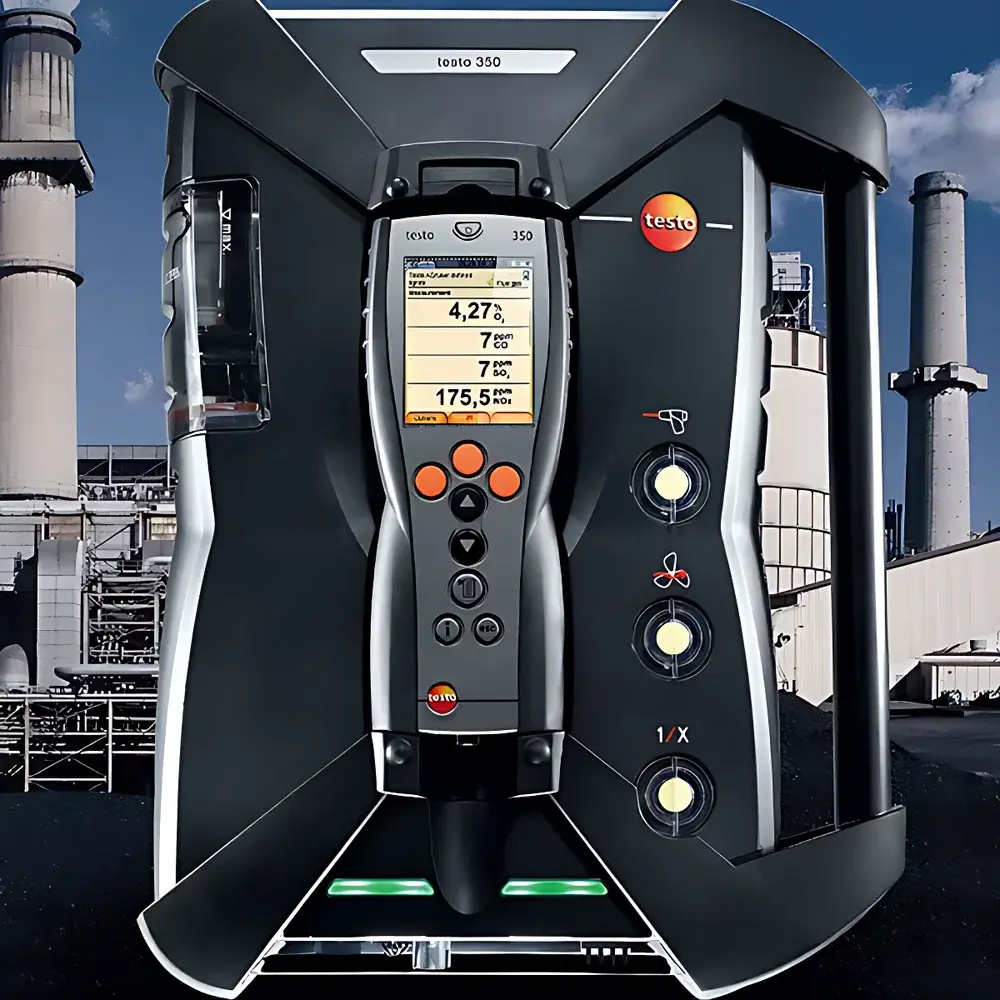
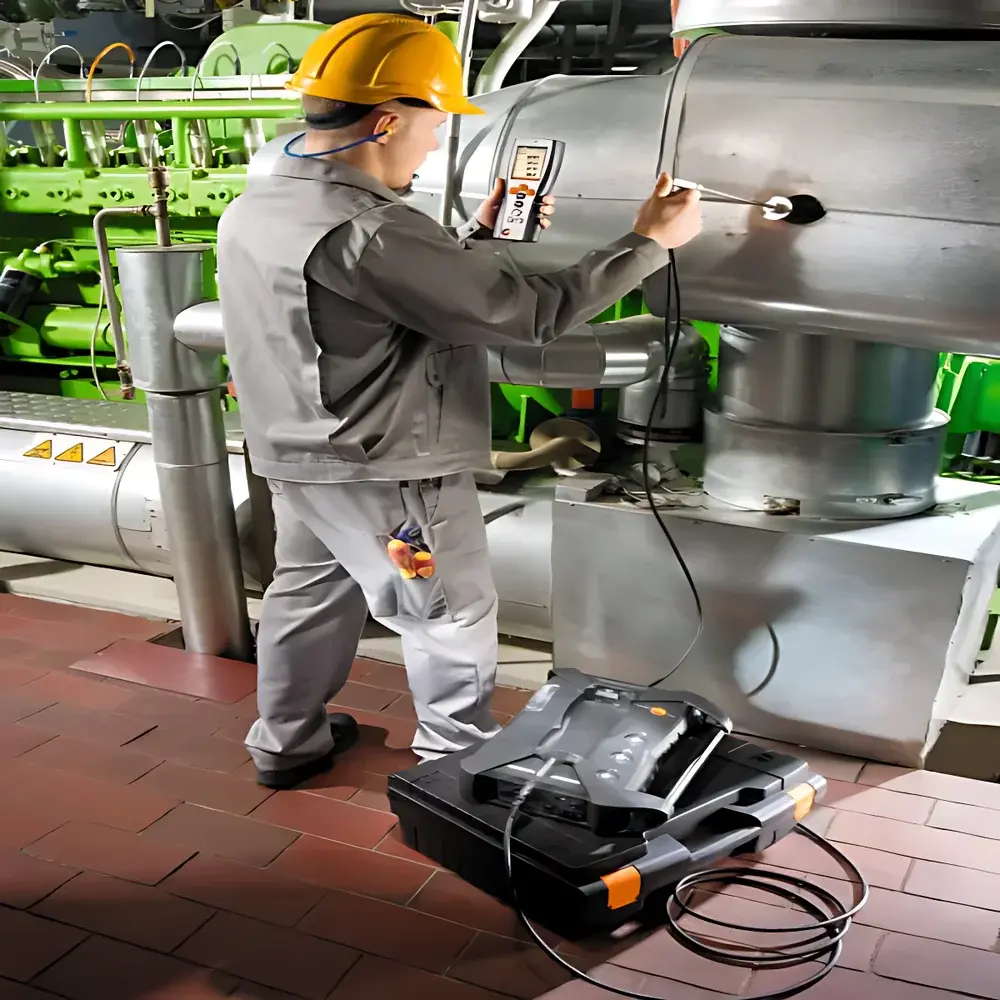

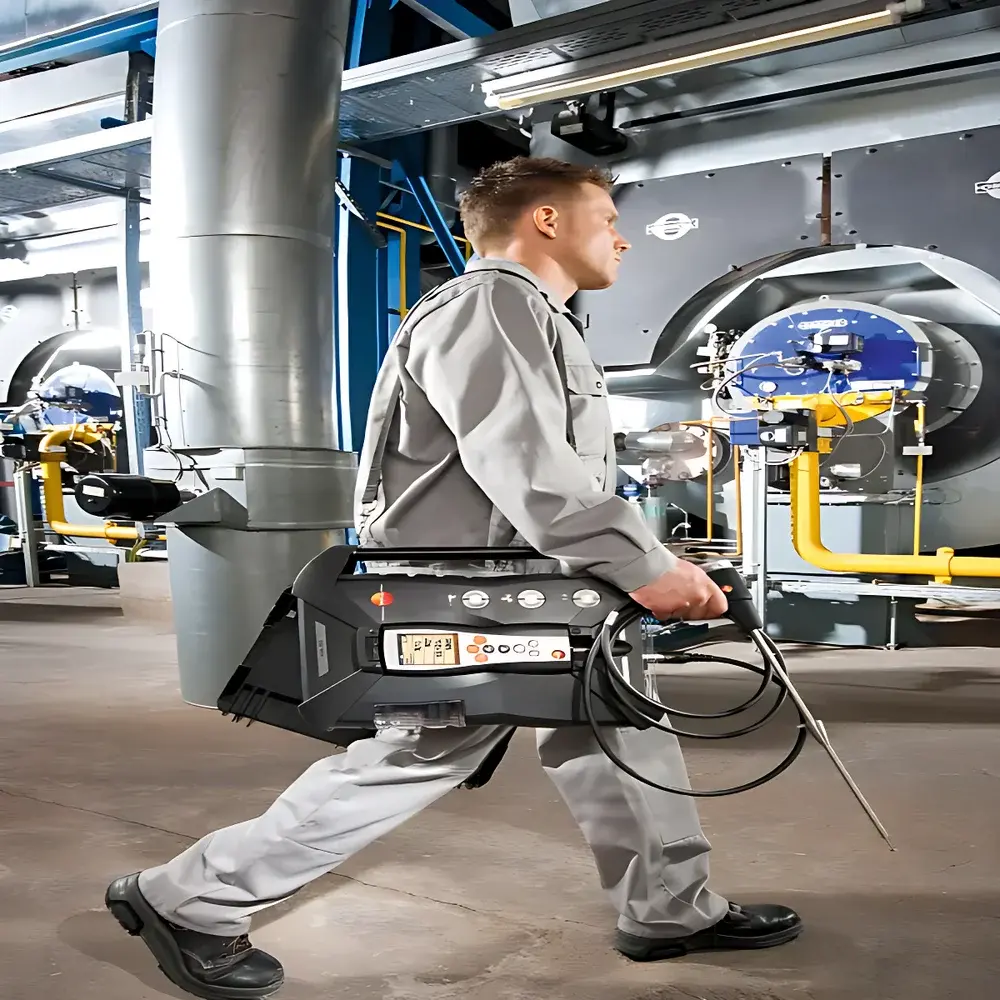
Testo 350 Portable Flue Gas Analyzer
| Brand | Testo |
|---|---|
| Origin | Germany |
| Model | testo 350 |
| Instrument Type | Portable Flue Gas Analyzer |
| Measurement Principle | Electrochemical (O₂, CO, NO, NO₂, SO₂, H₂S), NDIR (CO₂), Catalytic Combustion (CxHy) |
| Accuracy | ±5% of reading (for most gases, with low-range exceptions) |
| Response Time (t₉₅) | 20 s |
| Detection Gases (Configurable) | O₂, CO, COlow, NO, NOlow, NO₂, SO₂, H₂S, CO₂ (NDIR), CxHy (CH₄/C₃H₈/C₄H₁₀) |
| Operating Temperature | −5 to +45 °C |
| Storage Temperature | −20 to +50 °C |
| Dimensions | 88 × 38 × 220 mm |
| Weight | 440 g |
| Battery Life | Up to 5 h (without wireless) |
| Memory Capacity | 2 MB (~250,000 measurement values) |
| Protection Class | IP40 |
| Data Connectivity | Bluetooth® 4.0, USB, optional WLAN module |
Overview
The testo 350 is a high-precision, modular portable flue gas analyzer engineered for field-based emissions monitoring, combustion optimization, and regulatory compliance verification in industrial boiler systems, cogeneration plants, incinerators, and HVAC applications. It operates on a multi-sensor platform utilizing electrochemical cells for oxygen (O₂), carbon monoxide (CO), nitrogen oxides (NO/NO₂), sulfur dioxide (SO₂), and hydrogen sulfide (H₂S); non-dispersive infrared (NDIR) spectroscopy for CO₂; and catalytic combustion (pellistor) technology for hydrocarbon (CxHy) detection—including methane (CH₄), propane (C₃H₈), and butane (C₄H₁₀). Its architecture supports up to six simultaneously active gas sensors—configured at commissioning or upgraded in the field—enabling flexible adaptation to diverse regulatory frameworks such as EN 15267, EN 14181, EPA Method 6C, and ISO 12039. The instrument integrates real-time flue gas temperature (via K-type, S-type, or ambient probes), differential pressure, flow velocity (0–40 m/s), and dew point calculation (0–99.9 °Ctd), providing comprehensive stack characterization beyond simple concentration reporting.
Key Features
- Modular sensor configuration: Base system requires ≥2 electrochemical sensors; expandable to 6 total (including CO, NO, NO₂, SO₂, H₂S, CO₂, CxHy, and O₂)
- Dual-range CO detection: Standard CO sensor (0–10,000 ppm, 1 ppm resolution) and optional COlow (0–500 ppm, 0.1 ppm resolution) with integrated H₂ compensation to eliminate cross-sensitivity in reducing atmospheres
- NDIR-based CO₂ measurement (0–50 vol.%): High-stability infrared optics with absolute pressure compensation, built-in CO₂ absorption filter, and condensate level monitoring for long-duration sampling
- Peltier-cooled gas conditioning module (optional): Active condensate removal via thermoelectric cooling, integrated peristaltic pump, and automatic drain management—essential for >2-hour continuous operation in high-humidity flue streams
- Fresh air valve with 5× range extension: Enables extended measurement intervals while maintaining sensor linearity and mitigating zero drift during prolonged exposure to aggressive gas matrices
- Multi-parameter thermal profiling: Supports K-type (−200 to +1370 °C), S-type (0 to +1760 °C), and ambient temperature probes—all with traceable calibration and <0.4 °C accuracy in critical ranges
- Integrated differential pressure and flow velocity measurement: Coupled with automated flue gas dew point calculation for accurate dry/wet basis conversion and excess air ratio (λ) derivation
Sample Compatibility & Compliance
The testo 350 is validated for use across a broad spectrum of combustion sources, including natural gas, oil, biomass, coal, and waste-derived fuels. Its gas path design accommodates particulate-laden, high-moisture, and mildly corrosive flue streams when paired with appropriate probe filtration and the Peltier gas conditioning module. All electrochemical sensors comply with EN 50104 (O₂), EN 45544-1/-2 (toxic gases), and meet the performance criteria outlined in EN 15267-3 for automated measuring systems (AMS) used in continuous emission monitoring (CEMS). The NDIR CO₂ channel satisfies EN 14792 requirements for accuracy and stability over time. Data integrity features—including user-accessible audit trails, timestamped measurements, and configurable password protection—support adherence to GLP and ISO/IEC 17025 documentation practices. While not certified as a standalone CEMS, the testo 350 fulfills periodic QA/QC, stack testing, and commissioning roles aligned with EPA Performance Specification 2 (PS2) and EU Directive 2010/75/EU (IED).
Software & Data Management
Data acquisition and reporting are managed via testo’s proprietary software suite—testo EasyClimate and testo Smart Probes App—enabling real-time visualization, customizable report generation (PDF/CSV), and cloud synchronization via optional WLAN module. All measurements are time-stamped, geotagged (when GPS-enabled), and stored locally in non-volatile memory (2 MB capacity ≈ 250,000 records). The system supports FDA 21 CFR Part 11-compliant workflows through optional electronic signature modules and role-based user access levels (Operator, Supervisor, Administrator). Raw sensor outputs—including raw mV signals, temperature-compensated values, and diagnostic flags (e.g., condensate full, low battery, sensor timeout)—are retained for root-cause analysis and metrological traceability. Firmware updates are delivered via USB or OTA, ensuring ongoing alignment with evolving regulatory interpretation and sensor algorithm refinements.
Applications
- Combustion efficiency optimization: Real-time λ calculation, excess air analysis, and thermal loss estimation per EN 12953-10 and VDI 2066
- Emissions compliance auditing: Spot-checking of NOx, SO2, CO, and O₂ against local permit limits (e.g., US State Implementation Plans, German TA Luft, UK MCERTS)
- Boiler and furnace maintenance diagnostics: Identification of incomplete combustion, air leakage, heat exchanger fouling, and burner misalignment via multi-point flue profile mapping
- Waste-to-energy plant QA: Monitoring of H₂S and CxHy breakthrough during start-up/shutdown phases to verify scrubber and afterburner performance
- Research and development: Characterization of novel fuel blends, catalyst aging studies, and transient emission behavior under load cycling
- Academic training: Hands-on instruction in stack gas chemistry, sensor cross-interference, and regulatory measurement protocols
FAQ
What is the minimum number of gas sensors required for basic operation?
The testo 350 requires at least two electrochemical sensors (e.g., O₂ + CO) to initialize and perform valid flue gas calculations.
Can the instrument measure CO₂ using both NDIR and calculation methods?
Yes—the primary CO₂ value is derived from the dedicated NDIR sensor; a secondary calculated CO₂ value (based on O₂ depletion and stoichiometry) is provided for cross-validation but is not intended for compliance reporting.
Is the Peltier gas conditioning module mandatory for all applications?
It is strongly recommended for measurements exceeding two hours or in flue gases with dew points above 10 °C, where condensate accumulation risks sensor poisoning and signal drift.
How does the fresh air valve extend sensor range?
By periodically introducing ambient air into the sample stream, it dilutes high-concentration analytes—enabling linear response up to five times the nominal sensor range without hardware modification.
Does the testo 350 support external probe integration beyond the standard thermocouples?
Yes—it accepts third-party K- and S-type probes meeting IEC 60584 tolerances, and its analog input channels can interface with calibrated pressure transducers or humidity sensors via custom configuration.
Related Products







