

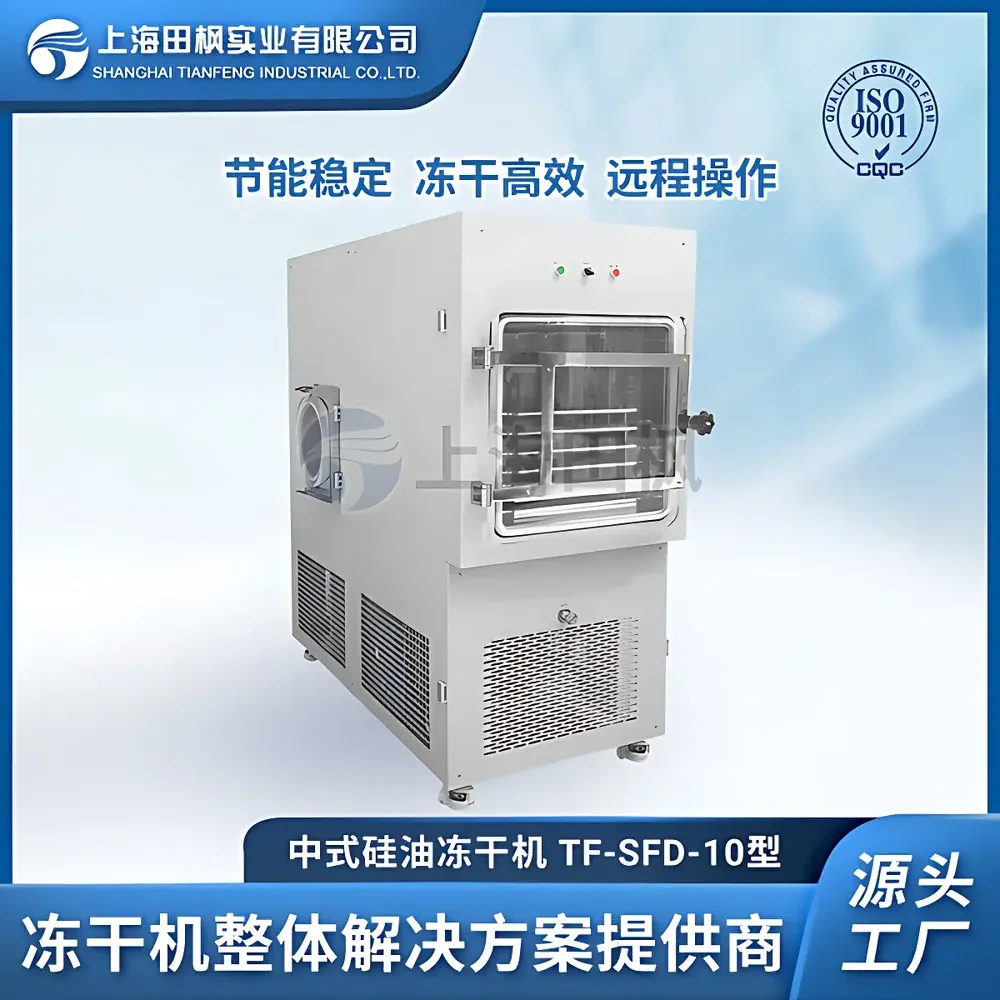
TF-Feng SFD-10 Pilot-Scale Manifold Freeze Dryer
| Brand | TF-Feng |
|---|---|
| Origin | Shanghai, China |
| Manufacturer Type | Direct Manufacturer |
| Region Classification | Domestic (China) |
| Model | SFD-10 |
| Instrument Type | Manifold Configuration |
| Scale | Pilot-Scale |
| Shelf Area | 1.04 m² |
| Ultimate Vacuum | ≤5 Pa |
| Condenser Capacity (24 h) | 16 kg |
| Condenser Temperature | ≤−70 °C |
| Shelf Dimensions (W × L) | 360 × 480 mm |
| Shelf Spacing | 70 mm |
| Number of Shelves | 6 + 1 (top shelf for temperature monitoring) |
| Shelf Temperature Range | −50 to +80 °C |
| Power Consumption | 8 kW |
| Net Weight | 750 kg |
| Max. Load Capacity (Φ16 mm vials) | 3828 pcs |
| Max. Load Capacity (Φ20 mm vials) | 2016 pcs |
| Max. Liquid Volume per Batch | 13 L |
Overview
The TF-Feng SFD-10 is a pilot-scale manifold freeze dryer engineered for reproducible, low-temperature lyophilization of heat-sensitive materials under high-vacuum conditions. It operates on the principle of sublimation—removing water or solvent directly from the frozen solid phase to vapor without passing through the liquid state—thereby preserving structural integrity, bioactivity, and dispersion stability in nanomaterials such as graphene oxide (GO) and reduced graphene oxide (rGO). Unlike conventional thermal drying methods—which induce thermal degradation, aggregation, and irreversible morphological collapse—the SFD-10 maintains sample morphology, porosity, and surface functionality by avoiding liquid-phase transitions and minimizing molecular mobility during desiccation. Its design supports both batch processing of pre-frozen samples in vials and controlled shelf-based lyophilization with active temperature regulation across multiple shelves.
Key Features
- Pilot-scale capacity with 1.04 m² effective shelf area and dual-mode operation: manifold vial drying and shelf-based primary drying.
- High-efficiency condenser operating at ≤−70 °C, capable of capturing up to 16 kg of water vapor per 24-hour cycle—optimized for extended primary drying phases common in nanomaterial and biopolymer formulations.
- Seven-shelf configuration (6 working + 1 monitoring shelf), each independently monitored for temperature uniformity; shelf temperature range spans −50 to +80 °C, enabling controlled annealing and secondary drying protocols.
- Ultimate vacuum performance ≤5 Pa, achieved via dual-stage oil-sealed rotary vane pump and integrated vacuum control system with real-time pressure feedback and automatic valve modulation.
- Robust stainless-steel chamber and condenser housing, compliant with ISO 13485-grade surface finish standards for cleanroom-compatible operation.
- Integrated electrical safety architecture including overcurrent protection, condenser overload cutoff, and emergency stop circuitry meeting IEC 61000-6-2/6-4 EMC requirements.
Sample Compatibility & Compliance
The SFD-10 accommodates diverse sample formats—including glass vials (Φ16 mm, up to 3828 units/batch; Φ20 mm, up to 2016 units), serum bottles, and open trays—making it suitable for R&D validation, formulation optimization, and small-batch GMP-aligned production. It supports lyophilization of aqueous dispersions of graphene oxide, exfoliated MXenes, protein-loaded liposomes, and pH-sensitive hydrogels where thermal instability or shear-induced aggregation must be avoided. The system meets core mechanical and operational requirements outlined in ISO 22042 (freeze-drying equipment specifications) and supports documentation practices aligned with FDA 21 CFR Part 11 when paired with validated data acquisition software. All wetted surfaces are electropolished 316L stainless steel, facilitating cleaning validation per ASTM E3063-17.
Software & Data Management
Equipped with an embedded PLC-based controller featuring a 7-inch color HMI touchscreen, the SFD-10 records time-stamped process parameters—including shelf temperature, condenser temperature, chamber pressure, and elapsed time—at user-defined intervals (1–60 s resolution). Raw data export is supported via USB 2.0 in CSV format, compatible with LIMS integration and statistical process analysis (e.g., JMP, Minitab). Optional Ethernet connectivity enables remote monitoring and alarm notification via Modbus TCP. Audit trails—including operator ID, parameter changes, and system events—are retained for ≥12 months and comply with ALCOA+ principles for data integrity in GLP and early-phase GMP environments.
Applications
- Stabilization of graphene oxide dispersions without thermal decomposition or agglomeration—critical for inkjet-printed electronics and conductive coatings.
- Lyophilization of enzyme-loaded nanoparticles and plasmid DNA formulations requiring retention of conformational fidelity.
- Processing of botanical extracts, probiotic cultures, and peptide therapeutics where residual moisture content must remain below 1.5% w/w.
- Method development for accelerated stability studies under ICH Q5C guidelines using controlled shelf ramping and vacuum modulation.
- Preparation of porous scaffolds for tissue engineering, leveraging preserved pore architecture post-drying.
FAQ
What is the maximum batch volume supported for liquid loading?
The SFD-10 supports up to 13 L of total liquid volume per batch when distributed across the full shelf area or manifold vials.
Can the system perform controlled ice nucleation or annealing steps?
Yes—programmable shelf temperature profiles allow precise ramping, hold, and cooling sequences between −50 °C and +80 °C, enabling ice nucleation control and crystalline phase optimization.
Is the condenser designed for continuous operation over 24 hours?
Yes—the condenser is rated for sustained operation at ≤−70 °C with 16 kg/24 h capture capacity, verified under ISO 13485-compliant load testing.
Does the system support IQ/OQ documentation packages?
TF-Feng provides standardized IQ/OQ templates aligned with ASTM E2500-13 and EU Annex 15; site-specific qualification support is available upon request.
What maintenance intervals are recommended for the vacuum pump?
Oil changes every 500 operating hours and annual inspection of pump vanes and seals are recommended per manufacturer guidelines.



