
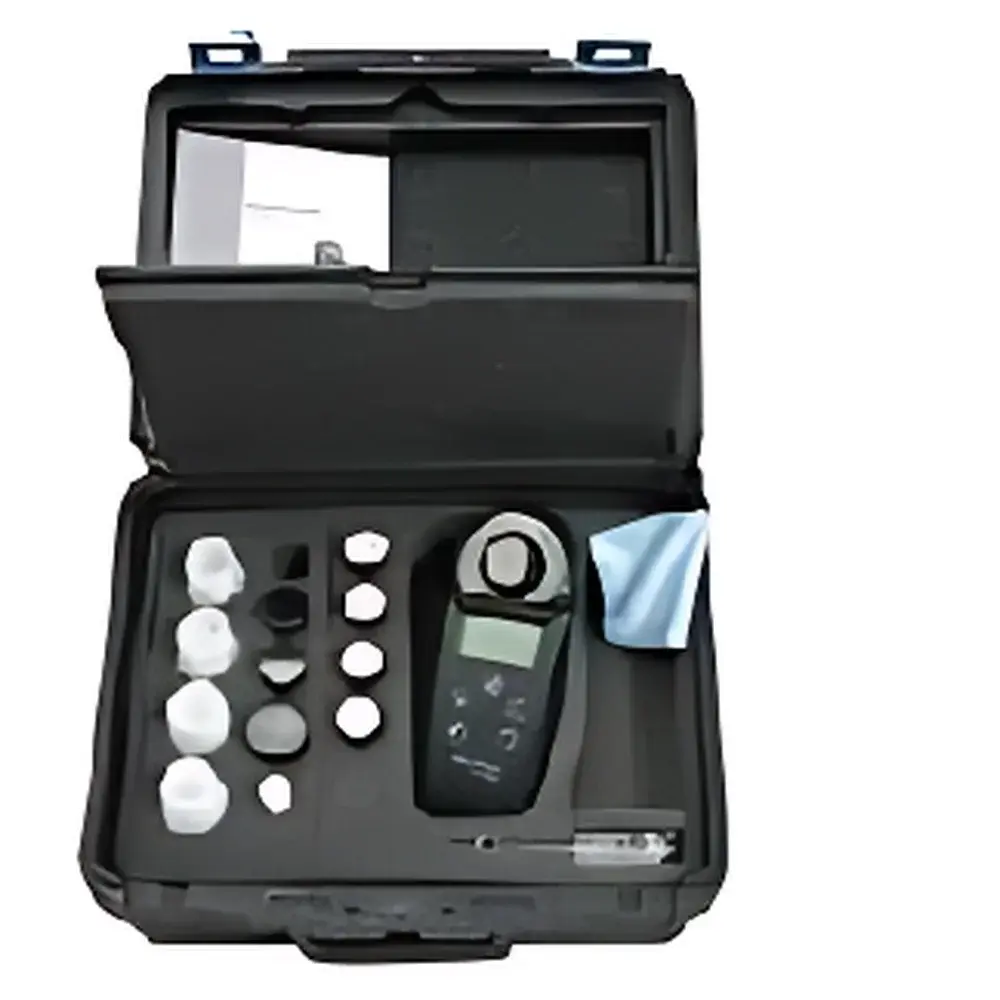
Thermo Fisher AQ3010 Portable Turbidimeter
| Brand | Thermo Fisher |
|---|---|
| Origin | USA |
| Model | AQ3010 |
| Measurement Principle | 90° Nephelometric Detection (ISO 7027 Compliant) |
| Light Source | Infrared LED |
| Measurement Range | Auto-ranging 0.01–1000 NTU |
| Resolution | 0.01 NTU (0.01–19.99), 0.1 NTU (20.0–99.9), 1 NTU (100–1000) |
| Accuracy | ±2% of reading +1 LSD (0–500 NTU) |
| Response Time | <6 s |
| Sample Volume | 10 mL |
| Calibration Standards | 0.02, 20.0, 100, and 800 NTU EPA-compliant formazin equivalents |
| Sample Cell | 25 mm diameter, numbered vials |
| Protection Rating | IP67 |
| Power Supply | 4 × AAA alkaline batteries (≥3,000 measurements) or lithium (≥12,000 measurements) |
| Auto-power-off | After 20 min idle |
| Operating Temperature | 0–50 °C (RH 0–90% at 30 °C) |
| Certifications | CE, TÜV 3-in-1 (CSA-US), FCC Part 15 |
| Self-diagnostic Function | Yes, with error code display |
Overview
The Thermo Fisher AQ3010 Portable Turbidimeter is an ISO 7027–compliant, infrared nephelometric instrument engineered for high reproducibility and field-deployable robustness in water quality monitoring. It operates on the principle of 90° scattered light detection, where an 850 nm infrared LED illuminates a sample and a photodetector positioned perpendicularly quantifies the intensity of scattered photons—directly proportional to suspended particle concentration. Unlike tungsten-based turbidimeters, the AQ3010’s stable, drift-free IR source eliminates spectral interference from colored dissolved organic matter (CDOM), ensuring accurate turbidity assessment across diverse matrices including surface water, wastewater effluent, drinking water distribution systems, and process streams. Its auto-ranging optical architecture dynamically selects optimal gain settings across three decades (0.01–1000 NTU), enabling trace-level sensitivity and high-range linearity without manual range switching or recalibration.
Key Features
- IP67-rated enclosure for full dust ingress protection and temporary immersion resistance—validated for continuous use in humid laboratories, rain-exposed field sites, and industrial plant floors.
- Infrared LED light source compliant with ISO 7027:2016, delivering long-term intensity stability (<0.5% drift/year) and eliminating the need for periodic lamp replacement or warm-up time.
- High-contrast LCD with backlighting and intuitive keypad interface (Power, Calibrate, Up/Down, Read/Enter) optimized for gloved operation and low-light environments.
- EPA-compliant calibration using four certified formazin-equivalent standards (0.02, 20.0, 100, and 800 NTU), eliminating dilution errors and supporting single-point verification or multi-point validation per US EPA Method 180.1 and ASTM D6508.
- Integrated self-diagnostic routine with alphanumeric fault codes (e.g., “ERR-07” for detector saturation, “ERR-12” for battery voltage below threshold), facilitating rapid troubleshooting without external software.
- Low-power architecture: 4 × AAA alkaline batteries support ≥3,000 measurements; lithium variants extend service life to ≥12,000 readings—ideal for remote deployments and unattended monitoring campaigns.
Sample Compatibility & Compliance
The AQ3010 accepts standard 25 mm diameter glass or polycarbonate vials (supplied with numbered identification), accommodating 10 mL sample volumes with minimal meniscus interference. Its 90° scattering geometry minimizes path-length artifacts and is insensitive to minor temperature fluctuations during sequential sample loading—a critical advantage over transmission-based methods when measuring thermally unstable or rapidly equilibrating samples. The instrument meets regulatory requirements for routine compliance testing under US EPA Standard Methods 2130B and ISO 7027:2016. Its CE marking, TÜV-certified CSA-US safety compliance, and FCC Part 15 Class B emissions certification confirm suitability for global deployment in GLP, GMP, and ISO/IEC 17025–accredited laboratories. No rubber light-shielding cap is required due to internal optical baffling and ambient-light rejection algorithms.
Software & Data Management
While the AQ3010 operates as a standalone instrument with no mandatory PC connectivity, it supports optional data export via RS-232 serial interface (cable sold separately) to compatible LIMS or laboratory informatics platforms. All measurements are timestamped and stored internally with operator ID fields (configurable via keypad). Audit trail functionality includes calibration event logging (date/time, standard used, deviation from nominal value), power-cycle history, and firmware version tracking—enabling alignment with FDA 21 CFR Part 11 requirements when integrated into validated workflows. Firmware updates are performed via ASCII text file upload through terminal emulation software, preserving configuration integrity across revisions.
Applications
- Drinking water treatment: Real-time monitoring of coagulation/flocculation efficiency, filter performance, and distribution system integrity.
- Wastewater discharge compliance: Verification of final effluent turbidity against NPDES permit limits (e.g., ≤2 NTU for disinfection-sensitive outfalls).
- Environmental field surveys: Rapid assessment of sediment resuspension events, stormwater runoff impact, and watershed health indicators.
- Pharmaceutical water systems: USP purified water and WFI turbidity screening prior to microbial enumeration.
- Food & beverage QC: Clarification validation in juice, beer, and dairy processing lines where particulate load correlates with shelf-life stability.
FAQ
Does the AQ3010 require annual recalibration by an accredited lab?
No. The instrument’s IR LED stability and factory-traceable calibration allow user-performed verification using the supplied 0.02 NTU and 20.0 NTU standards before each analytical session, satisfying ISO/IEC 17025 clause 5.9.2 for in-house verification.
Can the AQ3010 measure samples with high absorbance or color?
Yes. The 850 nm infrared wavelength minimizes absorption interference from humic substances, iron complexes, and dye contaminants—providing superior accuracy versus visible-light turbidimeters in yellow-colored or tannin-rich waters.
Is the 25 mm sample vial compatible with automated samplers?
The vial dimensions conform to ASTM D6508 mechanical specifications and can be integrated into third-party autosamplers with standard 25 mm cup holders; however, Thermo Fisher does not supply or validate robotic interfaces.
What happens if the instrument is submerged beyond 1 m depth?
IP67 certification guarantees protection against immersion up to 1 m for 30 minutes. Prolonged submersion or pressure cycling may compromise O-ring integrity and void warranty coverage.
How is measurement uncertainty reported in audit documentation?
Total uncertainty is calculated per GUM (JCGM 100:2008) as the root-sum-square of repeatability (≤0.5% RSD), calibration standard uncertainty (±0.3% k=2), and environmental influence (±0.2% for 0–50 °C)—yielding a combined expanded uncertainty of ±1.2% (k=2) across 0–500 NTU.





