
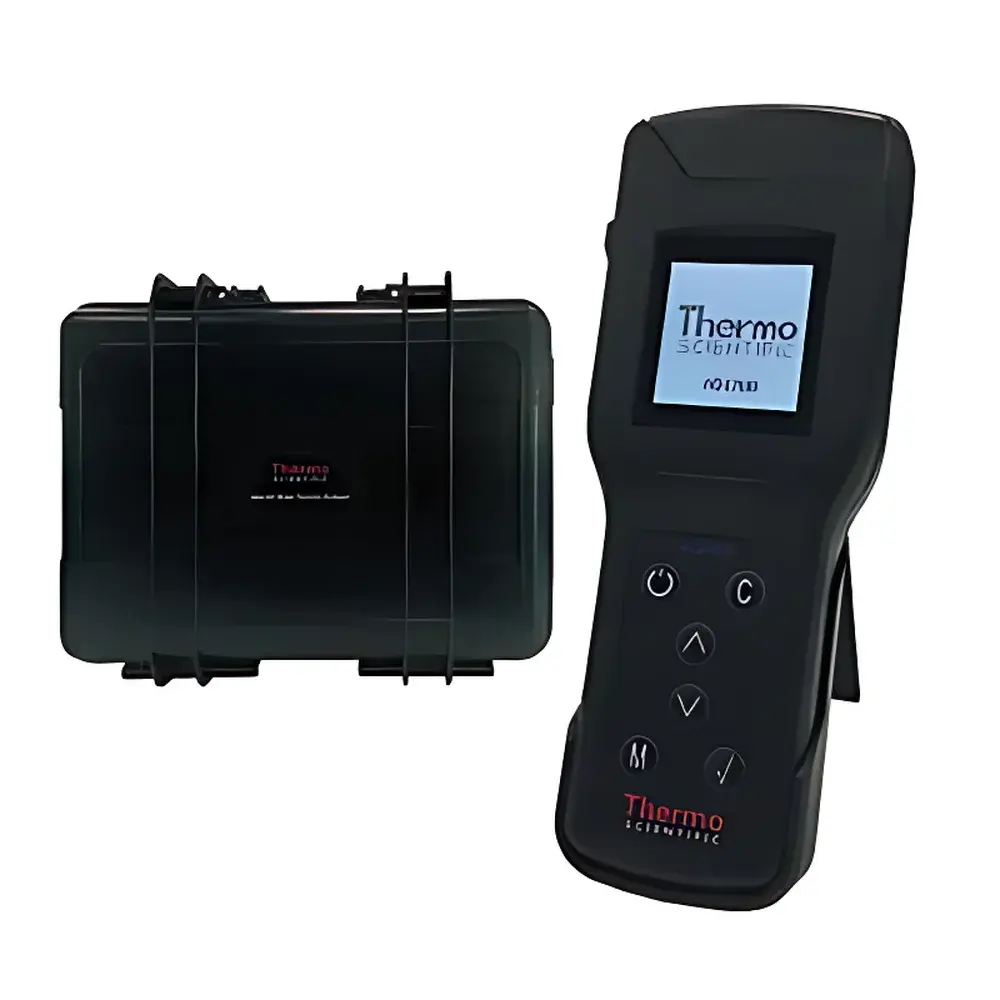
Thermo Fisher AQ4BW1 Mobile Laboratory Water Toxicity Analyzer
| Brand | Thermo Fisher |
|---|---|
| Origin | Beijing, China |
| Manufacturer Type | Manufacturer |
| Product Category | Domestic |
| Model | AQ4BW1 |
| Instrument Type | Laboratory-Based |
| Biological Indicator | Bioluminescent Bacteria |
| Detection Principle | Bioluminescence Inhibition Assay |
| Compliance | ISO 11348-3:2022 |
| Measurement Range | 0–65535 RLU |
| Spectral Response | 320–1000 nm |
| Detection Time | As low as 5 min |
| Operating Temperature | 5–40 °C |
| Relative Humidity | 10–90% RH (at 25 °C) |
| Battery Life | ≥8 h continuous operation |
| Weight | ~258 g (including batteries) |
| Dimensions | 202 × 78 × 30 mm |
| Power Supply | 3 V DC (AA batteries) |
| Data Interface | USB |
Overview
The Thermo Fisher AQ4BW1 Mobile Laboratory Water Toxicity Analyzer is a compact, field-deployable instrument engineered for rapid, quantitative assessment of acute aquatic toxicity using bioluminescent bacterial biosensors. It implements the standardized bioluminescence inhibition assay described in ISO 11348-3:2022, which measures the reduction in light output from Vibrio fischeri (or equivalent luminescent strains) upon exposure to toxicants. Unlike traditional whole-organism bioassays—such as those employing Daphnia magna, fish, or algae—the AQ4BW1 leverages the metabolic sensitivity and reproducible photon emission kinetics of freeze-dried or rehydrated bioluminescent bacteria to deliver results within minutes. This principle enables high-throughput screening of complex environmental matrices without requiring live culture maintenance, animal housing, or specialized aquaculture infrastructure. The system is designed for use in mobile laboratories, emergency response vehicles, field stations, and fixed QC/QA labs where portability, speed, and regulatory traceability are critical.
Key Features
- Three operational modes: ISO-compliant toxicity testing mode (with built-in incubation timing and dose-response calculation), Basic Mode (for rapid qualitative screening), and RLU Mode (supporting ATP quantification for microbial load estimation)
- Integrated optical detection module with photomultiplier tube (PMT)-grade sensitivity across 320–1000 nm, optimized for blue-green bioluminescence emission (peak ~490 nm)
- Onboard data storage supporting ≥1000 measurement records per mode, with timestamp, sample ID, and raw RLU values
- Real-time toxicity index calculation based on percentage inhibition relative to control luminescence
- Automatic over-limit alerting with visual and audible indicators when sample toxicity exceeds user-defined thresholds
- Lightweight (258 g) and ruggedized housing with IP54-rated enclosure; supplied with shock-absorbing portable case for field transport
- USB interface for secure data export to LIMS or compliance-ready reporting software; supports CSV and XML export formats
Sample Compatibility & Compliance
The AQ4BW1 accepts liquid samples directly—including raw surface water, treated drinking water, wastewater influent/effluent, leachates, industrial process streams, and sediment pore water extracts—without mandatory pre-filtration (though particulate removal is recommended for turbid matrices). It has demonstrated validated response to priority pollutants regulated under multiple Chinese national standards, including GB 8978-1996 (Comprehensive Wastewater Discharge Standard), GB 13456-2012 (Iron and Steel Industry), GB 4287-2012 (Textile Dyeing and Finishing), and GB 21903–21908 series (Pharmaceutical Industry Effluents). Detected analyte classes include heavy metals (Hg²⁺, Cd²⁺, Pb²⁺, Cr⁶⁺, Ni²⁺, Zn²⁺, Cu²⁺), phenolic compounds (phenol, chlorophenols, nitrophenols), aldehydes (formaldehyde), aromatic amines (aniline derivatives), and water-miscible organic solvents (acetonitrile, methanol, acetone, DMF). All test protocols align with ISO 11348-3:2022 requirements for repeatability (CV ≤15%), recovery validation, and control stability monitoring. The device supports GLP-compliant workflows through audit-trail-capable software integration and meets essential criteria for inclusion in emergency response protocols endorsed by China CDC and provincial environmental monitoring centers.
Software & Data Management
The AQ4BW1 operates standalone but interfaces seamlessly with Thermo Fisher’s optional AquaTox Manager desktop application (Windows 10/11), which provides full traceability per FDA 21 CFR Part 11 requirements—including electronic signatures, role-based access control, and immutable audit logs. The software enables batch calibration curve generation, statistical outlier detection, comparative toxicity profiling across sample sets, and automated report generation compliant with ISO/IEC 17025 documentation frameworks. Exported datasets retain metadata such as ambient temperature/humidity, operator ID, instrument serial number, and firmware revision—ensuring full chain-of-custody integrity for regulatory submissions or inter-laboratory comparison studies.
Applications
- Rapid emergency response to chemical spills, accidental discharges, or suspected contamination events in municipal water supplies
- Process control and toxicity monitoring at wastewater treatment plants (influent, activated sludge, effluent, digester supernatant)
- Verification of disinfection byproduct formation potential and residual biocide efficacy
- Regulatory compliance testing for pharmaceutical manufacturing sites under GMP-aligned environmental monitoring programs
- Academic research on mixture toxicity, QSAR modeling, and ecotoxicological benchmarking of novel compounds
- Field-based surveillance of drinking water safety in remote or disaster-affected regions
FAQ
What biological indicator does the AQ4BW1 use?
It employs lyophilized Vibrio fischeri or equivalent standardized bioluminescent bacterial strains certified for ISO 11348 compliance.
Can the instrument distinguish between specific toxicants?
No—it measures integrated acute toxicity (i.e., total inhibitory effect on bacterial metabolism); compound identification requires complementary chemical analysis (e.g., ICP-MS, GC-MS).
Is calibration required before each test?
Yes: a fresh negative control (dilution water) must be measured prior to sample analysis to establish baseline luminescence; no external calibration standards are needed.
How is data integrity ensured during field use?
All measurements include embedded timestamps, battery voltage logging, and automatic checksum validation; USB exports are digitally signed when used with AquaTox Manager.
Does the system support multi-user operation with permission levels?
Yes—when paired with AquaTox Manager, it supports administrator, analyst, and reviewer roles with configurable edit/delete privileges and electronic signature enforcement.
Related Products







