
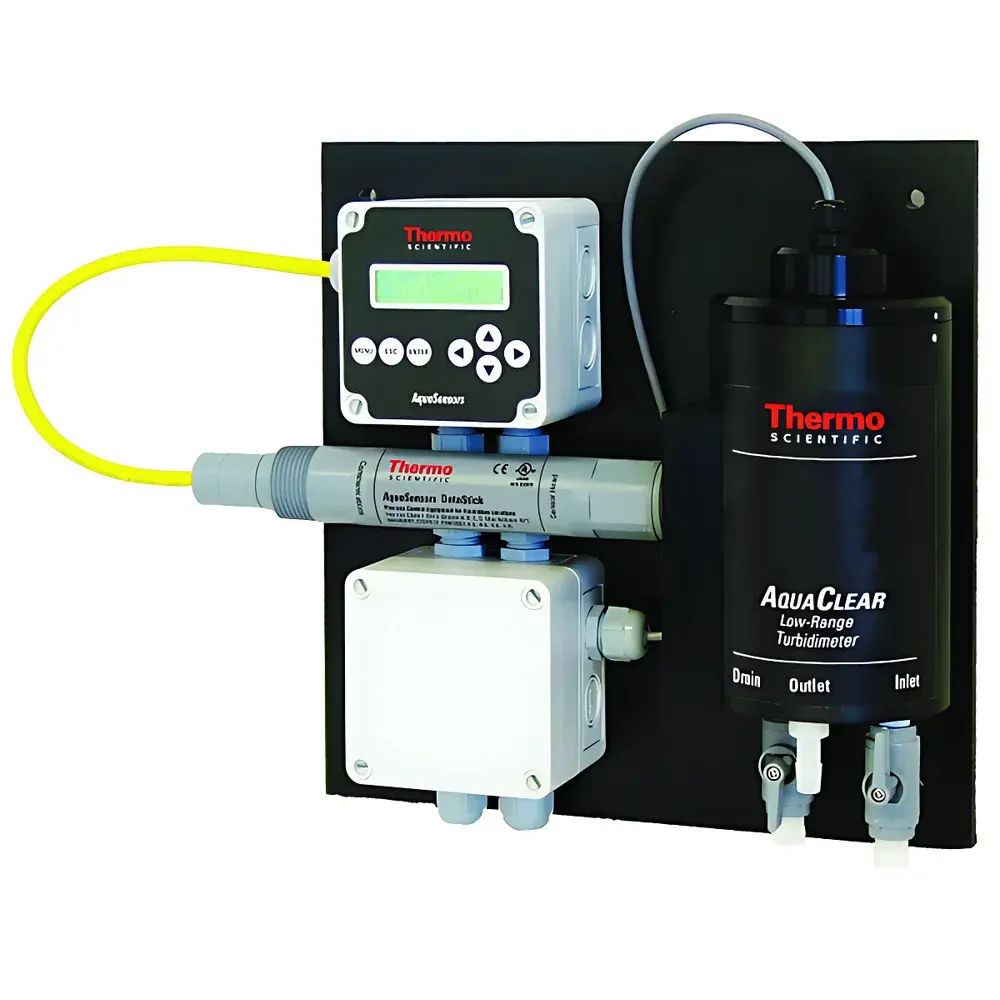
Thermo Fisher AquaClear Low-Range Online Turbidimeter
| Brand | Thermo Fisher |
|---|---|
| Origin | USA |
| Manufacturer | Thermo Fisher Scientific |
| Product Type | Online Turbidimeter |
| Model | AquaClear |
| Measurement Range | 0–200 NTU |
| Resolution | ±2% of reading (<40 NTU), ±5% of reading (>40 NTU) |
| Accuracy | 0.001 NTU |
| Operating Ambient Temperature | −20 to +60 °C |
| Sample Temperature Range | −5 to +50 °C |
| Flow Rate | 250–500 mL/min |
| Response Time | 90 s to 90% of final value |
| Light Source | Tungsten lamp (≥3-year lifetime) |
| Flow Cell Volume | 135 mL |
| Optical Cell Material | Quartz and anodized aluminum |
| Compliance | EPA Method 180.1 |
| Temperature Units | °C, °F |
| Output Interface | Plug-and-play communication adapter |
| Detection Principle | Nephelometric measurement at 90° (ISO 7027-compliant geometry) |
Overview
The Thermo Fisher AquaClear Low-Range Online Turbidimeter is an industrial-grade, continuously operating nephelometric analyzer engineered for high-stability turbidity monitoring in low-concentration aqueous streams—particularly critical in drinking water treatment, ultrapure water systems, pharmaceutical process water loops, and environmental compliance applications. It operates on the principle of 90° scattered light detection (per ISO 7027 and EPA Method 180.1), where incident light from a stabilized tungsten source interacts with suspended particles, and the intensity of scattered light is quantified by a precision photodetector aligned orthogonally to the beam path. Its optical architecture features tightly integrated optoelectronics housed within an anodized aluminum enclosure, minimizing thermal drift and electromagnetic interference. The 135 mL flow cell is purpose-designed to suppress bubble entrapment—a dominant source of noise in sub-5 NTU measurements—via optimized hydraulic geometry and laminar flow conditioning, enabling reliable detection down to 0.001 NTU with minimal baseline fluctuation.
Key Features
- Compliance-certified optical design meeting or exceeding U.S. Environmental Protection Agency (EPA) Method 180.1 and ISO 7027 requirements for low-range turbidity measurement.
- Integrated bubble mitigation system utilizing controlled flow dynamics and hydrophobic surface treatment in the quartz-anodized aluminum flow cell to eliminate air artifact interference below 5 NTU.
- Long-life tungsten lamp with ≥3 years of continuous operation under nominal conditions—reducing maintenance frequency and total cost of ownership.
- High signal stability achieved through rigid mechanical coupling between light source, flow cell, and detector—minimizing alignment sensitivity and vibration-induced noise.
- Compact 135 mL flow cell volume significantly reduces Formazin standard consumption during calibration and verification procedures, aligning with laboratory efficiency and reagent stewardship goals.
- Onboard temperature sensor (±0.3 °C accuracy) enables automatic temperature compensation of turbidity readings per ASTM D6508 and USP <<731> guidelines.
Sample Compatibility & Compliance
The AquaClear is validated for continuous monitoring of clarified potable water, membrane filtrate, reverse osmosis permeate, steam condensate, and pharmaceutical water (PW, WFI). It accommodates sample temperatures from −5 to +50 °C and supports flow rates between 250–500 mL/min without requiring external pressure regulation. Its construction—quartz optical windows, anodized aluminum housing, and corrosion-resistant wetted materials—ensures compatibility with chlorine-, ozone-, and UV-treated streams. Regulatory documentation includes full traceability to NIST-traceable Formazin standards, and the instrument supports audit-ready data logging required under FDA 21 CFR Part 11 when paired with compliant SCADA or LIMS integration via its plug-and-play analog/digital interface.
Software & Data Management
The AquaClear outputs calibrated turbidity values as 4–20 mA analog signals and optional Modbus RTU/ASCII over RS-485. When connected to Thermo Fisher’s optional AquaLink™ software or third-party platforms supporting HART or OPC UA, users gain access to time-stamped event logs, calibration history with operator ID tagging, and configurable alarm thresholds with hysteresis. All data records include metadata such as ambient temperature, sample temperature, flow status, and lamp operational hours—supporting GLP/GMP-aligned record retention and electronic signature workflows. Firmware updates are performed via secure USB or serial interface, preserving configuration integrity across revisions.
Applications
- Real-time verification of filtration performance in granular media and membrane-based drinking water plants.
- Monitoring of ultrapure water (UPW) distribution loops in semiconductor fabrication facilities (per SEMI F63).
- Final rinse water quality assurance in sterile pharmaceutical manufacturing (compliant with EU Annex 1 and USP <<1231>).
- Effluent turbidity compliance reporting for municipal wastewater disinfection stages.
- Research-grade low-turbidity characterization in environmental laboratories performing EPA-approved monitoring programs.
FAQ
Does the AquaClear require periodic lamp replacement?
No—the tungsten lamp is rated for ≥3 years of continuous operation under typical ambient conditions (25 °C, 50% RH); lamp status is monitored internally and reported via diagnostic output.
Can the instrument be calibrated using alternatives to Formazin?
Yes—while Formazin remains the primary reference standard per EPA 180.1, the AquaClear supports calibration with polymer-based stable standards (e.g., AMCO AEPA-1) provided traceability and matrix-matched validation are documented.
Is temperature compensation applied automatically during measurement?
Yes—integrated Pt1000 sensor provides real-time sample temperature input; compensation follows the polynomial algorithm defined in ISO 7027 Annex B for natural waters.
What is the minimum detectable turbidity level with statistical confidence?
At 0.001 NTU resolution and ≤2% relative error below 40 NTU, the instrument achieves a method detection limit (MDL) of 0.003 NTU (n=7, α=0.01) under controlled flow and degassed conditions.
How is cleaning of the flow cell performed in-situ?
The flow cell is accessible via two captive stainless-steel screws; routine maintenance involves flushing with deionized water followed by 0.1 M HCl (optional) and verified with blank water check—no disassembly or optical recalibration required.




