
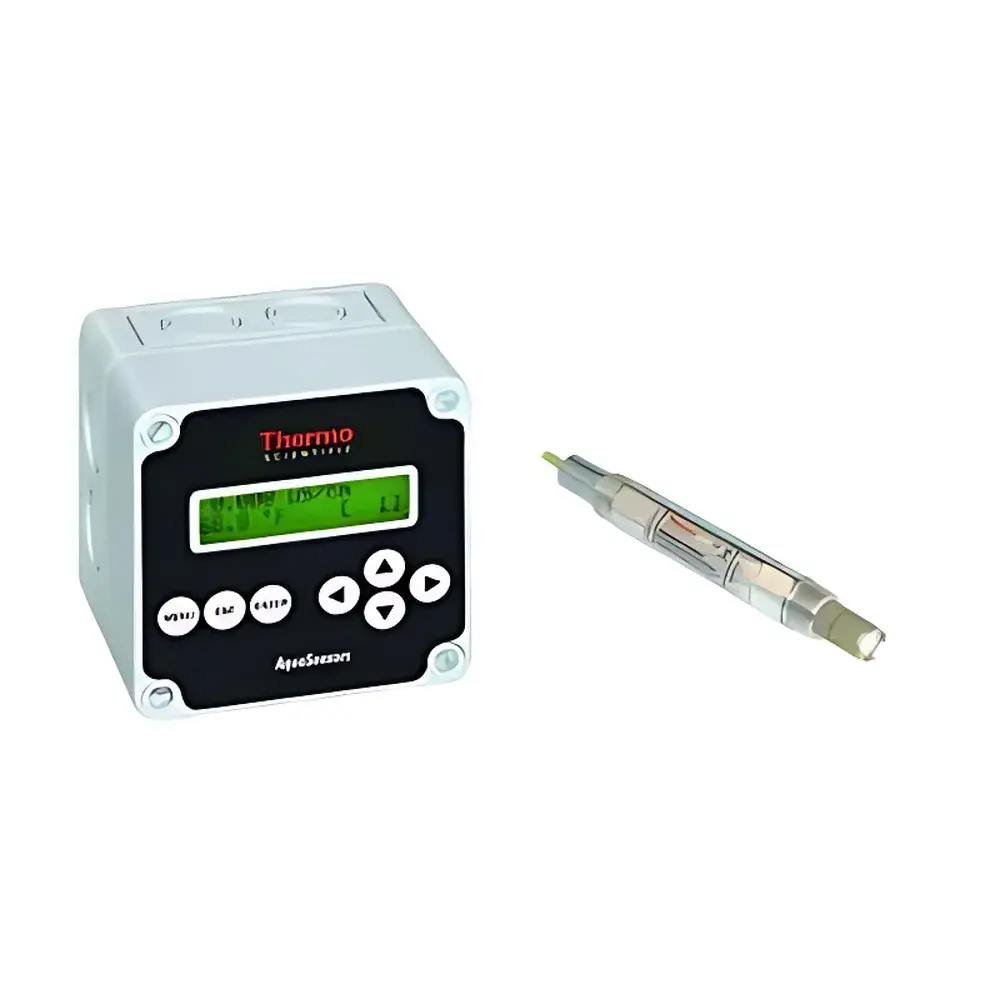
Thermo Fisher AquaSensor Polarographic Dissolved Oxygen Meter DO DataStick
| Brand | Thermo Fisher |
|---|---|
| Origin | USA |
| Manufacturer | Thermo Fisher Scientific |
| Product Type | Imported Instrument |
| Model | DO DataStick |
| Pricing | Available Upon Request |
Overview
The Thermo Fisher AquaSensor Polarographic Dissolved Oxygen Meter (Model DO DataStick) is a laboratory- and field-grade analytical instrument engineered for precise, stable, and trace-level dissolved oxygen (DO) measurement in aqueous environments. It operates on the Clark-type polarographic principle—a well-established electrochemical method in which molecular oxygen diffuses through a gas-permeable membrane to a gold cathode, where it undergoes reduction at a fixed polarizing voltage (typically −0.7 V vs. Ag/AgCl). The resulting diffusion-limited current is linearly proportional to the partial pressure of dissolved O₂, enabling quantitative determination in ppm (mg/L) and % saturation units. Designed for environmental monitoring, wastewater treatment, aquaculture, and process water validation, the DO DataStick integrates a robust three-electrode configuration—gold working electrode, silver counter electrode, and silver reference electrode—to eliminate drift associated with two-electrode systems and ensure long-term signal stability under variable salinity, temperature, and flow conditions.
Key Features
- Three-electrode Clark polarographic sensor architecture: gold cathode, silver anode, and dedicated silver reference electrode—enabling stable polarization and minimizing baseline drift during extended operation.
- Pre-assembled, field-replaceable membrane cap: each cap contains factory-installed FEP Teflon oxygen-permeable membrane and optimized electrolyte solution, reducing membrane replacement time to under 5 seconds without calibration recalibration.
- Durable PEEK (polyether ether ketone) housing: chemically inert, high-pressure rated (up to 4.5 bar at 50 °C), and resistant to abrasion, biofouling, and common disinfectants.
- Integrated dual-parameter sensing: simultaneous, factory-pre-calibrated measurement of dissolved oxygen and temperature—eliminating external probe pairing and inter-unit variability.
- Automatic compensation algorithms: real-time correction for atmospheric pressure, sample salinity (0–70 ppt), and temperature (−5 to 50 °C) using built-in thermistor and user-input or auto-detected parameters.
- Optimized response kinetics: achieves 90% of final reading within 90 seconds (t₉₀) under standard flow conditions (≥30 cm/s), meeting ASTM D888 and ISO 5814 requirements for rapid field deployment.
Sample Compatibility & Compliance
The DO DataStick is validated for use across natural waters (freshwater, estuarine, seawater), treated effluents, drinking water distribution systems, bioreactors, and cooling tower circuits. Its FEP Teflon membrane exhibits low protein adsorption and resistance to hydrocarbon fouling, supporting reliable operation in turbid or organically rich matrices. The instrument complies with key regulatory and methodological standards including ASTM D888-22 (Standard Test Methods for Dissolved Oxygen in Water), ISO 5814:2012 (Water quality — Determination of dissolved oxygen — Electrochemical probe method), and EPA Method 360.1. Data integrity is supported by GLP-compliant logging (time-stamped readings, operator ID, environmental metadata) and optional 21 CFR Part 11–enabled software modules for audit-trail generation.
Software & Data Management
The DO DataStick interfaces seamlessly with Thermo Fisher’s Orion Star™ Connect desktop and mobile applications via Bluetooth or USB. Raw and compensated data—including DO (ppm and % sat), temperature (°C/°F), pressure (kPa or inHg), salinity (ppt), and timestamp—are exportable in CSV or Excel-compatible formats. Firmware updates and sensor diagnostics (e.g., membrane integrity check, electrode polarization status, zero-current baseline verification) are accessible through guided workflows. For regulated environments, optional Orion Star™ Compliance Suite provides electronic signatures, role-based access control, and full audit trails aligned with FDA 21 CFR Part 11 and EU Annex 11 requirements.
Applications
- Environmental field monitoring: compliance-driven DO profiling in rivers, lakes, wetlands, and coastal zones per national water quality criteria (e.g., US EPA 304(a), EU WFD).
- Wastewater treatment plant optimization: real-time aeration basin control, nitrification/denitrification monitoring, and sludge respiration rate assessment.
- Aquaculture and hatchery management: hypoxia risk mitigation through continuous DO surveillance in recirculating aquaculture systems (RAS) and raceways.
- Pharmaceutical water systems: periodic verification of purified water (PW) and water for injection (WFI) storage/distribution loop DO levels per USP and Ph. Eur. 2.2.48.
- Research laboratories: kinetic studies of microbial oxygen consumption, sediment–water interface flux measurements, and sensor validation against Winkler titration references.
FAQ
What electrochemical principle does the DO DataStick employ?
It uses Clark-type polarography with a three-electrode system (Au cathode, Ag anode, Ag reference electrode) and a fixed-potential polarization scheme.
Can the sensor be used in high-salinity seawater?
Yes—automatic salinity compensation supports measurements from 0 to 70 ppt, with accuracy maintained across marine, brackish, and freshwater matrices.
Is recalibration required after membrane replacement?
No—the pre-filled, factory-calibrated membrane cap retains its temperature and DO sensitivity; only a single-point air-saturation verification is recommended post-installation.
What is the maximum operating pressure and temperature range?
Rated for continuous operation up to 4.5 bar (65 PSIG) at 50 °C, with ambient operating range of −5 °C to +50 °C.
Does the instrument support regulatory data integrity requirements?
When paired with Orion Star™ Compliance Suite, it delivers full 21 CFR Part 11 and Annex 11 functionality—including electronic signatures, audit trails, and secure user authentication.
Related Products







