
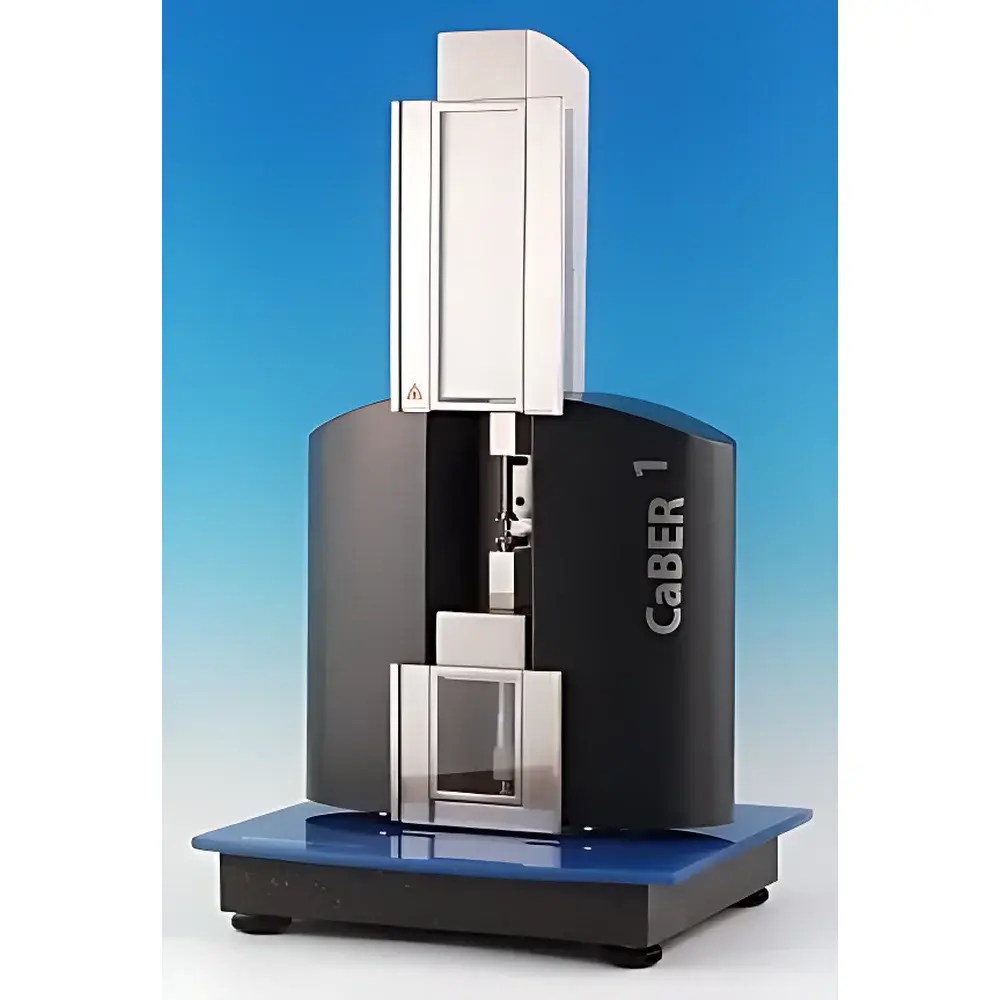
Thermo Fisher CaBER 1 Capillary Breakup Extensional Rheometer
| Brand | Thermo Fisher |
|---|---|
| Origin | USA |
| Manufacturer Type | Authorized Distributor |
| Origin Category | Imported |
| Model | CaBER 1 |
| Instrument Type | Extensional Rheometer |
| Actuation System | Linear Motor |
| Plate Diameter | 6 mm (standard, adjustable 4–8 mm) |
| Hencky Strain Range | up to 10 |
| Applied Strain Rate Range | 0.01–300 s⁻¹ |
| Fluid Strain Rate Range | 10⁻⁵–10 s⁻¹ |
| Shear Viscosity Range | 10–10⁶ mPa·s |
| Temperature Control Range | 0–80 °C |
| Filament Diameter Resolution | 10 µm |
| System Response Time | 10 ms |
| Dimensions | 40 × 34 × 60 cm |
Overview
The Thermo Fisher CaBER 1 Capillary Breakup Extensional Rheometer is a precision-engineered instrument designed for the quantitative characterization of extensional rheology in complex fluids. Unlike rotational (shear) rheometers, which measure response under shear deformation, the CaBER 1 applies controlled uniaxial extensional flow—mimicking industrially relevant processes such as fiber spinning, inkjet printing, coating, extrusion, and droplet formation. Its core principle relies on capillary breakup elongation: a small fluid sample (< 1 mL) is placed between two parallel circular plates; the upper plate rapidly separates from the lower at a user-defined strain rate, generating a transient liquid bridge. Following cessation of plate motion, the mid-filament thins solely under the competing influences of surface tension, viscoelastic stress relaxation, and solvent evaporation. A high-resolution laser micrometer tracks the time-dependent diameter decay at the filament midpoint with 10 µm spatial resolution and 10 ms temporal response, enabling direct extraction of extensional viscosity, relaxation time, surface tension, and breakup time via model-based analysis.
Key Features
- First commercially available instrument dedicated to laboratory-scale extensional rheometry using the capillary breakup method.
- Linear motor-driven actuation ensures precise, repeatable, and programmable plate separation profiles—eliminating mechanical backlash and enabling accurate control of Hencky strain (up to ε₀ = 10) and applied strain rates (0.01–300 s⁻¹).
- Integrated Class I laser micrometer provides real-time, non-contact measurement of filament diameter evolution with 10 µm resolution and sub-10 ms system latency.
- Modular plate geometry: standard 6 mm diameter plates (range: 4–8 mm), allowing optimization for low-viscosity Newtonian liquids or high-elasticity polymer solutions.
- Temperature-controlled environment (0–80 °C) supports studies of thermorheological behavior and process-relevant thermal conditions.
- Automated experimental sequence—including sample loading, stretching, imaging, data acquisition, and model fitting—ensures high reproducibility and operator independence.
Sample Compatibility & Compliance
The CaBER 1 accommodates a broad spectrum of complex fluids, including dilute and semi-dilute polymer solutions (e.g., PEO, Xanthan gum, HPAM), colloidal dispersions, surfactant micellar systems, food hydrocolloids (e.g., gelatin, pectin), and low-viscosity inks or adhesives. Sample volume requirement remains consistently below 1 mL, minimizing material consumption and waste—critical for high-value or hazardous formulations. The instrument’s design and operational protocols align with fundamental principles outlined in ISO 16789 (Rheology — Terminology and symbols) and ASTM D445/D7279 (Standard Test Methods for Kinematic Viscosity of Transparent and Opaque Liquids). While not inherently GLP/GMP-certified, its automated data capture, timestamped raw output files, and traceable calibration procedures support compliance with FDA 21 CFR Part 11 when integrated into validated laboratory workflows.
Software & Data Management
The CaBER 1 operates via Thermo Fisher’s proprietary CaBER Control & Analysis Suite, a Windows-based application providing full instrument orchestration and advanced post-processing capabilities. The software enables real-time visualization of filament thinning curves, automatic detection of breakup events, and simultaneous fitting of multiple constitutive models—including the Upper Convected Maxwell (UCM), Oldroyd-B, FENE-CR, and Giesekus equations—to extract linear and nonlinear extensional parameters. All raw laser displacement data, metadata (temperature, plate gap, strain history), and model fit residuals are saved in open ASCII format for third-party analysis. Audit trails log user actions, parameter changes, and calibration events—facilitating internal QA reviews and regulatory submissions requiring documentation integrity.
Applications
- Quantifying extensional viscosity overshoot and strain-hardening behavior in polymer melts and solutions—key predictors of spinnability and die swell.
- Evaluating formulation stability in consumer products (shampoos, conditioners, paints) where extensional rupture governs spray atomization and film continuity.
- Characterizing biofluids (e.g., mucus, synovial fluid) to correlate extensional relaxation times with pathological states.
- Validating constitutive models used in CFD simulations of microfluidic devices, inkjet nozzles, and pharmaceutical inhalers.
- Screening surfactant efficacy in foam stabilization by correlating breakup time with interfacial elasticity.
FAQ
What distinguishes extensional rheology from shear rheology?
Extensional flow involves stretching deformation, where fluid elements are pulled apart along one axis while contracting perpendicularly—inducing strong normal stress differences. Shear flow, by contrast, involves sliding layers past one another. Many complex fluids exhibit orders-of-magnitude higher resistance to extension than shear, making CaBER essential for predicting real-world processing behavior.
Can the CaBER 1 measure materials with very low surface tension?
Yes—the instrument’s sensitivity to filament diameter decay allows robust analysis even for low-surface-tension systems (e.g., silicone oils, fluorinated surfactants), provided sufficient elastic contribution delays breakup beyond the system’s temporal resolution window.
Is temperature control optional or integrated?
The CaBER 1 includes a built-in Peltier-based temperature control module spanning 0–80 °C, with ±0.5 °C stability, ensuring thermally consistent extensional measurements without external chillers or ovens.
How is calibration performed?
Laser micrometer calibration uses NIST-traceable gauge blocks; plate gap calibration employs capacitive displacement sensors. Thermo Fisher provides documented calibration procedures and recommends annual verification per ISO/IEC 17025 guidelines.



